John Aristotle Phillips ran for Congress twice. Connecticut’s Fourth District declined the invitation both times. For a young candidate who had already attracted international attention, these were fairly decisive reviews. Yet the campaigns left him and his brother Dean with something other candidates wanted: software for making a voter list useful. The electorate had rejected the applicant while inadvertently helping to validate the product. ↗
The brothers founded Aristotle in 1983. John became its chief executive; Dean became its president. Their business grew around the practical work of politics: identifying voters, organizing information, and helping campaigns decide whom to reach. A failed bid for a seat had opened a different route into the election business. ↗
That turn is worth remembering when Phillips appears today as a co-founder of PredictIt, explaining why people should put money behind their political forecasts. His career includes several encounters with the distance between wanting an outcome and getting one. Congress supplied an early lesson. Markets would eventually supply a way to put a price on the distance.
Before the database, a tiger costume
Phillips grew up in North Haven, Connecticut, in a Greek immigrant family. His father taught engineering at Yale; his mother was a schoolteacher. He enrolled at the University of California, Berkeley, before transferring to Princeton. He would graduate in 1978 with a bachelor’s degree in aerospace engineering. The orderly list of institutions gives little warning of the undergraduate career in between. ↗
He rode a motorcycle from Berkeley to Princeton. At football games, he wore the Tiger mascot costume, having secured the position by being the only volunteer. He also revived a student pizza operation and renamed it Aristotle Pizza. His colleagues called him “Shroom,” a nickname that connected his pizzas with the research that was about to make him famous. ↗
There is a pleasingly practical quality to these episodes. The mascot job required somebody willing to put on the suit. The pizza business needed somebody willing to run it. Long before the campaign software, Phillips had found work by noticing an unattended job. The more consequential opening came in an arms-control seminar.

Phillips at Princeton-Columbia, October 1976.
Ron Frehm / AP Images
The paper that escaped the classroom
In 1976, Phillips investigated whether publicly available information could be assembled into a theoretical nuclear-weapon design. His Princeton seminar involved Freeman Dyson and Harold Feiveson. The project became a paper, earned an A, and set off attention far beyond the classroom. It was an exercise on paper; Phillips did not build a nuclear weapon. ↗
The political point concerned access to knowledge. The unsettling possibility was that information assumed to belong to a guarded professional world could be gathered by an undergraduate. His argument was about proliferation, and the publicity gave him a platform to speak against it. The nickname that followed, “A-Bomb Kid,” was considerably easier to fit into a headline. ↗
Celebrity attached itself to the most sensational part of the story. Phillips and David Michaelis turned the experience into the 1978 book Mushroom: The Story of the A-Bomb Kid. Before his engineering degree could settle into an ordinary professional biography, his college assignment had become a public identity. Most graduates bring a transcript to their first interview. Phillips brought a nickname with international circulation. ↗
The episode also introduced a question that would follow his working life: what happens when information is gathered and made usable? At Princeton, the answer was alarm. In a campaign office, the answer could be a better mailing list. At a trading screen, it could be a changing estimate of who would win an election. The consequences depend very much on the information, and on who gets to use it.
Connecticut says no. Campaigns say yes.
Phillips stood as a Democrat against Republican incumbent Stewart McKinney in 1980 and again in 1982. He lost both general elections. During his campaign work, he obtained the state voter list, and Dean wrote a program on an Apple II to handle it. The brothers had encountered a mundane obstacle to political ambition: possessing a list was different from being able to work with it. ↗
That distinction gave Aristotle a market. Campaigns needed to sort names, locate potential supporters, and organize contact. A candidate might have a compelling message and still need help getting it to the appropriate doorstep. Software offered a way to do the repetitive work more efficiently. The candidate’s election had an end date. Other campaigns would keep coming. ↗
By January 1986, Phillips had a compact description of the opportunity: “Democracy is a growth business.” It is a line with an entrepreneur’s cheerfulness and a political operative’s calendar. Another contest is always on its way. Somebody else will need to raise money, identify supporters, and account for what the campaign spends. ↗
His own partisan beginning did not determine the company’s clientele. Aristotle became a supplier across party lines. By the 2012 presidential election, it was providing information to both the Obama and Romney campaigns. The former candidate had moved into a position from which either major-party nominee could become a customer. ↗
“Democracy is a growth business.”John Aristotle Phillips · 1986
The conversation on the other side of the screen
In 2012, Phillips described how powerful computers and software allowed campaigns to sift large amounts of information and identify people to contact about particular issues. The useful unit had become more specific than an undifferentiated electorate. A campaign could decide which voters it wanted to speak with, and what might make the conversation relevant. ↗
For the person receiving the message, the same capability raises a different question: how much does a political organization know? Precision is valuable to the sender. The recipient may have a different view of the bargain. Phillips’s business sits inside that disagreement, where a campaign’s desire to communicate meets a voter’s interest in controlling personal information.
The work also took him beyond American elections. In 2017, he and Aristotle colleague Andreas Katsouris were detained and deported from Kenya while working with opposition candidate Raila Odinga’s campaign. The authorities cited visa issues; the episode became part of the controversy around the election. The business of campaign data could involve considerably more than an office, a laptop, and a deadline. ↗
It would be too tidy to read the entire career as a sequence of clever technical solutions. Electoral information belongs to contests over power. Whoever organizes it must operate among rivals, authorities, clients, and people whose lives appear in the records. The engineering problem never stays entirely inside the machine.
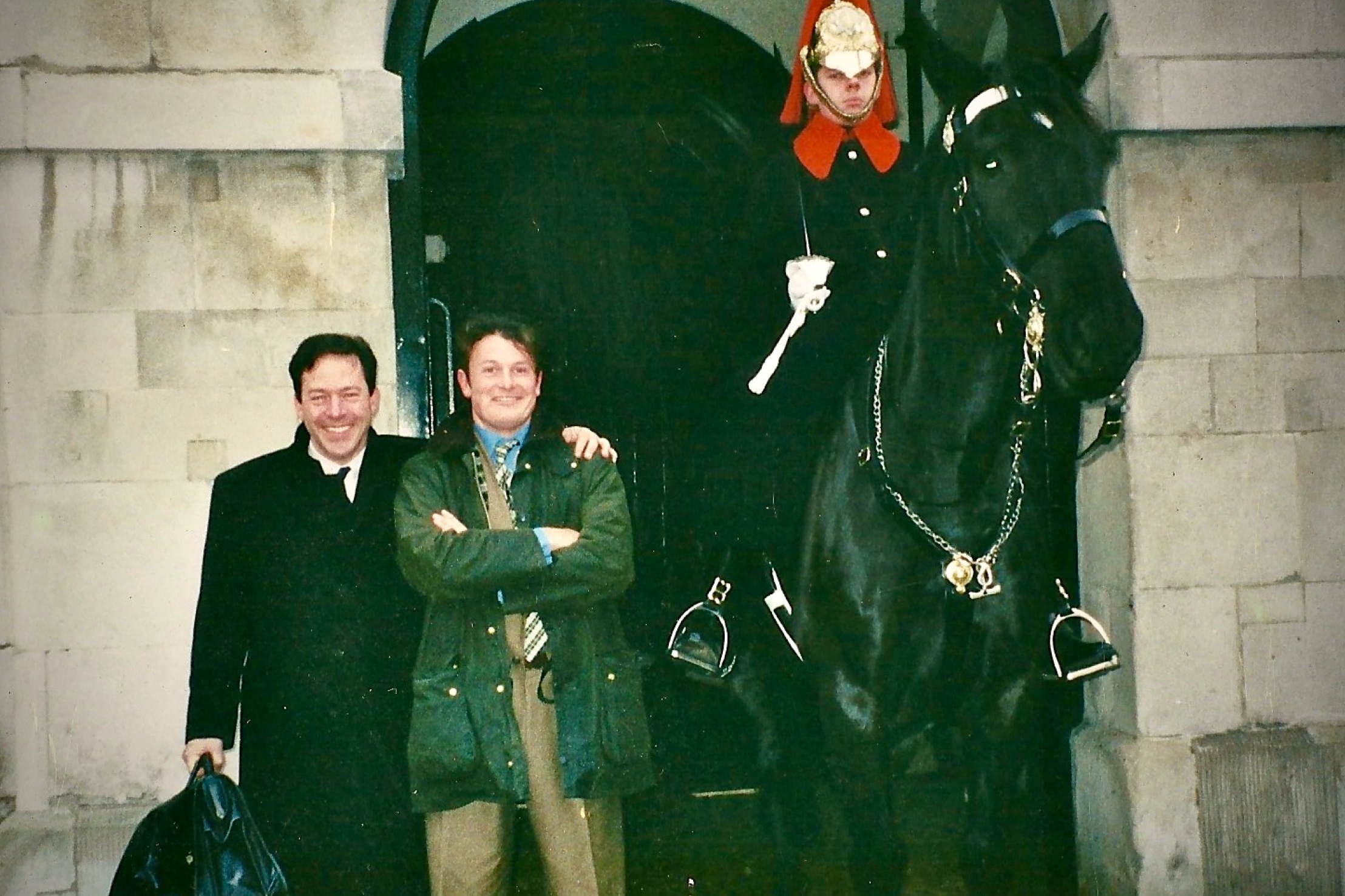
Photograph from Whitty Worldwide’s Aristotle case study.
What is an opinion worth at sixty cents?
PredictIt launched in 2014 as a Victoria University of Wellington project supported by Aristotle. Its purpose included academic research into how markets forecast events. Phillips had helped campaigns act on information; this venture invited participants to turn judgments about future events into tradable prices. ↗
The mechanism is small enough to explain without a finance degree. In an illustrative binary contract, one participant pays sixty cents for a “yes” share and another takes the forty-cent “no” side. The winning outcome pays a dollar. Participants can also trade before the event resolves, responding to changing news and expectations. Prices move as people reconsider the evidence. ↗
The example does not mean that a sixty-cent share guarantees a sixty-percent chance of reality cooperating. It shows how the market expresses a judgment. A price is an observable result of trading, with all the usefulness and limitations that implies. Preferences, information, incentives, and the people participating can affect what appears on the screen.
Phillips brought the idea to a TEDxMidAtlantic audience in a talk asking whether a stock market for politics could predict elections. The appeal is easy to understand: a person can support a candidate while expecting that candidate to lose. Buying a forecast requires confronting the difference. A cheering section can be wonderfully forgiving. A losing position offers a less indulgent review. ↗
His claims for the method deserve scrutiny alongside his enthusiasm. A Coalition for Political Forecasting report challenged broad assertions of market superiority, pointing to mistaken expectations of a Republican wave in the 2022 midterms. In a November 2024 conversation, Phillips himself acknowledged that markets are imperfect. An election market remains a forecast to evaluate, rather than an election result delivered early. ↗
Two views. One outcome.
The winning side pays $1 when resolved. This is an explanation of the mechanism, not live market data. Fees are excluded.
A forecast needs permission to exist
PredictIt’s future became its own uncertain political story. In 2022, the Commodity Futures Trading Commission moved to withdraw the no-action relief under which the project operated. Litigation followed. In a February 2023 interview, Phillips and Aristotle general counsel David Mason were discussing the possibility that the market would have to close. Forecasting elections had acquired a preliminary question: would there still be a venue? ↗
Phillips argued for access to the information the market generated. In January 2025, he framed the dispute around political data available to traders, researchers, journalists, and the public. That argument extends beyond the people buying contracts. Even somebody with no position can look at a price and use it as one piece of evidence. ↗
In July 2025, PredictIt announced a resolution of the litigation and a final judgment in its favor. Its revised framework also provided for academic oversight through the Prediction Market Research Consortium. A separate announcement that September said Aristotle had received approvals to operate an exchange and clearing organization. Those developments were distinct: securing the research market’s future and preparing infrastructure for a new exchange. ↗
Phillips’s expressed ambition remained broader use of forecasting. In the September announcement, he put it plainly: “Prediction markets help people understand the future.” The claim supplies a purpose, while the work of demonstrating value continues in the prices, the research, and the eventual outcomes. ↗
By August 2026, he was still explaining the field in a long interview on Predictable with Stu Burguiere. Nearly half a century after the college paper, Phillips remained in the business of persuading people to look again at information they thought they understood. There is something fitting about the career that followed those Connecticut defeats. Losing an election supplied useful knowledge. He has spent decades finding customers for that proposition. ↗
Follow the argument
Read, watch, and hear Phillips in his own professional world.
- Aristotle - company and leadership ↗
- John Aristotle Phillips on LinkedIn ↗
- PredictIt - the political prediction market ↗
- Watch the TEDxMidAtlantic talk on YouTube ↗
- Two Think Minimum - Phillips and David Mason, 2024 ↗
- The Princeton years ↗
- Predictable interview - August 2026 ↗
- July 2025 litigation resolution ↗