A bank can look at a person’s property and see a loan. The internet can look at a person’s ideas and see something to copy. Bruce Pon’s career has moved between those two worlds, carrying a question that sounds simple until somebody has to build the answer: how does an owner get a useful claim on what is theirs?
Pon helped build banks before he helped build blockchain ventures. Later came ascribe, a service for digital creative work; BigchainDB, a database with blockchain characteristics; and Ocean Protocol, an effort to make data available on terms its owners could accept. Read as a sequence of startup names, the career seems restless. Follow the ownership question and the route becomes easier to understand.
There is a small bureaucratic joke at the centre of it. A civilization that can send a picture around the planet almost instantly can still struggle to say who should get paid for it. Pon chose to work on the paperwork.
A loan officer’s question, without the loan officer
The preparation was fairly conventional. Pon earned an engineering degree at the University of Saskatchewan, worked at Accenture, and moved into international financial-services projects at Daimler. He later co-founded Avantalion, a consultancy that helped develop banks and financial-services businesses. His professional world included carmakers, enterprise systems and the practical business of making organizations function across borders.
Those jobs put him close to the machinery through which people obtain capital. He has described spending twelve years helping build banks around the world, with ordinary borrowers in mind. Executive studies at MIT Sloan exposed him to digital business models. Bitcoin arrived in his thinking in 2013. The attraction extended beyond moving money.
A book helped supply the connection. Hernando de Soto’s The Mystery of Capital examines how formal property rights affect people’s ability to turn assets into economic opportunity. Pon took an analogous question into the digital world: could a claim on intellectual property make an idea easier to transact? It was a proposition to test, rather than a reason to assume that every file would become valuable.
The art came before the database
His connection to Trent McConaghy went back to university in Saskatchewan in 1993. Years later, both were in Berlin, and an old acquaintance became a working partnership. Pon recalled a five-month discussion before he joined Trent and Masha McConaghy full time in 2014. That is a pleasingly unhurried origin for a career in an industry fond of counting everything in seconds.
Ascribe gave creators a way to register work, track attribution and transfer digital editions. The interesting scarcity was a claim on a work that could otherwise be copied. Long before digital collectibles became dinner-table conversation, the team was trying to make the relationship between an image and its owner usable online.
BigchainDB followed as the infrastructure problem grew. Its design brought database features such as querying together with decentralized control, immutable records and asset support. For a developer, the aim was to make applications possible without requiring every problem to squeeze into the limitations of an existing blockchain. The artistic experiment had led into the less photogenic business of building a database.
- 2014ascribeAttribution for digital work
- 2015BigchainDBA database for digital assets
- 2017OceanAccess and markets for data
Cars, computers and the price of permission
The automotive world returned in a different form. In May 2017, BigchainDB announced AVDEX, an autonomous-vehicle data exchange prototype developed with Toyota Research Institute and MIT Media Lab. It allowed researchers to buy datasets from producers for work on machine-learning algorithms. The prototype was presented at Consensus in New York.
That makes a useful counterweight to the fog that sometimes settles over blockchain discussions. Here were identifiable parties with an identifiable problem. Vehicle data was useful to researchers. Producing it and obtaining it were different activities. A shared mechanism could connect them. The demonstration was a prototype, with all the distance from demonstration to routine use that word implies.
“Data is the lifeblood of AI,” Pon said at the time. The line explains why his work has kept returning to access. An algorithm may be ingenious and still require information somebody else controls. The commercial challenge begins when that somebody asks what sharing will cost them, what it will earn them and what they will retain.
“Data is the lifeblood of AI.”
Bruce Pon · 2017
In 2018, BigchainDB announced another practical step: software governance would pass to IPDB Foundation, while the company concentrated on Ocean Protocol. Decentralization had acquired an organizational consequence. Maintaining a codebase, holding intellectual property and deciding the company’s next focus required decisions about actual institutions. A diagram alone would not do it.
Three things in the way
At a 2019 MOBI talk in Los Angeles, Pon reduced the difficulty of data sharing to three obstacles: price, trust and process. A seller needs a reason to share. Both sides need confidence about what happens next. Then they need a way to discover each other and complete the transaction. None of those requirements disappears because a token exists.
He also recalled a conversation with an EU parliamentarian. His suggestion was to have chief financial officers estimate the value of their organizations’ data on their balance sheets. The point was to provoke attention: once a number exists, somebody may start asking why an asset sits unused. The accountant, usually cast as the person who slows down an adventure, could become the person asking why it has not started.
Ocean’s V3 release in 2020 explored pricing through datatokens and automated market makers. Pon described an open-source marketplace in which owners could publish data and retain control over sharing. The early activity interested him because prices could give people a reason to participate. That was an experiment in incentives, and its claims belong to that release and period.
Keeping the data where it lives
A further difficulty follows immediately. Selling access to information can feel perilously close to losing it. Ocean’s Compute-to-Data approach addresses that concern by bringing computation to the data. An approved algorithm can perform work where a dataset resides, rather than requiring the owner to send the raw material away.
The current Ocean stack also distinguishes between data NFTs, used for managing intellectual property and access arrangements, and datatokens, which provide token-based permissions. Those details matter because the whole proposal depends on specifying what another party is allowed to do. The value of permission lies in its boundaries.
algorithm→Data owner’s
environment→Permitted
results
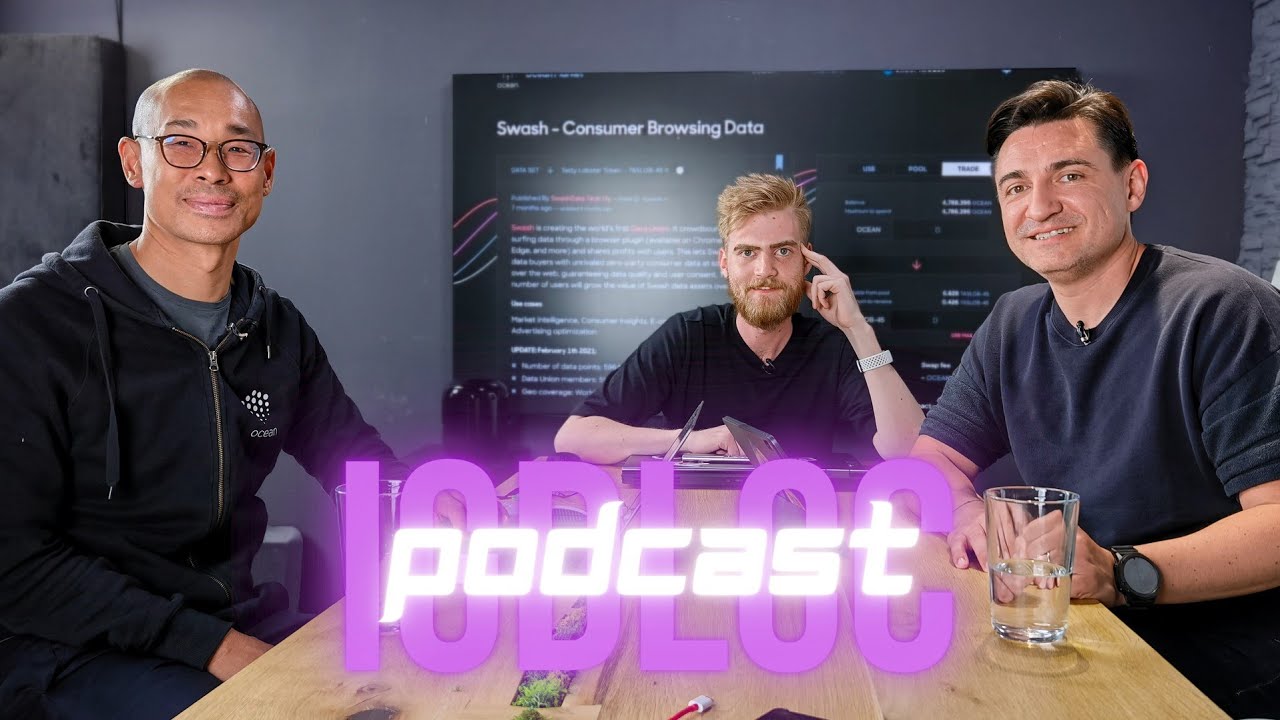
Pon has also argued for working with the tools data scientists already use. In a 2022 conversation, he described a focus on usable workflows, ethical access, provenance and the ability of individuals to choose. There is an appealing restraint in that ambition when stated practically. A user needs to run a job, understand the conditions and get a result. Grand theories still have to survive the afternoon’s work.
 WATCH THE CONVERSATION ↗
The cost of building together
Partnership is another recurring part of the story. Pon’s work has taken him into guest lectures at Oxford, MIT Media Lab, Columbia and ESMT, and into the 2020 documentary Cryptopia. He has spent considerable time explaining a set of ideas whose vocabulary tends to arrive before its everyday applications.
Collaboration has also produced disagreement. Remembering the early working relationship with McConaghy, Pon said, “The great thing was, we never took things personally.” It is a modest sentence beside the ambitions of decentralized infrastructure. It also sounds like useful equipment for anyone who hopes to keep a company alive through more than one product.
Ocean joined Fetch.ai and SingularityNET in the ASI Alliance in 2024. On October 9, 2025, Ocean Protocol Foundation announced its withdrawal. Pon published his account later that month, contesting allegations and setting out Ocean’s position. The alliance had offered a route to collaboration around decentralized AI; the separation exposed how difficult agreements about autonomy can become.
The dispute also reached court. Fetch Compute and other plaintiffs filed a civil action naming Pon and other defendants in November 2025. On April 30, 2026, the defendants filed a motion to dismiss. Those are procedural events, and the allegations remain claims rather than established facts. Any assessment of the partnership needs room for the dispute as well as the original ambition.
A choice worth making available
Pon’s public profile now lists Singapore. His career connects that base with Saskatchewan, Berlin and years of international finance work. The geography fits a business interest that has long crossed borders, although a global ambition still has to resolve a local transaction between particular people.
His enduring proposition is that more people should be able to take part in the economy around their ideas and information. Whether any particular market succeeds depends on usefulness, confidence and demand. Ownership can provide a starting point; it cannot manufacture a willing buyer.
That is what makes the banking experience relevant all these years later. A claim has to be credible. Terms have to be intelligible. Somebody has to find a use for the asset. The internet solved much of the problem of moving information around. Pon has made a career of asking what its owner gets to decide when it arrives.
Continue the conversation
WORK, WORDS & PUBLIC APPEARANCES