In May 2018, Zilliqa’s token market capitalization reached a billion dollars. Xinshu Dong was its CEO, and the project was less than a year old. It was the sort of number that can swallow a biography whole. Yet the more revealing part of his story is what happened around it: a researcher trying to turn a blockchain design into something other people could build on, and then moving into the businesses that help those networks function.
A market value supplies a dramatic opening. It cannot tell you whether a developer can find the right library, whether a user understands a wallet, or whether the people operating a network will keep it running. Dong’s path through Zilliqa, RockX, investing and Babylon gives those questions a place in the plot. The expensive-looking number is easy to remember. The work underneath it takes longer to explain.
Zilliqa token market capitalization, May 2018. A historical market milestone, distinct from company revenue or Dong’s net worth.
Before the token, the fault
Dong earned his doctorate in computer science at the National University of Singapore. His technical background was in making software more secure. The settings included web browsers and applications, then software connected to larger systems such as power grids and transportation. That is an education in the awkward question behind any attractive design: how might someone make it behave badly?
The publication trail gives this background substance. He co-authored work on browser-cache attacks and on isolating sensitive web content. A browser cache saves time by remembering things. Security research asks what else it might remember, reveal or permit. The convenience that makes a feature useful can also make it interesting to an attacker. A system’s everyday virtues deserve an occasional hostile inspection.
In a 2015 paper, Dong and collaborators examined software-defined networking for smart-grid resilience. The proposal considered both its potential benefits and the new risks it could introduce. It also asked how those claims might be validated. Faster, more flexible communication is attractive; electricity infrastructure gives the word “reliable” a rather concrete job description. The paper treated resilience as something requiring evidence.
Bitcoin had already caught his attention. He later recalled doing a little mining around 2009–2010. After his doctorate, he became aware of blockchain research by his collaborator Prateek Saxena and labmate Loi Luu. His route into the field ran through people and technical problems already close to him. The eventual founder had encountered cryptocurrency well before he had a company to introduce.
The idea leaves Singapore
Zilliqa began in June 2017. Its central proposition was sharding: dividing the network’s transaction-processing work among smaller groups that could work in parallel. For a reader unfamiliar with blockchains, the useful image is several worktables handling different batches, with their results brought together. The complication is that an open network cannot assume everyone at the tables is honest.
That complication gave the team plenty to do. The January 2019 mainnet launch account describes an initial sharding idea, a smart-contract language still taking shape, and research into running contracts efficiently on the divided architecture. A live network needed the pieces to cooperate. The story between founding and launch was full of dependencies that a neat introductory diagram could politely leave out.
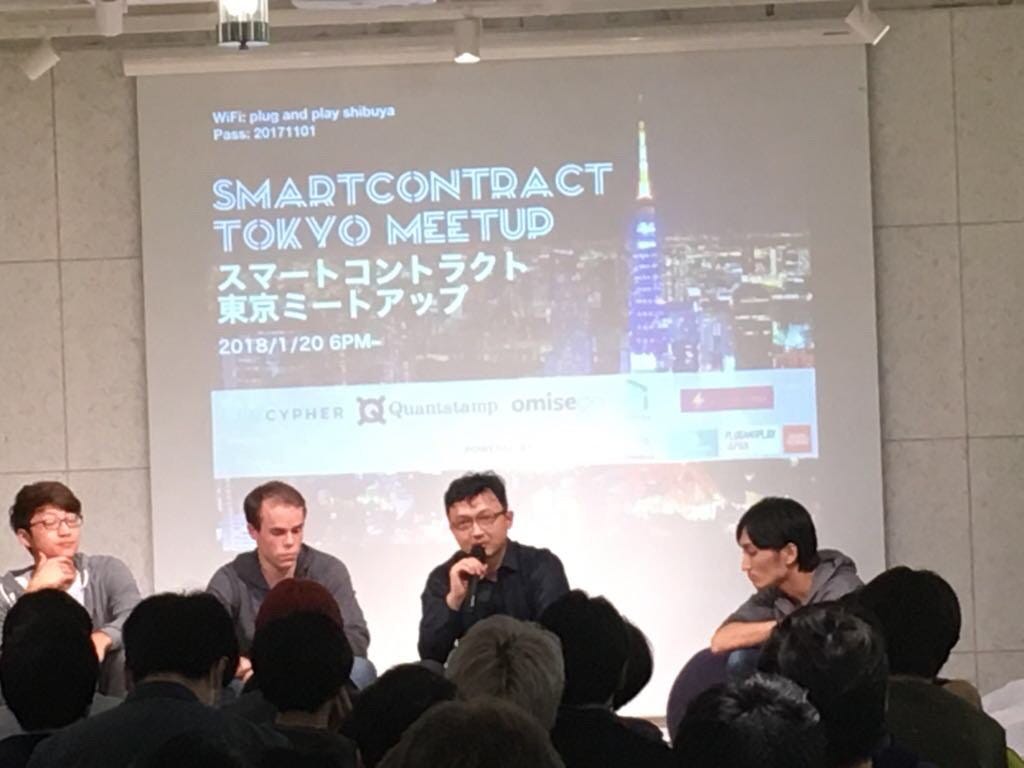
The idea also had to travel. In January 2018, Dong appeared at a smart-contract meetup in Tokyo. He and Yaoqi Jia then visited the San Francisco Bay Area, meeting projects and speaking at events, including university meetups. These were rooms where a protocol acquired an audience capable of questioning it. The photograph from Tokyo shows the modest apparatus: a screen, a microphone, a panel and people listening.
Zilliqa’s mainnet went live on January 31, 2019. Dong had helped lead a project from research into a public network. That transition is an achievement with a date attached, though the date can make the work look tidier than it was. A mainnet launch gives builders a place to start. Whether they find it useful becomes another set of questions.
- 2017Zilliqa
Build the network - 2019RockX
Operate participation - 2020IOSG
Evaluate builders - 2024–26Bitcoin research
Study security sharing
A platform needs a front door
During Dong’s CEO years, Zilliqa began funding the things around its protocol. The first ecosystem grant batch, announced in August 2018, included 12 projects or developers. They worked on libraries, wallets, browser extensions, smart-contract tools, games and a cross-chain project. The range matters. An application platform needs more than the central machinery; it needs ways for people to approach that machinery.
A second grant wave in November explicitly emphasized user and developer experience. It included block explorers, wallet projects, development tools and human-readable naming. A long cryptocurrency address might satisfy a computer perfectly while leaving its owner staring at it with little affection. Ease of use had become a funding category. That is a practical admission that the protocol cannot do every job by itself.
Even the testing had a local flavor. Zilliqa’s third testnet was called Mao Shan Wang, after a durian variety; its earlier alpha code had used Durian. The fruit names were team choices. They gave serious engineering releases a little personality, without telling us anything about Dong’s lunch. Behind the cheerful name, the testnet announcement described security-audit findings, added checks and enforcement mechanisms.
The sequence helps explain why Dong’s later career belongs in the same story. A blockchain can solve a processing problem and still leave a participation problem. Developers need tools. Users need understandable interfaces. Operators need to know how to do their work. Each group encounters a different version of the platform, and each can discover a different reason to give up.
RockX and the unglamorous middle
In 2019, Dong co-founded RockX with Alex Lam, the founder of RockMiner. Their experience met at a useful junction: Dong had helped create a public blockchain, while Lam had worked in cryptocurrency mining. RockX’s launch announcement positioned it as a service for both individuals and institutions, beginning with staking. Its headquarters were in Singapore, with an office in Shenzhen.
Staking gives token holders a way to participate in certain networks’ security and receive protocol rewards. Running the necessary infrastructure is a separate occupation. RockX offered services that connected those two sides. For Dong, the problem had moved closer to the participant: how could someone make use of a network without first becoming its resident systems administrator?
By September 2019, RockX had announced the official launch of its initial staking service. Its early supported networks included Cosmos and IoTeX, among others. That is a historical account of the service’s beginnings, rather than a present-day menu. The important career detail is the shift into operating across networks. After helping build one chain, Dong was helping people participate in several.
The company’s early description of its founding stressed project selection and technical infrastructure. Dong and Lam’s team considered technological innovation, engineering integrity and team competence. Uptime and asset security featured in the product philosophy. These are sober words for a young business in a noisy market. They describe the work customers would depend on after the launch announcement had finished circulating.
Across the table from the founder
Dong joined IOSG Ventures in 2020, moving into investment work. In a March 2021 interview, he described curiosity about investing as part of the attraction. His experience now included building projects and judging other people’s proposals. A founder’s explanation of what makes a project promising can sound different after the founder has had to deliver one.
His criteria allowed room for useful adaptation. He said a project based on existing technology could be compelling if it served a particular group better. Novelty alone supplied no guarantee. He also wanted conviction from founders and distinguished the considerations involved in equity and token investments. His caveat was concise: “evaluating projects can’t be 100% scientific.” There was room for judgment alongside analysis.
“evaluating projects can’t be 100% scientific”
Xinshu Dong, 2021
A November 2021 deBridge spotlight recorded another interest: making separate decentralized networks connect more effectively. Dong described an aspiration for “fully interconnected decentralized networks.” For someone who had worked on a chain’s internal capacity and then on services spanning chains, the concern fits the sequence. Capacity within a network still leaves the question of what happens at its edges.
Back to Bitcoin, with a different question
By August 2024, Dong was publicly billed as Babylon Labs’ chief strategy officer at a Bitcoin staking event in Bangkok. His work had returned to the asset he had experimented with years earlier. The new question involved using Bitcoin to help secure other networks. A familiar name in cryptocurrency had become the starting point for a different infrastructure problem.
Dong is one of seven authors of research first submitted in August 2024 as Remote Staking with Economic Safety. Its May 18, 2026 revision is titled Bitcoin Staking. The paper proposes a protocol through which Bitcoin holders can use their assets to secure a proof-of-stake chain. Its technical challenge includes penalizing safety violations on that other chain through Bitcoin itself. The connection has to carry consequences.
His name also appears in the acknowledgements of Babylon’s February 2025 best-practices publication for Bitcoin liquid staking tokens. The community-created guidelines address disclosure, audits, reserves, redemptions and incident response. These are the kinds of details a user needs when a financial interface makes an elaborate system look simple. The document makes transparency and operational practice part of the conversation.
The work that survives the announcement
There is a human complication in Dong’s early account of Zilliqa too. He described criticism of a crowdsale decision as painful, and said the team listened and changed course. He recalled community support as a particularly happy moment. His stated preference was collaboration: “I think we need more collaboration.” An open network was also a group of people who could disagree with its founders.
That leaves a more interesting portrait than the billion-dollar opening can provide. Dong’s public career has moved among research, leadership, operations and investing, with research continuing into 2026. The recurring demands are concrete: make the design hold up, give people a workable way in, and understand what happens between systems. The announcement gets its day. Someone still has to do the work the next morning.
Follow the work
Profiles · writing · conversations