An email address is a rather small thing to build a business around. It fits on a business card. It looks harmless in a spreadsheet. In Louis Hur's line of work, though, it can be the first loose thread: a clue that leads from a compromised computer to a leaked account, then into the places where stolen information circulates. The address has acquired a second life. Its owner may be the last to know.
Hur is the Singapore-based co-founder and CEO of StealthMole, a company built to investigate those second lives. His particular concern is a missing part of the map. Working in cybersecurity and white-hat hacking, he encountered what he described as a shortage of data points and information networks about Asia. Building a security business around that gap meant asking a deceptively ordinary question: where should an investigator look next?
That question gives his career its shape. Before StealthMole, there was NSHC, a cybersecurity company he helped start with university friends. There were penetration tests, industrial security classes and conference stages. Today there are investigations into financial cybercrime and classes in how to follow a digital trail. The tools change; the habit of looking beyond the first answer persists.
A hacking club grows up
NSHC's name spelled out its origins: Network Security Hacking Club. Hur co-founded the company in 2004. The name preserves something appealing about the enterprise before the formal titles arrived. A club has members, shared interests and people who turn up because the problem is interesting. A business adds customers, deadlines and the obligation to make the answers useful.
Hur attended Hannam University. Before NSHC, his work included penetration testing and management at TSONNET. By the time he appeared on the 2017 Hack In The Box speaker roster in Amsterdam, his responsibilities included daily operations, security product development and technology strategy. By 2017, NSHC was profitable and had more than 50 employees. That is quite a distance from a group of university friends.
There is a useful tension in those responsibilities. A penetration tester tries to discover how something can fail. A chief executive has to arrange things so an organization can keep working. Hur's public career contains both jobs. Finding a weakness is satisfying; making a service that someone can use repeatedly demands a different kind of patience.
His work also left a trail in print. Hur is also the author of iOS Forensic Analysis. Forensics, testing, product development: these are different ways of making a machine explain itself. They also place his later intelligence work in context. StealthMole grew out of a career already spent asking what digital systems reveal when someone examines them closely.
“The key to fight cyber-crime across the Asia-Pacific region is through collaboration”
Louis Hur, 2015
The classroom has a miniature power plant
In Singapore in 2017, Hur was listed alongside Edward Lee and Ellie Kim for a three-day course on industrial control system security. These are the systems behind factories, power plants and transport. The course used actual industrial products and miniature systems to make the work visible. Its syllabus ran from architecture and protocols through forensics and fuzzing, a method of testing software with unexpected inputs.
It is a wonderfully concrete teaching choice. A miniature industrial system gives a student something to examine instead of another slide to admire. The course also offered a cyber drill simulation with a live scoreboard. Even serious infrastructure training, it seems, can make room for the irresistible attraction of seeing your score.
For Hur's profile, the class matters because it places teaching well before StealthMole's funding announcements. Explaining security has been part of his work for years. An expert who can find a problem and an expert who can help someone else find it perform related, but distinct, services. His conference and training record keeps returning to the second task.
Asia belongs on the map
StealthMole was founded in 2022, with Hur as CEO and Simon Choi as CTO. The company paired a Singapore headquarters with research and development in South Korea. Its founding argument was regional: investigators needed a better view of threats connected to Asia, including information living beyond the reach of an ordinary web search.
Choi brought a background in threat investigation and open-source intelligence, with experience advising South Korean public agencies. Hur brought enterprise security experience and the experience of building a company. Their partnership put the business and the investigation in the same room. For a customer, the value would depend on whether those capabilities produced a useful next step.
The vocabulary can sound like the entrance to a thriller: deep web, dark web, hidden sources. The actual work has a more clerical side. Search. Collect. Compare. Follow a relationship. A leaked database, an underground forum and a messaging channel may contain pieces of the same inquiry. An investigator needs enough context to decide whether the pieces belong together.
Regional context is central to Hur's explanation of the business. A worldwide internet does not make local knowledge redundant. It makes the task of organizing that knowledge larger. His founding complaint was specific enough to suggest a product: give investigators access to the information networks they were missing, then help them understand the relationships inside them.
Seven million dollars, and a practical next step
On March 28, 2024, StealthMole announced a US$7 million Series A. Korea Investment Partners led the round, joined by Hibiscus Fund and Smilegate Investment. The company said the money would support expansion into new markets and more commercial applications of its technology. Government and law enforcement work had supplied an early foundation; enterprise customers were part of the next chapter.
Series A led by Korea Investment Partners
With Hibiscus Fund and Smilegate Investment. Company capital, not personal wealth.Funding announcements naturally favor the future tense. For Hur, the useful question remained close to the customer: what problem does the investigator need to solve? He has emphasized understanding customer pain points and reducing trial and error. That is a refreshingly workaday ambition in a field with a generous supply of cinematic language.
He also described StealthMole's assistance with investigations into trafficking organizations in Cambodia and efforts against illegal streaming sites. These were accounts of the company's contribution. They show the range of work he wants intelligence to support: tracing criminal activity, interrupting revenue and helping people who have to decide what to do with a lead.
A browser, a microphone, a live investigation
At the 2025 PAGO Security Summit, Hur appeared at a lectern with StealthMole open on the large screen beside him. The photograph offers a pleasingly unglamorous view of cyber intelligence. There is a laptop, a microphone, a browser and someone explaining the work. No hooded silhouette is required.
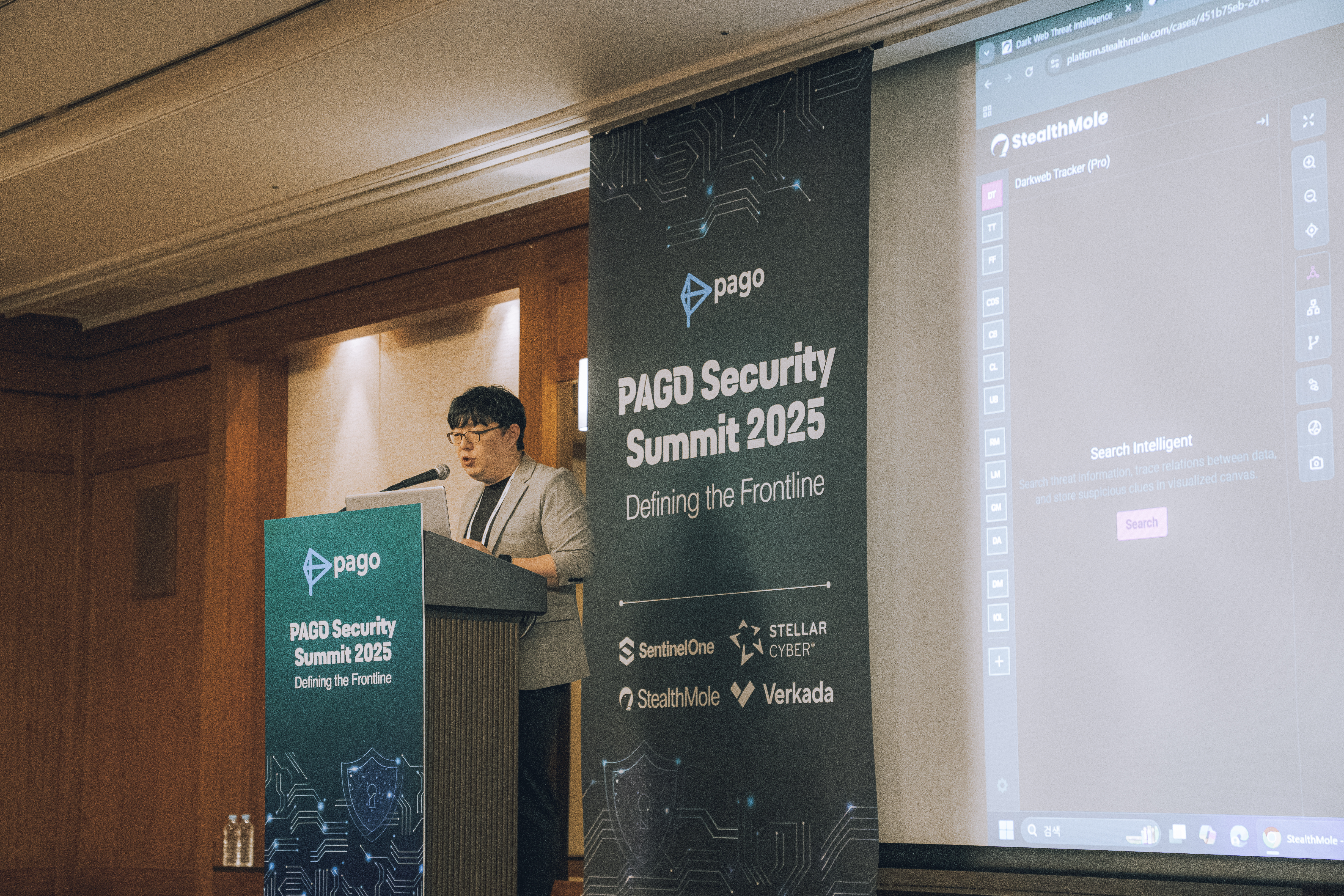
The session's subject was investigating hacking crimes, profiling threat actors and examining anonymized suspects through open-source intelligence. Hur's account of the presentation described searches using artifacts such as email and IP addresses. He connected dark web monitoring with incident response, showing how evidence outside the affected organization can add context to what happened inside it.
A live demonstration has a different burden from a promise. The audience can watch the query and the result. It still has to judge the interpretation. That distinction suits the broader arc of Hur's work: assembling information is one task; deciding what it supports is another. A screen full of relationships is an invitation to investigate, rather than the final paragraph of the case.
The CEO still enters the competition
On May 26, 2026, Hur announced that he had solved every challenge in a UK OSINT capture-the-flag competition and finished first among approximately 624 participants. This was his own account of the result. The telling detail was what he enjoyed about it: problems that forced him to think harder, check his work and try different approaches.
A founder entering a technical challenge offers a small correction to the familiar career ladder. Management does not have to mean retiring from the puzzle. His post thanked Wonjae Choi, Muskan S. and Hyunpyo Choi. The names matter too. Even a first-place announcement had room for other people.
That social side appears elsewhere. In February 2024, he announced StealthMole's sponsorship of GCC Camp in Bangkok and said he wanted to participate as a mentor and friend. Later that year, ahead of Black Hat MEA, he invited visitors to the company's booth for traditional Korean snacks. The internet's underground can be grim territory. The invitation to the booth was considerably more hospitable.
Keep following the people
Hur's newer research interests extend to North Korea-linked financial cyber operations. He combines technical analysis with human intelligence, including interviews with former North Korean IT personnel. A proposed talk follows fraudulent remote IT workers, cryptocurrency theft and laundering infrastructure, examining reused accounts, recruitment activity and other traces of working life.
That agenda brings his story back to the small clue. A job profile, a communication account or a familiar alias can become part of an investigation. The technical and the human occupy the same trail. Hur's stated aspiration is to build StealthMole into an influential Asian threat intelligence company. The daily work implied by that ambition is less grand: look carefully, ask a better question, and help the next investigator know where to search.
Follow the investigation
Public conversations, teaching and company updates.
Watch Hur's PAGO Security Summit session ↗StealthMole website ↗Louis Hur on LinkedIn ↗Louis Hur on X ↗Speaker profile and research topics ↗The March 2024 funding announcement ↗A conversation with Hur ↗The industrial security classroom ↗Hur at HITB Amsterdam, 2017 ↗NSHC's Asia-Pacific collaboration, 2015 ↗His May 2026 OSINT competition post ↗The GCC Camp mentoring invitation ↗An invitation for Korean snacks at Black Hat MEA ↗