The first interesting thing about SpyCloud is what it refuses to call a finish line. Finding a stolen password is not the job. Neither is placing a red dot on a dashboard, sending an email to a security inbox or producing a handsome report about the dark web. The Austin company wants the next move: reset the credential, revoke the session, isolate the infected device, flag the consumer account or give an investigator a trail worth following. That last mile turns an exotic data-collection story into a fairly legible enterprise software business.
SpyCloud's researchers collect what it calls recaptured identity data from criminal ecosystems - breach records, successful phishes, malware logs, combolists, passwords, cookies, tokens, device details and other digital exhaust. Its systems clean and correlate those artifacts, then deliver them through a SaaS console, APIs, data feeds and integrations with identity providers, SIEMs, SOAR platforms and endpoint tools. In July 2026, the company said that corpus passed one trillion identity assets. Nearly half were session cookies and tokens, a neat summary of how the target has moved beyond the password box.
The product is the shrinking window
An identity can be compromised long before a company's own telemetry notices. An employee installs an infostealer on a personal laptop, signs into a work app, and leaks a live cookie. A customer reuses a password exposed elsewhere. A contractor's credentials appear in a phish kit. Conventional controls may see a legitimate user, a familiar browser or an already authenticated session. SpyCloud tries to see the upstream evidence first and make it usable before the access is monetized.
The customers are security operations teams, identity engineers, fraud groups, threat-intelligence analysts, incident responders and government investigators. SpyCloud reports more than 600 market leaders, including seven of the Fortune 10. Atlassian says Session Identity Protection covers more than 250,000 cloud customer accounts automatically. Samsonite has discussed using the investigations and supply-chain products. Banks, retailers and digital platforms can use the same data for consumer account takeover and fraud decisions.
“Intelligence without action is trivial. SpyCloud delivers defense.”SpyCloud's product position, in one blunt sentence
The first thing that failed was the password-only story
SpyCloud began in 2016 around exposed credentials and account takeover prevention. The early pitch was crisp: recover credentials being traded underground, match them to employees and customers, and prompt remediation before a criminal logs in. At FinovateFall in 2017, the startup reported more than 50 active customers and demonstrated an exposed-credential monitoring service. That wedge was narrow enough to sell and painful enough to matter.
Then the attacker changed the unit of theft. Infostealers began lifting browser cookies, tokens, autofill data and device information alongside passwords. A valid session can sail past a freshly strengthened password and, in some cases, MFA. That changed SpyCloud's mind about what an identity-protection product had to contain. The company expanded into post-infection remediation with Compass, session protection, holistic matching through IDLink, consumer and supply-chain modules, and investigation software. The shift was not a repudiation of credential monitoring. It was the recognition that a credential is now one object in a much larger burglar's bag.
Enterprise Protection
Monitors workforce credentials, sessions and infected endpoints, then connects findings to response tools.
Consumer Protection
Helps banks, retailers and platforms detect exposed identities, account takeover and fraud risk.
Supply Chain Protection
Replaces a static vendor score with evidence that a supplier's people are actively exposed.
Investigations
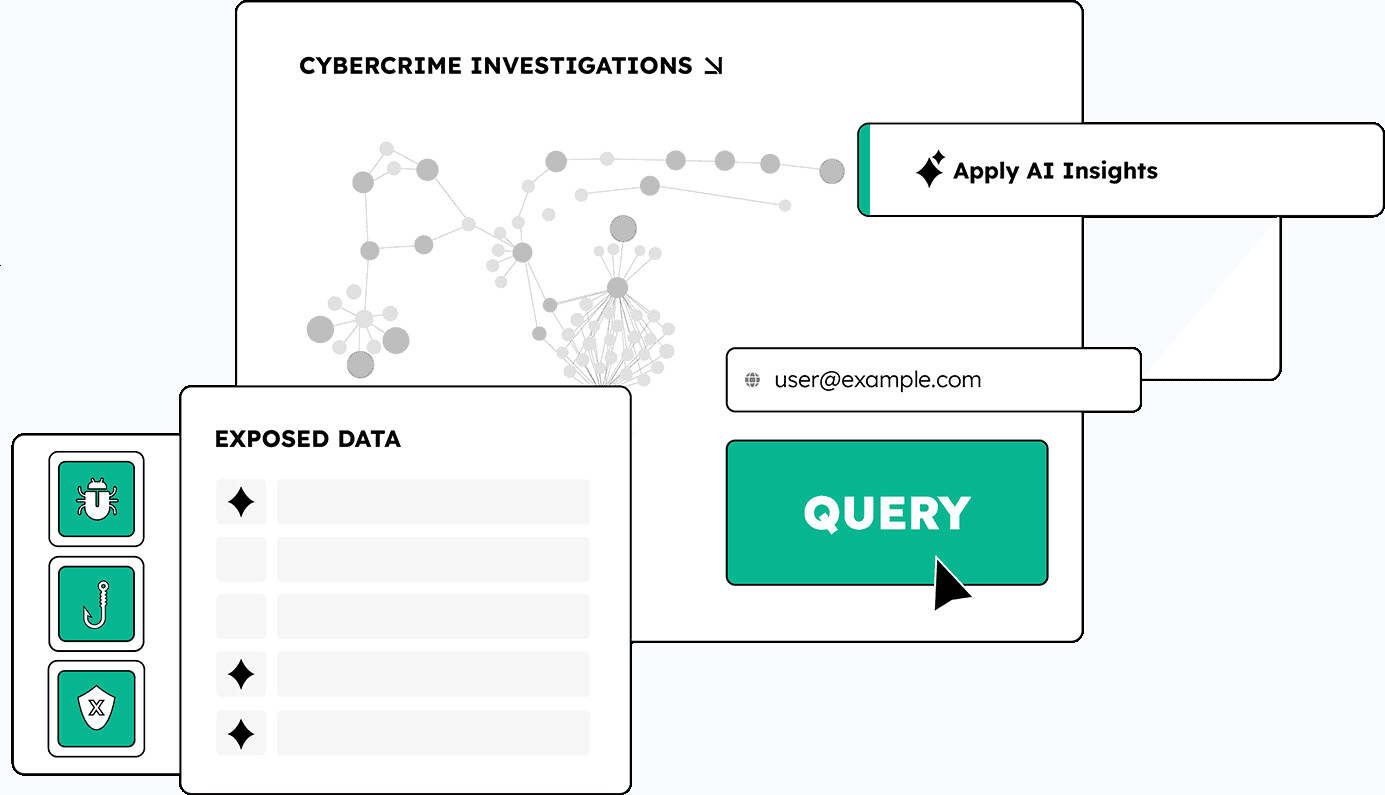
Correlates aliases, devices and criminal infrastructure through a console, API and AI-assisted workflows.
A data company dressed as a workflow company
The moat starts with collection, but collection alone is a storage bill. SpyCloud's more defensible work is normalization, identity resolution and delivery. IDLink looks beyond exact matches to connect personal and professional accounts, old usernames, shared identifiers and devices. The company says this can surface far more records than a single-selector lookup. Research Agent, launched in June 2026, adds a conversational layer that plans investigative pivots and returns findings tied to specific records. That traceability matters in a category where an AI can produce a polished accusation faster than a human can verify it.
For buyers, the difference from broad threat-intelligence platforms such as Recorded Future, Flashpoint or Intel 471 is emphasis. Those products can cover a wider threat landscape. SpyCloud concentrates on identity artifacts and the response attached to them. Flare, Constella, KELA and Enzoic overlap more directly in exposed-credential or criminal-source monitoring. Endpoint vendors and identity providers compete for parts of the response. SpyCloud's bet is that its recaptured data and cross-identity correlation make those downstream tools smarter, which is why partnerships with Okta, Ping Identity and Cisco matter as much as another feature in its own console.
The disclosed capital stack
What did it cost?
For investors, the visible answer is $203.5 million: a $2.5 million seed round, $5 million Series A, $21 million Series B led by Microsoft's M12, $30 million Series C, a $110 million growth round led by Riverwood Capital, and $35 million in growth capital from CIBC Innovation Banking. SpyCloud said revenue tripled between the 2020 Series C and the 2023 round. It does not publish a valuation.
For customers, there is no honest public sticker price. SpyCloud uses enterprise, quote-based sales. The bill likely changes with modules, protected identities, data volume, API access and integration needs. That means a buyer should model more than license cost: somebody must own the response policy, decide when an exposure deserves a forced reset or session kill, and handle false matches and exceptions. Automation removes repetitive labor; it does not remove accountability.
Works when
The signal has somewhere to go
Identity providers, endpoint tools and incident workflows are connected; owners agree on policy; affected users can be remediated quickly.
Breaks down when
The feed becomes another inbox
A small team lacks response capacity, identity mapping is poor, or the organization expects stolen-data monitoring to replace MFA, EDR or basic hygiene.
The uncomfortable proof point
In August 2025, SpyCloud landed inside its own thesis. A compromised OAuth token associated with the third-party Salesloft Drift application was allegedly used to reach the company's Salesforce instance. SpyCloud disconnected the integration, investigated and told customers that relationship data had been exposed. It said consumer data, product systems and its darknet corpus were not accessed. The episode did not validate every product claim, but it illustrated the problem cleanly: trusted connections and active tokens can become the path around the front door.
This is also the limit of the category. SpyCloud cannot observe every criminal source, guarantee that recaptured data arrives before abuse, or fix an organization that has no reliable map from a leaked artifact to a real person or machine. Correlation can widen coverage, but widening can create sensitive investigative judgments. Automated remediation can shrink attack time, but an aggressive policy can also interrupt legitimate work. The best fit is an enterprise with enough identity surface to justify the data and enough operational maturity to act carefully on it.
The part worth stealing
Copy the operating loop, not the trench coat.
- Start with a proprietary, hard-to-clean upstream data source.
- Translate it into one urgent decision, not a buffet of charts.
- Ship the decision into tools customers already operate.
- Follow the adversary as the valuable unit changes - from password to session to device to linked identity.
- Keep evidence visible when automation or AI recommends consequential action.
The market position: before the incident, after the theft
SpyCloud sits between prevention controls and incident response. It is downstream from the theft - the credential, cookie or token already escaped - but it tries to remain upstream from the expensive event. That middle position supports several budgets: identity security, threat intelligence, fraud, endpoint response, third-party risk and investigations. It also creates product sprawl. A security chief needs to know whether the purchase solves one well-defined exposure loop or merely adds an ambitious platform to an already crowded stack.
The company, now more than 250 people by its public count, talks about itself as both cybersecurity and big data. Its culture language is unusually practical: focused, grounded, driven, insightful, inventive and united. The founding expertise supports the pairing. CEO Ted Ross built threat-intelligence programs after work in the Air Force, Walmart, TippingPoint and HP; the broader team draws from security vendors, Fortune 500 companies, law enforcement and national security. The mission - make digital life safer - is broad. The product insight is tighter: stolen identity data is useful to defenders only while they can still do something about it.
That is SpyCloud's durable idea. The dark web is not a spooky destination to monitor. It is an upstream system producing operational signals. The company wins when those signals arrive early, resolve correctly and trigger a proportionate response. It loses when the data is late, ambiguous or trapped in a dashboard. After ten years and one trillion artifacts, the central question is no longer whether SpyCloud can collect evidence. It is how reliably customers can turn that evidence into fewer incidents.