Brian Murphy’s business education included a lesson in ketchup. At Publix, where he worked as a teenager, helping a shopper meant walking them to the shelf. Pointing vaguely down an aisle would not do. Years later, running a cybersecurity company, he still returned to the difference between indicating where an answer might be and taking responsibility for getting someone there.
It is an agreeably unglamorous origin for a technology executive. There is no garage full of mysterious circuitry in this particular lesson. There is a customer, a question and an employee who can either finish the job or leave the awkward part to somebody else. Murphy has spent much of his career arguing for finishing the job.
ReliaQuest, which he founded in Tampa in 2007, eventually became a company valued at $3.4 billion in a March 2025 financing. The distance between the supermarket aisle and that valuation is considerable. The more interesting distance is between the tidy story a successful founder can tell afterward and the untidy decisions that actually got him there.
A company before a master plan
Murphy graduated from Florida State University in 2000 with degrees in accounting and finance, then began working as a management consultant at PwC in Tampa. His attachment to Florida State had started earlier: his older brother Robert attended, and Brian followed him into an enthusiasm for the university and its football team. The institution became a recurring character in his life, first as a destination and later as a place to recruit, give and return.
The company arrived with considerably less certainty. ReliaQuest began by selling IT and engineering consulting and contract services to large businesses. Murphy did not start with a fully formed vision of the platform the company would eventually build. In the account he gives of its beginnings, there was even a missed meeting with someone he had hoped to pitch. He left his job without a business plan.
That detail deserves to survive the valuation headlines. The first task was finding work and learning what customers would pay the business to do. A contract involving satellite systems in Iraq helped lead the company toward networking, information assurance and cybersecurity. The early business had to acquire a vocabulary as well as customers. Its eventual specialty emerged through work that needed doing.
On a 2021 Florida Funders interview, the evolution is described through successive adjustments, including the move from IT toward cybersecurity and the development of recurring revenue. That is a less cinematic founding story than a single flash of invention. It is also more useful: an enterprise can discover its direction while serving people, provided its founder remains willing to change course.
career begins at PwC
starts in Tampa
is introduced
funding valuation
Walk the customer to the answer
GreyMatter, introduced in 2019, gave that service instinct a software expression. Large organizations already had security tools. They also had the difficulty of making those tools, and the information inside them, useful together. A collection of alerts does not automatically become a coherent account of what is happening.
Murphy’s explanation of the product starts with visibility. GreyMatter connects information across an organization’s technology so security teams can investigate and respond with a more complete picture. The practical problem is easy to imagine without becoming a security specialist: several instruments are sounding, and someone must decide whether they describe the same incident.
In its early GreyMatter announcement, ReliaQuest emphasized helping customers get more control from investments they had already made. That is a revealing choice of emphasis. The customer’s existing environment becomes the starting point. The company has to meet the organization where it works, with all the complications that entails.
By March 2025, ReliaQuest said the platform integrated with more than 200 cybersecurity tools. Its funding announcement set out a plan to expand internationally and invest further in AI-driven automation. The financing exceeded $500 million, led by EQT, KKR and FTV Capital, with Ten Eleven Ventures and Finback Investment Partners participating. These were company figures and a company valuation, measures of a business rather than Murphy’s personal wealth.
New funding at a $3.4 billion company valuation.
Announced March 31, 2025. Funding and valuation measure different things.Money makes a convenient plot ending. Murphy seems reluctant to let it have the last paragraph. At an Embarc Collective founder event, he treated capital raising as an outcome of earlier work, while pushing attention back toward present customer problems. The champagne, in this philosophy, has a rather short appointment in the diary.
The founder who stays in Florida
The insistence on Tampa is another constant. Murphy lives there with his wife, Renee, and their two children. ReliaQuest grew into an international business while retaining its headquarters in the city. In a technology industry fond of geographic instructions, staying put can become a statement even when the person doing it considers the location perfectly practical.
His wider commitments have also remained close to that base. He serves as chairman and a Founders Circle member of Embarc Collective, mentoring other founders as they work through the awkward stages of building companies. He also serves on Florida State’s Board of Trustees. The same graduate who once followed his brother to university now helps govern it.
Recognition accumulated along the way: an EY Entrepreneur Of The Year award in 2017, induction into Florida State’s business alumni Hall of Fame in 2022, and recognition among Goldman Sachs’ exceptional entrepreneurs in 2023. Read together, the honors trace his move from local founder to established business leader. They cannot explain the daily decisions, but they establish how far the early consulting business travelled.
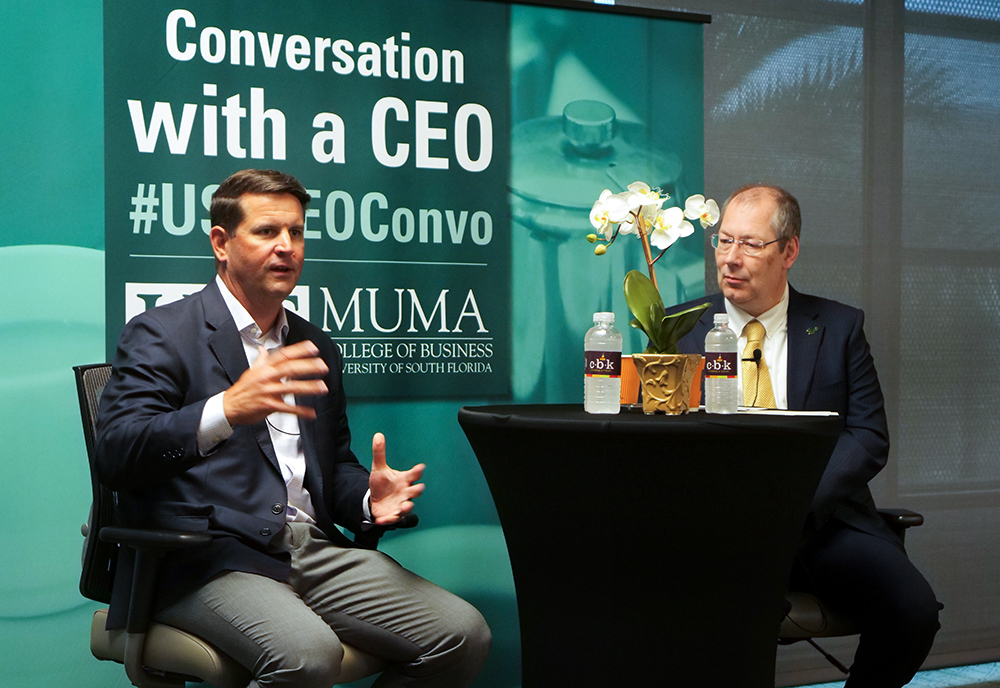
When he spoke at the University of South Florida in 2024, his least favorite four-letter word was apparently “wait.” His answer about the company name was similarly brisk. A friend with a marketing firm helped him consider names; ReliaQuest stood out. There was no elaborate founding myth attached. As Murphy put it, a name acquires meaning through what people make of it.
His advice to students was more demanding than a pleasant slogan about following a passion. He urged them to gather knowledge, spend time around other people and take opportunities even at the risk of appearing foolish. His dislike of hesitation runs through these conversations. For a prospective employee, that gives a fairly clear preview of the pace he values.
“Don’t build your resume. Build your knowledge.”
Brian Murphy, at USF in 2024
Build the people who can do the work
ReliaQuest’s relationship with USF gives this interest in learning a concrete shape. In 2018, the company committed $1 million to establish cybersecurity labs at the Muma College of Business. The program would bring practical training into students’ education, with company professionals helping them work through the kinds of situations a security team encounters.
The original lab announcement described using a simulator that ReliaQuest had first developed for its own employees and then offered to customers. That progression matters. Training was something the company already needed for itself. Opening it to students extended a working practice beyond the payroll, giving newcomers a way to try the work before asking an employer to take a chance on them.
In September 2026, the partnership expanded again. A new software engineering track would put students on projects connected to GreyMatter, following the work through planning, coding, review and deployment. A $1.5 million ReliaQuest investment supported broader AI and cybersecurity programming and established an endowed professorship at USF’s Bellini College.
The first software engineering cohort was planned for approximately 20 students, working in teams with access to engineers and mentor office hours. The scale is human enough to picture: a small group facing an actual project, receiving criticism, revising the work and presenting it. For all the discussion of AI, part of the investment still comes down to experienced people making time for beginners.
Another rung, then another
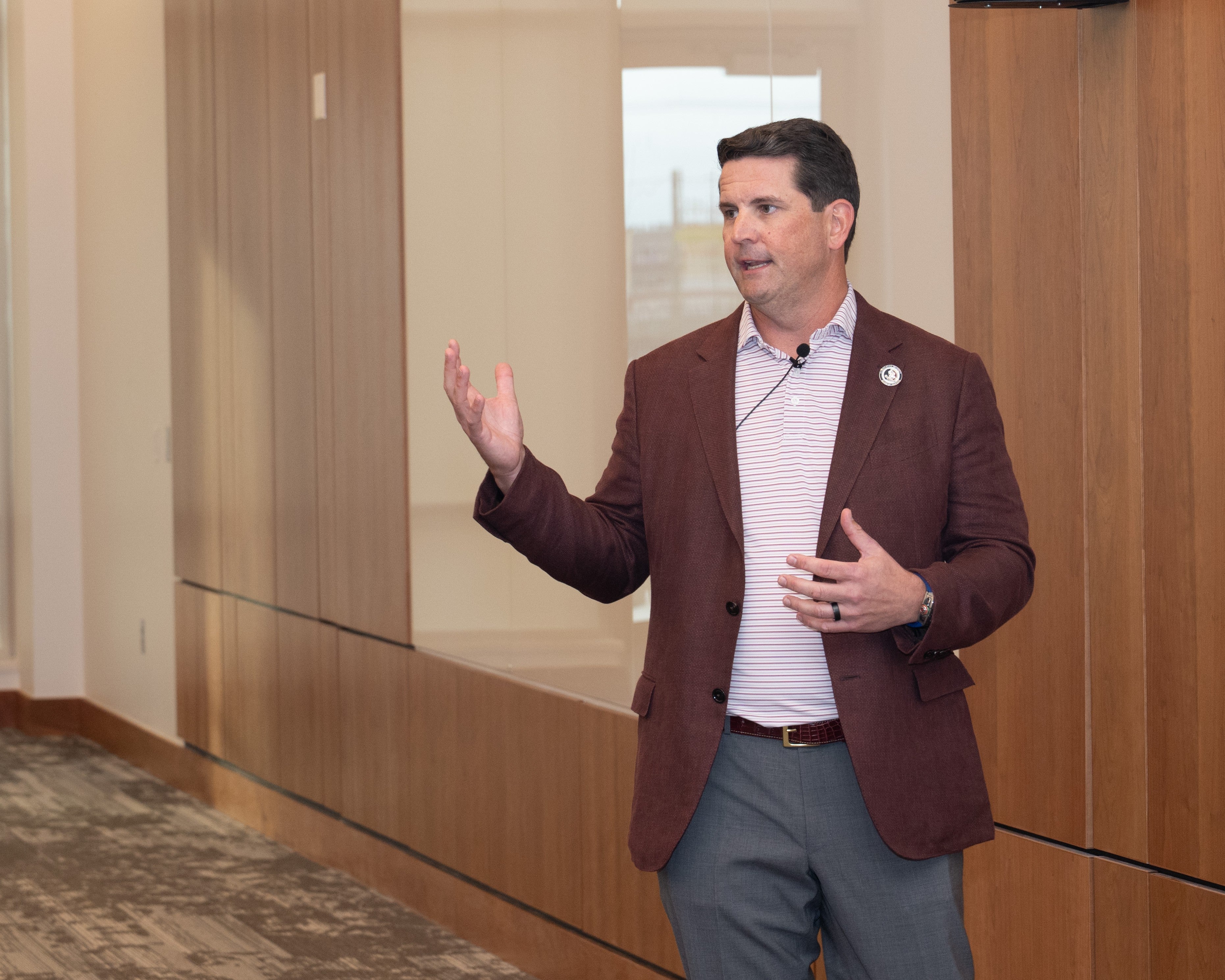
At Florida State in January 2026, speaking in the Brian and Renee Murphy Forum, Murphy reached for a playground analogy. Moving along monkey bars requires taking the first rung, then reaching for the next. Waiting for certainty leaves a person hanging. His phrase for the habit is “chase possible,” words displayed outside the forum.
There was a personal note, too. He credited Renee with much of his success and admitted that, after 21 years of marriage, he was still trying to impress her. It is a useful interruption to the usual founder monologue: the audience for a life is sometimes much smaller, and more discerning, than the audience for a funding announcement.
His 2026 EXPONENT keynote turned the same willingness to move toward his own company. With AI changing both attacks and defense, he argued that ReliaQuest should be the business that makes its present approach obsolete. A founder who discovered his company’s specialty through successive adjustments is now asking an established organization to preserve that ability to change.
He has found a smaller arena for being a beginner as well: golf. He describes it as humbling and appreciates the friendships it has brought. A game that offers immediate feedback on misplaced confidence seems a suitable diversion for someone so attached to fundamentals.
The supermarket lesson endures because it leaves little room for ceremony. A customer still needs help. Someone still has to understand the problem, make a decision and carry it through. Murphy has added software, investors, university partnerships and a global business to that early education. The walk down the aisle remains recognizable.
Keep the conversation going
Read and watch more of Murphy’s work and conversations.
- ReliaQuest: leadership and company
- Brian Murphy on LinkedIn
- Brian Murphy on X
- The Importance of Reinvention - Florida Funders
- Watch the 2026 EXPONENT keynote
- USF’s 2026 software engineering expansion
- The January 2026 Florida State conversation
- Doing Simple Well - the early years
- Murphy’s Florida 500 profile
- A conversation about customers and GreyMatter
- Watch the Florida Funders interview on YouTube