The modern security operations center has a peculiar inventory problem. It owns plenty of software, yet its analysts still spend their days behaving like human extension cords. One alert appears in an endpoint product. The identity clue lives somewhere else. Network evidence sits in a SIEM. Threat intelligence arrives in another window. Somebody copies, pastes, checks, waits and decides. ReliaQuest’s answer is GreyMatter, a layer that connects those tools, translates their data and coordinates what happens next.
That answer has become a large business. The Tampa company says it serves more than 1,300 customers with roughly 1,200 employees across six operating centers. In March 2025, investors led by EQT, KKR and FTV Capital put in more than $500 million at a $3.4 billion valuation. ReliaQuest said annual recurring revenue had passed $300 million, was growing above 30 percent and the business was profitable. A current company biography says 2025 revenue later exceeded $400 million.
01. The first product failed the moment the economy did
Brian Murphy founded ReliaQuest in 2007, just as the financial crisis was turning discretionary IT work into a very hard sell. The original company was a broad IT services operation, not the AI security platform now described on conference stages. What failed first was the premise that a new shop could build a durable business from generic technology projects in a collapsing market.
A contract connected to the U.S. Department of Defense supplied the clue that changed Murphy’s mind. Security work was urgent, specialized and tied to outcomes customers could not postpone. ReliaQuest moved toward cybersecurity, remained bootstrapped for nearly a decade, and took its first major institutional check - $30 million from FTV Capital - in 2016. The lesson was not to predict a fashionable category. It was to notice which customer problem survived a recession.
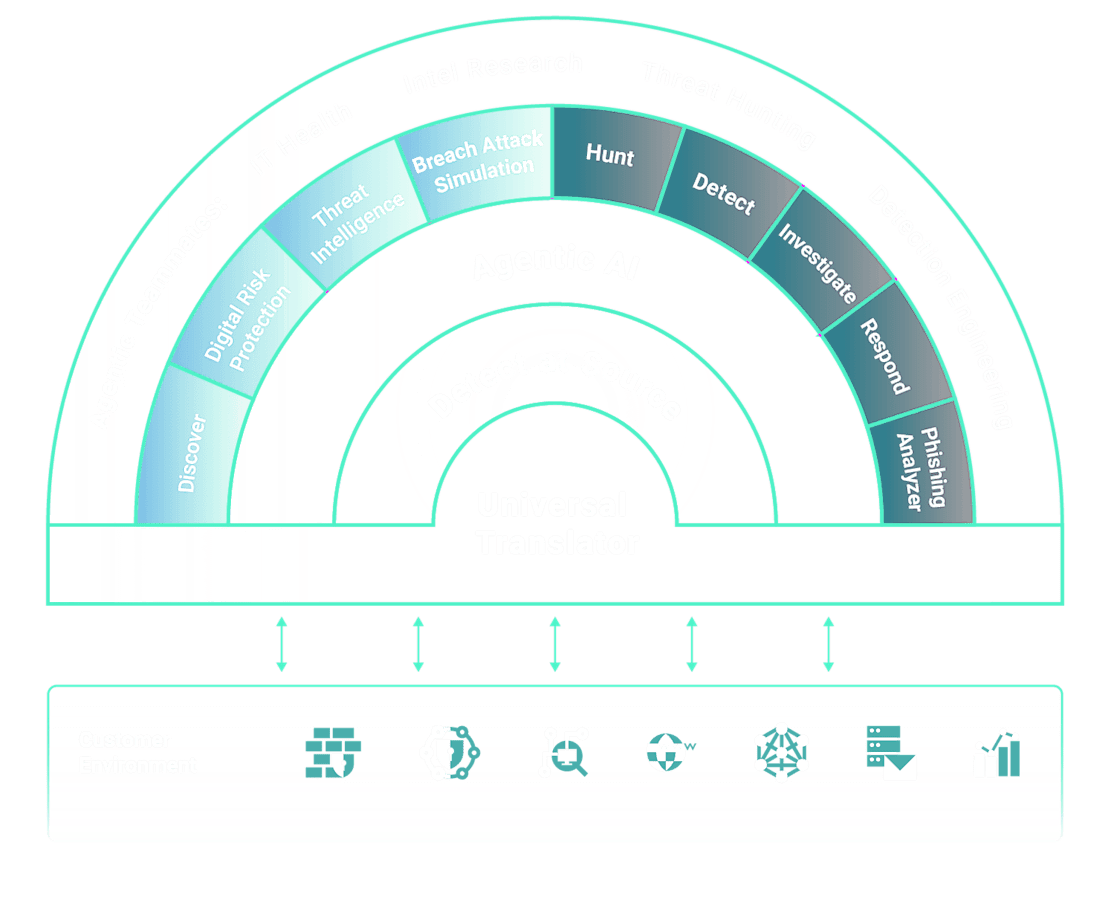
GreyMatter arrived in 2019 as the product expression of another observation: enterprises had accumulated capable security tools, but the handoffs between them were poor. ReliaQuest did not ask the chief information security officer to throw the stack away. It built a cloud layer above it. A patented Universal Translator maps fields and telemetry across cloud, endpoint, identity, network and on-premise systems. Automations then investigate alerts, enrich them with context, run response playbooks and send the important decisions to humans.
02. The product is the space between products
ReliaQuest sits in an awkward but valuable part of the market. It overlaps with managed detection and response firms such as Arctic Wolf, Expel and Red Canary; with endpoint-led suites from CrowdStrike and SentinelOne; with SIEM and automation platforms from Microsoft, Google, Palo Alto Networks, Splunk and Securonix; and with the internal team a large company might build for itself. GreyMatter’s distinction is not that it invented alerts, threat hunting or incident response. It is that those jobs can run across a customer’s mixed estate.
The platform now includes detection at the data source, in storage and in transit; managed investigation and response; digital risk protection; phishing analysis; a mobile app; and six role-based AI “Teammates.” Those agents divide work into recognizable jobs such as threat intelligence research, threat hunting and detection engineering. One agent can find a new campaign on the open or dark web, another can search the customer’s environment for evidence, and another can prepare a detection rule. The label is cute. The operating question is serious: which actions run autonomously, which require approval, and how well does the translation layer preserve context?
ReliaQuest strengthened the outside view in 2022 when it paid $160 million for Digital Shadows. GreyMatter could already see activity within a customer’s environment. Digital Shadows added exposed credentials, brand abuse and threat activity beyond the perimeter. In 2023, ReliaQuest bought agent software assets and an engineering team from EclecticIQ to speed integrations. These were not random additions to a security shelf. Both made the connective tissue thicker.
03. What does the $600,000 buy?
ReliaQuest does not publish a menu price. Its core platform is priced per endpoint, while extras can depend on mailboxes, employee count, data volume or the scope of digital-risk coverage. A commissioned 2025 Forrester study gives the clearest public anchor. For a composite global business with $5 billion in annual revenue, the model assumed $600,000 a year for GreyMatter. After a five percent risk adjustment, the subscription cost became $630,000 annually.
A model, not a quote
The cost becomes sensible only if GreyMatter removes other costs. In the model, the customer retired a legacy point product, reduced SIEM data ingestion and saved analyst time. Legacy savings reached a risk-adjusted $810,000 in years two and three. That is the heart of the pitch: pay for a coordination layer, then stop paying to store every scrap of telemetry or maintain overlapping tools.
There is an important asterisk. The study was commissioned by ReliaQuest, built from four interviews and explicitly warns that other organizations should use their own assumptions. A regulated company required to retain extensive logs may save less on ingestion. A buyer unable to retire existing contracts may simply add GreyMatter to the bill. A small team with a simple stack may not have enough fragmentation to justify an enterprise subscription. The ROI is not inside the software. It appears when the buyer changes the operating model around it.

04. The strongest evidence is attention returned
Customer stories make the abstract platform easier to inspect, though they remain vendor-selected cases. At the University of Kansas Health System, two security groups used different tools and handled incidents through email. Over six months, ReliaQuest says GreyMatter processed 75,000 alerts and escalated 174 to the health system. Thirty-eight were true positives. Detection coverage grew 110 percent, while visibility across the combined environment improved by more than 98 percent.
At lighting manufacturer Signify, automated containment playbooks reportedly returned more than 1,000 analyst hours in a year, cut alert noise and reduced mean time to resolution by 75 percent. At DTCC, phishing analysis that could take 15 minutes per message became an automated workflow, with the company reporting 6,000 analyst hours saved. Lowe’s says it connected 33 systems across mainframes, cloud and software services, then improved visibility by 200 percent and accelerated response by 70 percent.
These are not claims that attacks disappear. They describe a narrower and more believable improvement: fewer minutes spent swiveling between consoles, fewer low-value alerts reaching skilled people, and faster containment when the integrations allow it. That is also why the managed-service component matters. Customers are buying software, but they are also buying ReliaQuest’s accumulated detection content, integration maintenance, incident knowledge and people who keep the machinery tuned.
05. The playbook worth copying
ReliaQuest offers a useful strategy beyond cybersecurity. First, do not attack a customer’s sunk investment if you can make it more valuable. Second, standardize the messy middle: the translations, handoffs and repetitive decisions everyone tolerates because no single product owns them. Third, attach the price to operating outcomes - time returned, tools retired, data not stored, incidents contained - rather than the number of features shipped.
The company also shows when to change direction. Generic IT services met a collapsing market; urgent security work survived it. A managed-security business then encountered customers buried in disconnected products; GreyMatter turned that recurring pain into software. External threats sat outside its view; Digital Shadows filled the gap. Each move followed a visible constraint instead of a slogan.
Conditions that help
- A large, mixed security stack
- Expensive SIEM ingestion
- Analysts buried in repeatable triage
- Authority to connect and automate response
Conditions that break it
- A small or single-vendor environment
- Contracts that cannot be retired
- Log-retention rules that block savings
- No appetite for cross-tool automation
The next test is agentic AI. ReliaQuest says its role-based agents can operate around the clock and collaborate across hundreds of technologies. In July 2026, it joined OpenAI’s Daybreak Cyber Partner Program to develop and evaluate new cyber-defense capabilities. The opportunity is obvious: attackers automate, defenders automate back. The risk is equally obvious: an agent with incomplete context can make a bad decision faster than a tired analyst.
That leaves ReliaQuest with the same challenge it has always had. The company must make complex systems cooperate without pretending complexity has vanished. If GreyMatter keeps the useful context, contains the right threats and gives human teams their attention back, the layer above the stack earns its place. If it becomes one more console, one more contract and one more stream of confident AI prose, the mess simply moves upstairs.