A pizza can fail a taste test and still do its job. In 2017, Villa Italian Kitchen put pumpkin pie filling and mozzarella on the same crust. Jimmy Kimmel took notice. Viewers had something to argue about. Brian M. Lowe, whose agency helped put the combination into circulation, had a useful demonstration of his trade: give people a reason to talk, then make it easy for the conversation to travel.
There is something pleasingly practical about Lowe’s appetite for absurdity. The founder, president and CEO of BML Public Relations works in Florham Park, New Jersey, with a business built around earned attention. A strange idea has to survive several ordinary questions. Who cares? Who would cover it? What does the client get? Somewhere between the joke and the phone call, a campaign becomes work.
A $300 reason to begin
Lowe’s entry into public relations involved an adviser and an empty student-government position. He was studying communications at a small undergraduate college in Vermont when the adviser suggested he consider the vacant PR chair. He followed the suggestion into a profession. The career began with someone else spotting a possibility he had yet to name.
Agency work followed, including experience with Campbell’s Soup, Progressive Insurance and Verizon. Growing up around a family business had already made ownership attractive, although joining that business did not appeal to him. In 2006, a $300 press-release assignment gave him a starting point of his own.
The modest fee is an unusually good detail in a founder’s biography. It measures a piece of work rather than a promise. Someone needed a release; Lowe could write it. The business would have to acquire its ambitions one assignment at a time.
The pizza had an assignment
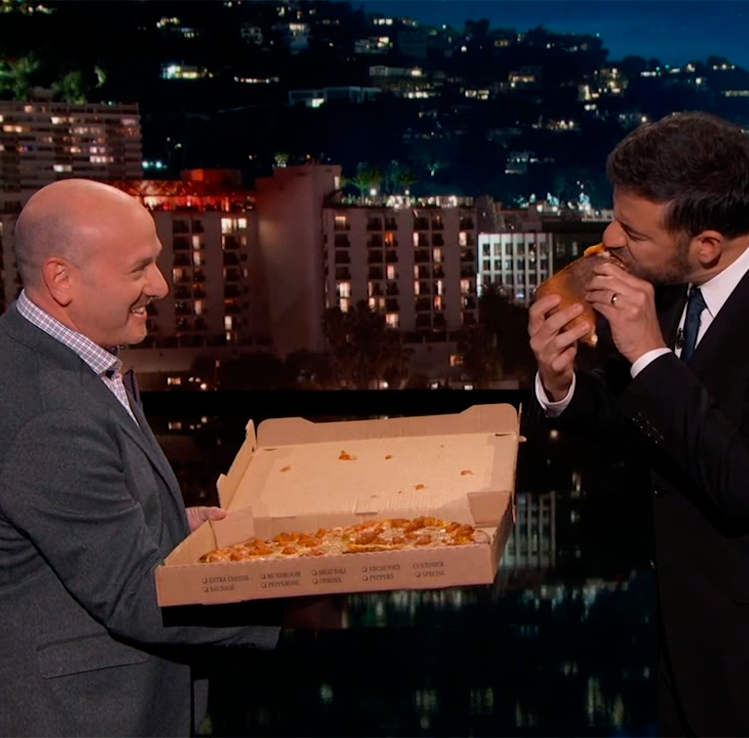
The pumpkin-spice campaign makes Lowe’s approach visible. BML timed the launch for the first day of fall, when seasonal flavor announcements were already familiar news. Putting that flavor on pizza introduced a small culinary disturbance. Readers did not need a briefing to understand it. They could develop a firm opinion before finishing the headline.
The work also required logistics. BML arranged deliveries of hot pizzas to morning television programs. Villa Restaurant Group’s chief operating officer appeared on Jimmy Kimmel Live. The agency’s case study records more than 990 stories for the campaign. That is a reported coverage count, rather than a count of customers or an explanation of what happened at the till.
The distinction matters. A publicity stunt is easy to admire as spectacle and harder to evaluate as business. Lowe’s work invites both reactions. The pizza supplied the spectacle; getting it into the right rooms supplied the professional labor. Someone still had to answer the producer, organize the delivery and make the guest available.
A town gets a title
Another BML campaign began with a place name. Highland Titles sold souvenir plots associated with a Scottish nature reserve. BML found Scotland, Connecticut, and worked with its local government to offer plots to the town’s 1,694 residents. The accompanying courtesy titles gave the holiday pitch its punch line: a Connecticut town of lairds and ladies.
The campaign won the PR on a Shoestring category in Ragan’s 2018 PR Daily Awards. Its published results included 268 media placements and a 34 percent rise in holiday sales. Lowe was credited alongside Michelle LoGuercio and Kelsey Moran. The recognition belongs to a team, as the mechanics of the idea suggest.
Here, the useful creative act was a connection between two existing things. The client had Scotland. Connecticut had a Scotland. Put them together and a gift-guide pitch acquired a cast of characters. The courtesy titles were part of the promotion; nobody needed to order a throne.
Before the punch line, the homework
Lowe can be surprisingly methodical when discussing the quieter business of holiday gift guides. He advises checking an outlet’s actual requirements, auditing media contacts and learning what an editor needs before sending a product. A costly item pitched to a modestly priced gift list is an avoidable mismatch. Enthusiasm does not repair the arithmetic.
Samples need planning, too. Editors require time to try things. Expensive products can circulate on a return basis, provided the arrangements are clear. These are the details a reader rarely sees in a finished feature and a client might overlook when admiring a placement.
They help explain why Lowe’s fondness for spectacle coexists with an insistence on preparation. A good idea cannot compensate for every wrong address, missed deadline or irrelevant pitch. His advice gives the profession a less glamorous, more recognizable shape: read carefully, ask a useful question, send the appropriate thing. Occasionally, the appropriate thing happens to be a very inappropriate pizza.
“Relationships are key to our success”
Brian M. Lowe
The telephone survives another forecast
In his writing about earned media, Lowe argues for personal contact with journalists. He describes reading their work, offering relevant angles and helping them find interview subjects. He also urges candor with clients when a proposed campaign has little prospect of coverage. Those positions put obligations on both sides of the agency relationship.
The journalist needs a reason to pay attention. The client needs an honest assessment of whether there is one. Sending more pitches can look industrious, but volume by itself resolves neither problem. Lowe’s preference for conversations puts a person back inside a process that can otherwise resemble bulk mail.
That preference also places limits on the fun. A joke still needs to be relevant. A reporter remains free to pass. The agency has to earn the next conversation after the current one is over. For a founder whose business depends on attention, that continuing relationship is a more durable asset than a single noisy afternoon.
Fun, with some numbers attached
Lowe has also made a research argument for levity. BML commissioned The Harris Poll to survey 2,046 American adults. In the findings he discussed publicly, 85 percent agreed it was time for fun to return to brand marketing, and 62 percent associated humor in marketing with a fun brand.
Those are findings from that survey, with that audience and wording. They do not guarantee that a particular gag will work. Their value in Lowe’s story is more specific: the practitioner associated with playful campaigns wanted evidence about the audience’s appetite for them.
His practical advice leaves room for restraint. Know the audience and the brand’s boundaries. A conservative business can be upbeat without performing a comedy routine. The aim is a response the audience welcomes. A room full of marketers enjoying their own joke is a rather small market.
There is an agency to run
Building a firm requires a different kind of judgment from building a promotion. In June 2021, BML announced Joe Flores as executive vice president and chief client officer and Charles Leone as vice president. Both brought experience from larger agencies. Lowe presented talent as central to the company’s development.
The appointments give substance to his stated ambition for BML: a small agency that attracts capable people and worthwhile clients. That aspiration asks for more than a founder with ideas. Other people must be able to develop the work, challenge it and deliver it.
His interests offer a little context for the person doing the hiring. BML’s biography describes a news junkie, a music enthusiast and a New York Giants season-ticket holder. The combination makes room for information, entertainment and loyalty. It also leaves him well equipped for a Sunday on which the story refuses to follow the preferred script.
Listening to the students
In 2024, Seton Hall University’s Market Research Center named Lowe among the business partners honored at its Pair Up with the Pirates event. Students had worked with BML on consumer research. He praised the fresh perspective they brought to the firm.
That episode is a useful companion to the undergraduate adviser who first suggested PR. Years after a university conversation helped direct his career, Lowe was working with students on questions relevant to his own company. The roles had changed. The possibility that another person might see something useful remained.
It is also a quieter achievement than a television appearance. Research partnerships rarely produce an instantly recognizable photograph of a host eating something questionable. They offer a different reward: a chance to examine assumptions before turning them into the next pitch.
The next story may be closer to home
By April 2026, Lowe’s discussion of restaurant publicity included an adjustment in emphasis. Returning to QSR Uncut, he addressed local promotions, spokesperson-led advice and human-interest stories in a crowded media environment. The episode explored how restaurants could open with momentum and sustain interest afterward.
That is an interesting development for someone associated with national stunts. A restaurant’s most useful audience may live close enough to visit. A local story has to make sense in that community, where recognition can become an actual decision about lunch.
Lowe’s career began with a small assignment and has repeatedly returned to the same practical question: what gives someone a reason to care? Sometimes the answer occupies a television studio. Sometimes it sits inside a neighborhood opening. The scale changes. The work still begins by finding a story another person might choose to tell.
Keep the conversation going
More from Lowe, plus the conversations behind the work.