Brian Fox has spent much of his career staring at the gap between an idea and the machine asked to render it. In an edit bay, that gap is measured in clicks, revisions, crashes and the small hours of the morning. In product management, it becomes a roadmap. In marketing, it becomes a promise. Fox has held all three views, sometimes nearly at once.
Today he is Chief Marketing Officer at Boris FX and product manager for Sapphire, the visual-effects plugin collection used inside the professional software where editors, compositors and motion designers already live. The pairing of titles can sound like two jobs accidentally printed on one business card. For Fox, it is a continuous sentence. He used the tools, taught the tools, helped decide what the tools should become, and then learned how to explain that work to a much larger market.
His career is best understood from the timeline, not the title. Fox trained in film at Emerson College and moved through Boston's production world as an Avid editor at Fox Sports Net New England, a Smoke artist at CBS4 Boston and a director of photography at Fox Sports. He learned pictures from the side where the clock is always visible.
The deadline was the first product brief
By the time Fox became a senior creative editor at Viewpoint Creative, his work crossed network sizzles, promos and commercials. Public credits put him on teasers for Better Call Saul, including the wonderfully low-rent majesty of Saul Goodman and his desert pay phone, and on the Critics' Choice Awards graphics package. HBO, Discovery, ESPN and Microsoft appeared among the agency's clients. The assignments differed, but the bargain was familiar: turn a loose intention into a precise feeling, then deliver it on schedule.
A 2010 GenArts webinar captures the bridge forming beneath his feet. Fox, then a creative editor, walked through the National Geographic Channel's “Preserve Our Planet” PSA using Adobe After Effects and Sapphire. The lesson was not merely how to make an image glow. It was how plugins could compress the labor of masks, composites and effects-heavy motion graphics. Fox was teaching a software story from the user's chair.
The leap into software came through GenArts, where Fox became product manager for Sapphire. A former colleague, Gary Oberbrunner, described knowing him first as a customer and later as a product manager. That sequence matters. Fox did not have to imagine the impatient editor behind a support request. He had been that editor.
“We want to let our users decide what's right for their individual pipelines.”Brian Fox, on Sapphire's expanded GPU support
A marketer with render-time memories
Boris FX acquired GenArts in 2016, bringing Sapphire into a portfolio that already included Continuum and Mocha. Fox's roles widened. He appeared at IBC in 2017 as Director of Product Marketing. At NAB in 2018, he presented sessions on creating looks with Sapphire 11. In a 2019 webinar, he joined Peter McAuley and Mary Poplin to walk through new versions of Sapphire, Continuum, Mocha Pro and Particle Illusion. By December 2021, he had become CMO.
He kept the Sapphire product role. It gives his executive work an unusual center of gravity. Marketing can drift toward adjectives; product management keeps asking whether the button works. Fox's public comments tend to favor the second language. When Boris FX added AMD GPU acceleration to Sapphire in 2025, he talked about artists mastering in 8K and experimenting with 12K, about performance and budgets, and about avoiding lock-in to one graphics-card vendor.
Those performance numbers came from Boris FX's testing and carry all the usual workload caveats. The more revealing number may be zero: the number of extra codebases the small team wanted to maintain. AMD's HIP toolkit let the developer adapt the existing CUDA work instead. The project delivered more customer choice without volunteering the team for permanent duplication. This is the sort of compromise editors understand instinctively. Elegance is lovely. Shipping is lovelier.
What “faster” meant in the AMD case study
Indexed illustration. “Up to 400% faster” is shown as 500 versus a CPU baseline of 100. Results vary by effect and system.Choice is a feature, too
Fox's argument for hardware support is broader than a component contest. Professional post-production is an ecosystem of host applications, file formats, operating systems, studio conventions and individual muscle memory. A feature that demands the wrong detour may be technically impressive and practically unemployed. His preferred stance is to let users choose what fits their pipelines.
That principle also explains the durability of plugins. Sapphire does not ask an editor to abandon After Effects, Premiere Pro, Media Composer, Resolve, Nuke or Flame in order to gain a particular look. It arrives inside the room where the work is already happening. The product has grown into hundreds of effects and transitions, but its social contract remains modest: help, then get out of the way.
Fox talks about new effects in sensory terms. For Sapphire's Advanced Defocus, he emphasized the imperfections and texture that make physical lenses feel cinematic. For VHS Damage, he described worn textures, tracking glitches and color shifts from the analog era. This is product language from somebody who has adjusted pictures for a living. The engineering is there, but the destination is a feeling in the frame.
The unofficial dog test
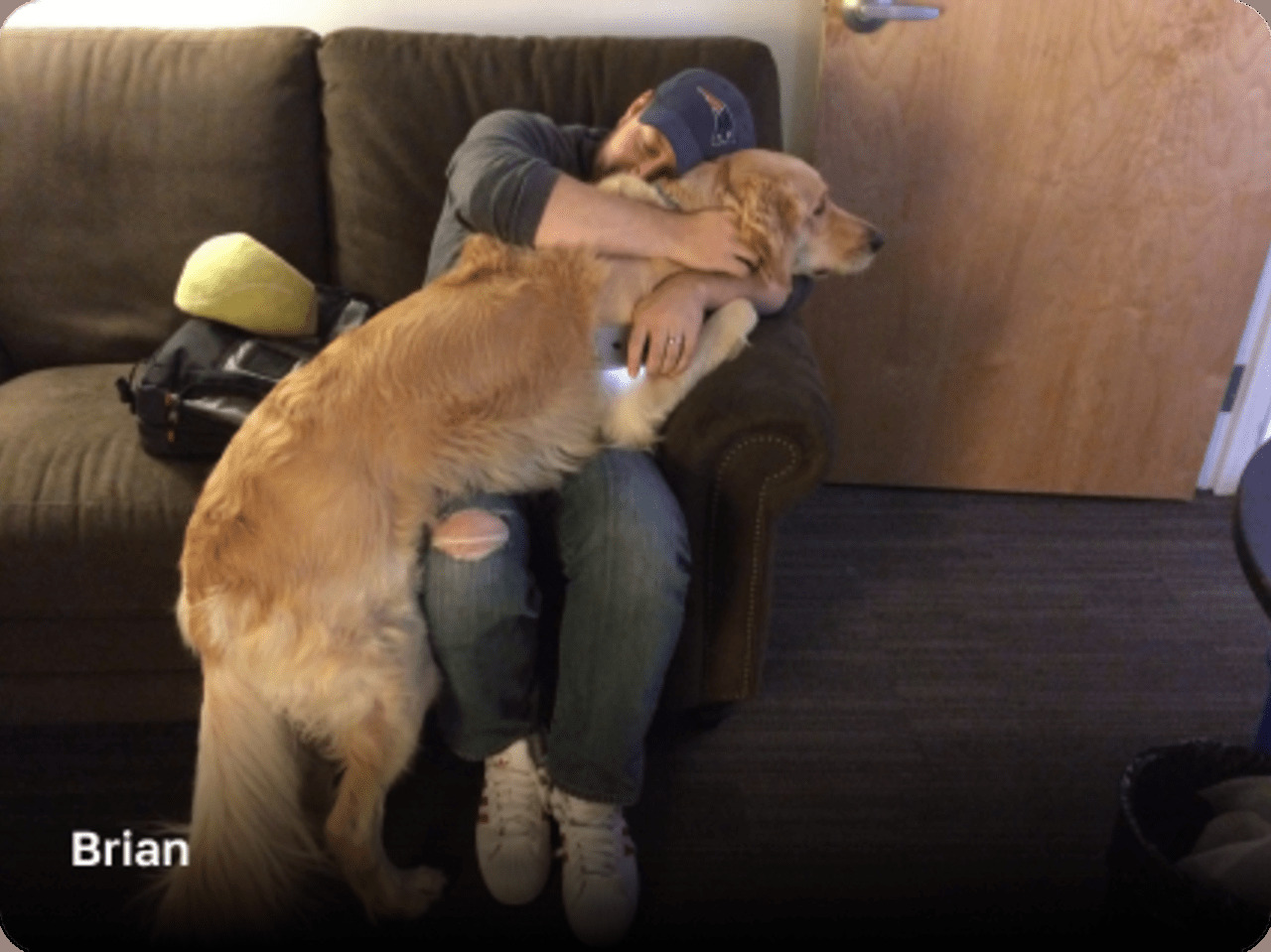
The official Boris FX team page offers a compact editorial judgment of its own. Instead of the familiar executive headshot, Fox appears in a backward cap on a couch while a golden retriever climbs into his lap. He hugs the dog. The dog occupies most of the photograph. Corporate hierarchy has rarely looked so correctly arranged.
It is tempting to make too much of a candid, but the image agrees with the public testimony. Colleagues have described Fox as thoughtful, genuine, funny, positive and collaborative. Oberbrunner praised the combination of customer focus, design sense and attention to both the big picture and details. Evan Berenson, who worked with him at CBS Boston, emphasized versatility, dependability and an ability to inspire a team.
The career supports those descriptions without requiring mythology. Editing is collaborative even when the room has one chair. The editor absorbs the ambitions of a director, producer, client and audience, then turns them into choices measured in frames. Product management performs a similar trick with engineers, designers, sales teams and users. Marketing does it once more, at public scale. Fox did not abandon one discipline for the next. He kept translating.
The portfolio gets wider; the brief stays narrow
Boris FX has expanded well beyond the collection Fox joined. Its portfolio now reaches tracking, rotoscoping, image restoration, audio repair, editing and music production. In July 2026, after iZotope joined Boris FX, Fox co-hosted a public discussion with leaders from both companies. The conversation moved from pixels into frequencies, from Sapphire and Mocha to RX and Ozone.
For a CMO, acquisitions offer an irresistible invitation to speak in grand architectures. Fox's most credible contribution is smaller and harder: keep the user's working reality inside the architecture. The audio editor protecting a forensic workflow and the VFX artist waiting on a 12K composite have different problems. Both can recognize when a tool respects their time and when it merely requests attention.
He has also kept an eye on who will occupy those chairs next. In 2024, Fox wrote “New School of Motion,” profiling four editors under 18 making gaming highlights and YouTube work. It was a fitting assignment for somebody whose own path began in a more centralized television world. The tools have spread. The routes into the craft have multiplied. The young editor may meet the audience before meeting a studio.
“In today's post-production world, you want to be on the side of the customer, and on the side of choice.”Brian Fox
Stay close to the frame
Fox's story does not need a heroic reinvention. It is more useful as a story of proximity. He stayed close to the users because he had been one. He stayed close to Sapphire while moving into marketing leadership. He kept showing the work in webinars and trade-show demos. When the technology shifted from CPU to GPU, from HD to 12K experiments, and from hand-built masks toward assistive machine learning, his public test remained practical: does this give the artist better options?
Creative software is full of spectacular possibilities and ordinary frictions. The possibilities make the reel. The frictions decide whether anyone finishes it. Fox has built a career in the narrow space between them, where a faster render can rescue an afternoon and a broader hardware choice can rescue a budget.
The titles now say executive and product manager. The instincts still belong to an editor: watch the whole sequence, notice the awkward cut, and remove whatever the audience should never have to see.