Before Brian Elliott asked businesses to trust AI with their software, he helped people answer a smaller question with a surprisingly large emotional budget: will I actually like this engagement ring? At Wove, the company he co-founded with Andrew Wolgemuth, couples could design a ring and receive a replica to try at home. The final purchase could wait until the object had survived an encounter with the finger.
It was a practical accommodation to human nature. People can admire a photograph and still want to know what happens when they open the box. A replica made an expensive decision easier to examine. Romance retained its mystery; the dimensions of the jewelry did not have to.
Elliott now runs Blitzy with co-founder and chief technology officer Sid Pardeshi. The customers are enterprises, the material is code, and the ambition is autonomous software development. Between the two businesses lies a useful thread: making decisions about complicated things requires a better view of what you are getting.
Europe, if the grades permitted
Elliott graduated from West Point in 2014. His explanation for choosing it begins with his father, a National Guardsman who volunteered to serve in Iraq. Watching a parent choose time away from family for public service influenced Elliott when he was weighing West Point against a very different college experience.
He has resisted making his student years sound like an uninterrupted march toward destiny. Describing his priorities later, he said he had aimed to earn the grades needed for a posting in Europe while enjoying himself with friends. He got the Germany assignment. Backward planning, apparently, could accommodate a social life.
He studied systems engineering, a discipline concerned with how parts fit together. Military service gave that interest a demanding setting: Elliott became a platoon leader in the Army's 75th Ranger Regiment, leading 40 special operators. Coordinating people and resources was consequential work long before he began discussing the coordination of software agents.
One student project brought systems analysis down to the level of a barbershop. Elliott collected data on customers with appointments and those who walked in, modeled the queues, and presented recommendations for improving service times. Another used Microsoft Access to organize scattered information into a database. These were modest exercises with recognizable problems: people waiting, information dispersed, a process that could work better if someone understood it. The scale would change considerably.
His later transition into entrepreneurship required preparation of its own. He studied independently and conducted informational interviews before leaving active duty. The habits of an established officer did not come with a ready-made civilian business. He had to learn what to build, how to explain it and whom to ask.
Learning to sell a very personal purchase
Wove paired Elliott with another former Ranger and West Point graduate, Wolgemuth. The business grew from helping service members stationed overseas design engagement rings. An overseas posting is an awkward place from which to conduct a careful jewelry-shopping expedition. Remote consultation and a physical prototype offered a workable route through the distance.
The company brought a designer into the process and sent customers a replica before the finished ring. Couples could examine a specific design together. They could also keep the replica as an alternative for travel. The product addressed a peculiarly human combination: wanting a meaningful purchase to feel personal, while wanting fewer opportunities to get it wrong.
Elliott's responsibilities included digital product, user experience and marketing. Those jobs put him close to the distance between a company's explanation and a customer's understanding. Wove's ecommerce platform went live in December 2021. In November 2022, the company announced $3.85 million in seed funding led by Springdale Ventures.
His advice during that period was to approach an idea as a test. A prospective founder could spend considerable effort assembling the formal machinery of a company before discovering whether anyone wanted the thing. Elliott encouraged finding a quick way to examine the underlying hypothesis. A business begins to become useful when another person can react to something concrete.
There was room for a less solemn side, too. A 2022 biography listed kayaking Boston's Charles River and writing comedy sketches among his interests. The latter seems a reasonable extracurricular activity for someone whose professional life involved persuading people to make expensive decisions about love.
A bakery gets a software department
At Harvard, Elliott met Pardeshi, who brought years of software engineering experience at NVIDIA. Elliott would graduate from Harvard Business School in 2024. Their joint experiment began with a Boston bakery that needed an app. Working on the project exposed them to how AI models could help produce software, and how much human intervention the process still demanded.
The experiment mattered because it gave the pair a job to finish. They were handling a customer's requirements, trying different tools and dealing with the result. That is a useful education in the gap between generating a piece of code and delivering an application someone can use.
Blitzy was founded in Cambridge in 2023. By December 2024, Elliott was describing a business serving enterprise customers, with particular relevance to finance and insurance. The trajectory had carried the founders a long way from the bakery: existing corporate software brought scale, dependencies and conventions that a new app could avoid.
Harvard supplied a setting for those experiments and a network around them. Blitzy appeared at the Rock Center's first annual Demo Day, and Elliott participated in Rock Venture Catalyst. He later credited that program's network and resources with helping the business get started. His advice to subsequent founders stayed practical: put building and selling ahead of perfecting the plan.
“Action begets information, not the other way around.”
Brian Elliott
The missing information problem
The technical question behind Blitzy is easy to underestimate. A model can produce a plausible change while missing a relationship elsewhere in a software system. A company may have years of private decisions embedded in its code. Understanding what a file does is only part of understanding what changing it will do.
Blitzy's approach puts a representation of the existing codebase around the models doing the work. Its platform maps the software, develops a technical specification and coordinates agents assigned to different tasks. It also builds validation into the process. The intent is to give each task the information it needs from the wider system.
- 01UnderstandMap the existing code and its relationships.
- 02PlanDefine the requested change and its scope.
- 03CoordinateGive agents context and sequence their work.
- 04ValidateTest the output before human review.
This is where Elliott's enthusiasm for systems becomes visible in the product. The work includes deciding which tasks can happen together and which have to wait. The model's answer sits inside an arrangement of information, instructions and checks. The arrangement is part of what the founders are selling.
The company's own technical paper makes the trade-off explicit: allow more time and computation to pursue broader context and validated output. Elliott is among its authors. Speed, in this account, is measured across a software project. An immediate answer in a chat window is a different unit of satisfaction.
What $200 million buys time to attempt
In May 2026, Blitzy announced a $200 million growth round at a $1.4 billion valuation. Northzone led the financing, with participation from investors including PSG and Battery Ventures. The company said the money would support research, commercial expansion and its partnership ecosystem. It also reported adoption across dozens of Global 2000 enterprises.
Financing led by Northzone
$1.4B company valuation
The financing gave Elliott and Pardeshi more resources to pursue the problem. Their prospective customers still needed reasons to change how engineering work happened. A large enterprise has an existing organization, approval processes and people responsible for the software after an outside vendor has finished demonstrating it.
That organizational side featured in Elliott's January 2026 conversation with RSM's chief technology officer, Tom Jackson. Their discussion concerned adopting an agentic software development lifecycle, including the change management required around the tools. A faster way of producing software creates decisions for managers and reviewers as well as developers.
Elliott has described the long-term aim as fully autonomous enterprise software development. The distinction between an ambition and the present workflow matters. Blitzy's instructions still call for customers to carry out their own quality and security checks before deployment. The business that owns the production system keeps the final responsibility.
The backlog acquires a Boston address
September 2026 brought a physical expression of the company's growth: a 52,000-square-foot lease at One Kendall Square in Cambridge, tripling its office space. Blitzy also became a Boston Celtics partner, with a role in the Shamrock Foundation's annual Tip-Off Gala. A company founded in a local university ecosystem was making a more visible commitment to its home region.
Later that month, Blitzy introduced PR Review. The feature explains changes in AI-generated pull requests and presents information about their validation. It addresses a consequence of the company's own ambition: when agents can produce large amounts of code, people need a manageable way to understand what arrived.
In his account of why he founded Blitzy, Elliott has connected cheaper software creation to economic productivity. He describes wanting to expand what people can produce. That aspiration reaches well beyond a single engineering backlog, though the route to it runs through specific projects and customers deciding whether the work is useful.
The route from engagement rings to enterprise software looks less peculiar viewed from the customer's side. In each case, someone has to commit to something they cannot judge from a reassuring description alone. Elliott has spent parts of his career trying to give that person more to work with. The ring could be tried on. The code must be examined, tested and understood.
Read, watch, follow
- Blitzy · company and platform
- Brian Elliott · LinkedIn
- Brian Elliott · X
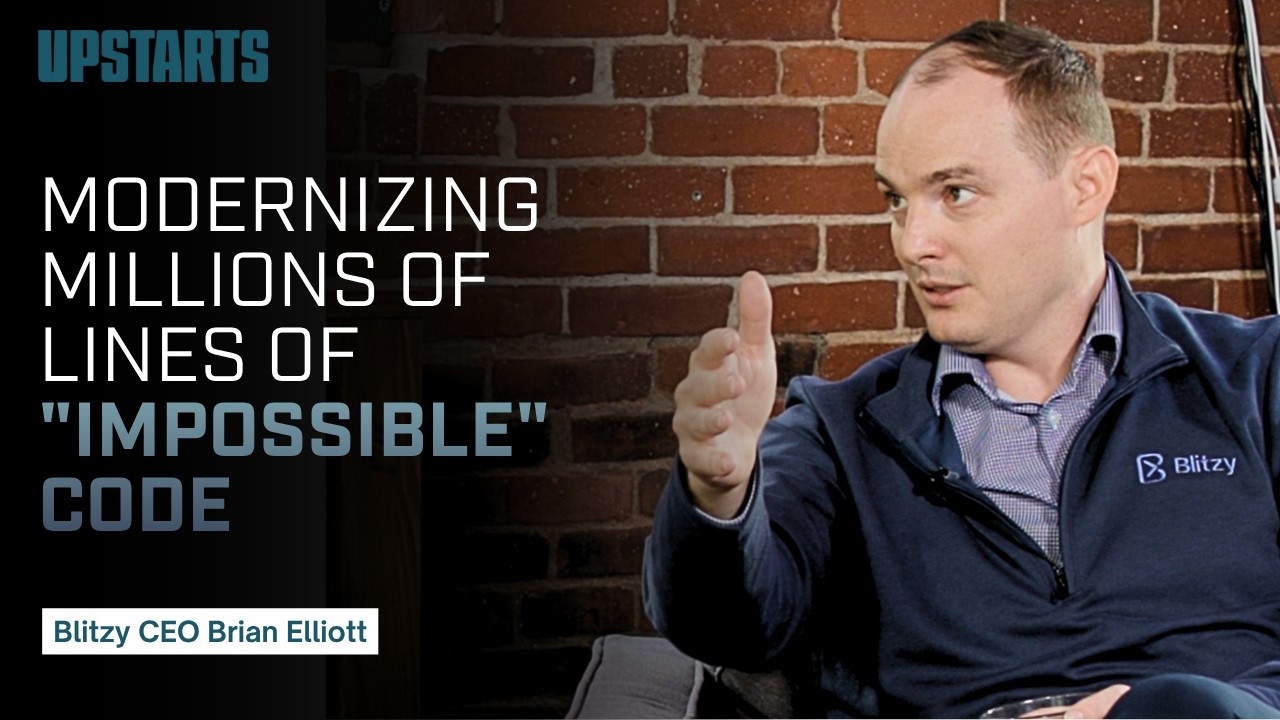
- Watch · The Upstarts Podcast, July 2026
- Watch · Modern CTO with RSM, January 2026
- Listen · Wove and the transition from military service
- Read · West Point and Wove
- Read · Harvard’s Rock Venture Catalyst
- Read · Blitzy’s May 2026 financing announcement
- Read · PR Review announcement