Brett McGill’s first job around boats involved washing them and mowing the lawn. He was 12, helping at his father’s Gulfwind Marine dealership in Florida. The weekend had its own curriculum: water-ski tournaments, with his sisters competing too. He liked trick skiing best. Long before boats became revenue, inventory or acquisitions, they were the family’s way of spending time together.
There is a useful way to read the career that followed. Look past the yacht photographs and watch the work required to get a customer out of the parking lot and onto the water. Someone has to organize the information, maintain the engine, teach the owner and find a berth. McGill has held jobs on several sides of that problem. Eventually, he began buying businesses that addressed more of it.
A software person in a boat business
His professional career started at Integrated Dealer Systems, a software development firm. He joined Gulfwind in 1996. When MarineMax formed in 1998, he became its director of information services. His early contribution was technical: connecting dealerships and their information as the organization expanded.
The job offers an unusually practical introduction to a retail business. A collection of locations can share a name while remaining awkwardly separate in daily life. Information has to move between people who are busy selling, repairing and delivering things. A computer system is useful only when it helps those people do their work. It is easy to admire a yacht. Admiring an orderly dealership network requires a more specialized taste.
His responsibilities widened. In 2004 came information technology, service and parts. In 2006, regional leadership. In 2012, West Operations. He became executive vice president of operations in 2015, chief operating officer in 2016 and president in 2017. The sequence matters because each promotion brought him closer to the whole operation, rather than keeping him within the technical department where he started.
The family name, and the jobs in between
His father, William H. McGill Jr., was MarineMax’s co-founder and chief executive. Brett succeeded him as CEO in October 2018, continuing as president. Bill moved into the executive chairman role. Brett joined the board in February 2019.
A family succession invites a quick explanation. The operating history slows it down. By the time the board promoted him to president, McGill had worked through technology, service departments, regional management and company operations. In announcing that appointment, board member Joe Watters pointed to his ability to build teams, his relationships with customers and the usefulness of his technology background.
That is a fairly specific case for a promotion. It also gives the succession a different texture from a ceremonial handover. A dealership is a place where promises become appointments, repairs and deliveries. Experience there can be tested in small, public ways, repeatedly. The family connection belongs in the story. So do the years spent learning where an organization can disappoint someone who has already paid.
What happens when the customer comes back?
McGill has described the 2008 financial crisis as a reason to broaden MarineMax’s business. A company heavily dependent on new-boat purchases is exposed when buyers postpone an expensive decision. Storage, servicing and marina operations give it other work to do for existing owners.
“Historically, we lived or died by each new boat sale.”Brett McGill
The change asks the retailer to take responsibility for more of the ownership experience. Training helps a new buyer feel comfortable at the controls. Organized Getaways give that buyer somewhere to go and people to go with. Service and storage attend to the less photogenic intervals between trips. McGill has also described other family recreation, including softball and backyard swimming pools, as competition for boating.
Seen that way, the scarce resource is a family’s free time. A boat competes for it every weekend, whether or not another dealer is offering a discount. The customer has already bought the hardware. The next question is whether using it feels easy enough to do again. That makes an instructor, a service appointment and a well-run marina commercially consequential in ways a showroom photograph cannot capture.
In 2023, McGill was notably restrained about taking credit for the preceding sales surge. He acknowledged the unusual strength of demand. His emphasis fell instead on customer satisfaction and MarineMax’s internal “FANS” measure, its name for net promoter score. He said customer feedback was discussed in every meeting.
That choice of emphasis is revealing. Sales describe what a customer has done. Satisfaction asks something about the relationship that remains. Neither metric excuses poor execution, and a good score cannot make a boat arrive on time. But the distinction explains why McGill keeps returning to the experience around the purchase when discussing the business.
Buying the rest of the trip
MarineMax’s acquisitions under McGill give the strategy a set of concrete addresses. Fraser joined in 2019, expanding the company’s reach into superyacht brokerage and services. That brought capabilities around yacht management, charter management and crew placement, as well as the sale itself. An owner moving into a larger vessel could require an increasingly elaborate organization around it.
Northrop & Johnson followed in 2020. Its activities included brokerage, charter, crew placement and advice on new construction. The acquisition announcement also emphasized its digital marketing capabilities. The combination with Fraser extended MarineMax’s resources across international yachting markets. These were established businesses with their own people and relationships, rather than a dealership simply adding a bigger boat to its display.
There is an organizational wager in every such purchase. Adding a capability makes sense on paper; making it useful to a customer requires people to work together. McGill’s career began with connections between dealerships. The later acquisitions enlarged the problem to include different services, brands and countries. The work of connection remained.
In March 2020, MarineMax acquired Boatyard, an on-demand digital services platform. Founder Nathan Heber stayed to lead it. The stated purpose was to simplify access to boating services through a smartphone, while Boatyard retained its own brand. For a CEO whose early career involved dealership software, this was familiar territory at a different scale.
The appeal was practical. Booking work, communicating about it and arranging service are all part of owning a boat, even though none makes the holiday album. A useful digital product can reduce that administrative burden. MarineMax framed the acquisition around making ownership easier, rather than treating the technology as a separate destination for the customer.
Superyacht services
Yacht expertise and digital service
Manufacturing
International marina network
A place to build, a place to berth
The 2021 purchase of Cruisers Yachts put MarineMax on the manufacturing side of the business. The company paid $63 million, including a recently acquired manufacturing facility in Pulaski, Wisconsin. McGill explained that Cruisers filled a gap left by the loss of Sea Ray sport yacht and yacht models in 2018.
That is a less abstract acquisition rationale than growth for its own sake. There was a product category MarineMax wanted to offer, and an American builder that could supply it. The purchase also introduced the responsibilities of production. Selling the finished boat and running the organization that builds it are related occupations, with different daily demands.
IGY Marinas made the geographic expansion tangible. The transaction closed in October 2022 at an initial $480 million purchase price, subject to adjustments, with additional contingent consideration possible. The acquisition presentation described a network of 23 marinas across 12 countries, positioned around established superyacht destinations.
The logic extended beyond adding waterfront property. MarineMax already had brokerage and yacht services through Fraser and Northrop & Johnson. IGY added places where those vessels could berth. A customer relationship could now involve finding a yacht, arranging services and securing a destination. Each additional piece increased the range of problems the organization could address.
The arithmetic beneath the leisure
The strategy still faces a boat market that can be difficult. For the quarter ended June 30, 2026, MarineMax reported revenue of $611.3 million, down 7% from the comparable quarter. Same-store sales also fell 7%. Gross margin rose from 30.4% to 35.7%, and gross profit increased to $218.1 million.
McGill credited improved boat margins and contributions from businesses including superyacht services, marinas, finance and insurance, and parts and service. The result illustrates the argument for diversification, with an important qualification: approximately 110 basis points of quarterly gross margin came from a tariff refund. The whole improvement cannot be assigned to a change in business mix.
Scale: 0-40%. The 2026 figure includes approximately 1.1 percentage points from a tariff refund.
A larger decision followed. On August 10, 2026, MarineMax announced an agreement to be acquired by Safe Harbor, a Blackstone Infrastructure portfolio company, for $53 per share in cash. The announced enterprise value was approximately $1.5 billion. The board unanimously approved the transaction.
The October merger proxy scheduled a November 11 shareholder meeting. As of October 23, completion remained subject to shareholder and regulatory approvals and other closing conditions. An agreement describes an intended next chapter. The approvals determine whether it begins. For McGill, the proposed transaction places the expanded MarineMax business into another combination, this time as the company being acquired.
Back aboard
Some of the smaller details supply a useful counterweight to the transactions. In 2019, McGill said he read every first-year customer survey. He also described bringing managers to work on Habitat for Humanity homes. His account of team building included paint and practical tasks, rather than another afternoon of golf.

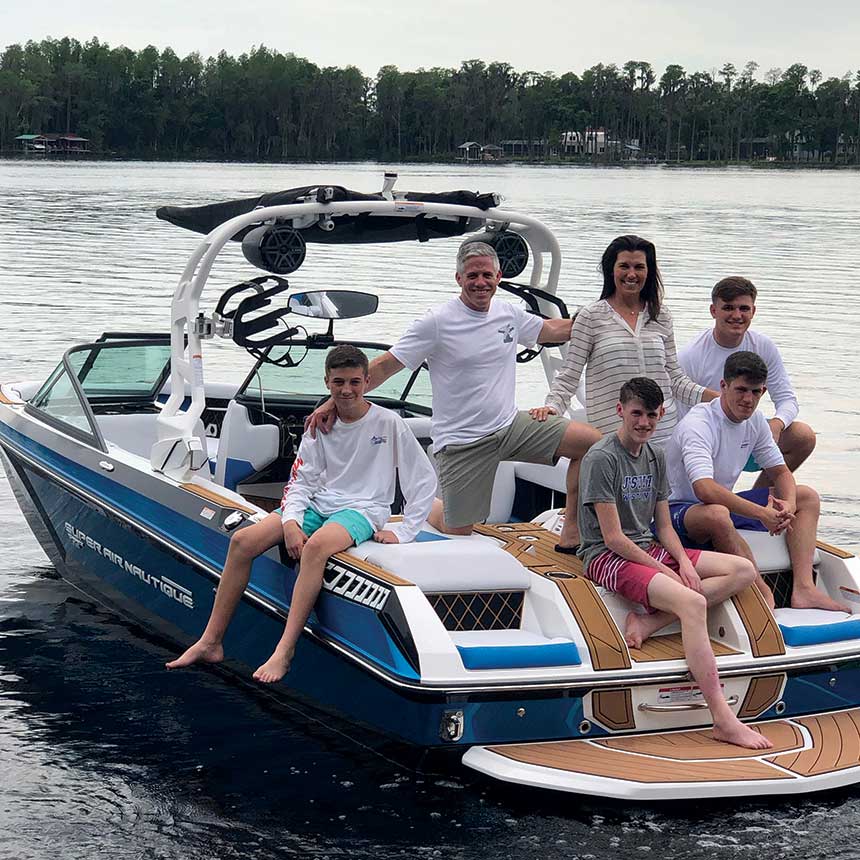
The family photograph offers another measure of continuity: McGill, his wife Vicki and their four sons together aboard a boat. The business around that activity has become considerably more complicated. Software, dealerships, yacht builders, brokers and marina operators all enter the story. At the center remains a recognizable ambition: get everyone aboard, get underway and have a Saturday worth repeating.