Before Brenda Jones Barwick started a public relations firm, she asked a former ambassador a question that her résumé could not settle. She had worked in the White House West Wing. She had worked with the American ambassador to Switzerland. But could she run a business? And when, exactly, was the right moment to begin?
Phil Winn had started businesses himself. His answer was admirably economical: “You don’t know until you do it.” Seven words, no forecast, and very little material for a reassuring spreadsheet. Barwick took the advice. In 2001, she founded the company that began as Jones PR and now operates as Jones Strategies.
The exchange gets at something revealing about her career. Working close to authority had given her experience, contacts and an education in how institutions speak. Ownership required her to make a decision on her own account. Knowing your way around the West Wing does not automatically tell you what to do on the first Monday of your own company.
“You don’t know until you do it.”
Ambassador Phil Winn’s advice, recalled by Barwick
Writing, politics, and a trip home
Barwick graduated from the University of Oklahoma in 1980. Writing and politics were already intertwined: she worked as a copy editor at The Oklahoma Daily and participated in College Republicans. An internship during Ronald Reagan’s election campaign helped take those interests out of the classroom and into a career.
At the Reagan White House, she worked as a writer. Her next assignments moved her into diplomacy, including the American Embassy in Switzerland, where her responsibilities included diplomatic events, congressional visits and public outreach. She later served on a presidential commission advising President George H. W. Bush and Congress on restructuring the U.S. Agency for International Development.
The jobs varied, but the practical problem was related: institutions have things they need people to understand. A writer, an event organiser and a public affairs adviser approach that problem from different directions. Barwick’s early career gave her experience in all three, before she had an agency of her own to introduce.
She returned to Oklahoma in 1993. Work at Feed the Children came before a role in advertising. At Ackerman McQueen, she became vice president of public relations, handling commercial communications that included Six Flags. The move brought a private-sector audience into a career that had begun in government.
Returning home is sometimes treated as the quiet part of an ambitious career. In Barwick’s case, it set up the decision that made her an employer. She had come back with experience acquired elsewhere. Now she would find out what she could build with it in Oklahoma.
- 1980OU journalism graduate
- 2001Jones PR begins
- 2015PROI partnership
- 2023Gaylord recognition
- 202625 years in business
Oklahoma, with the windows open
Her account of the company’s beginnings is decidedly domestic. In a PRSA board application, she described establishing Jones Public Relations at her kitchen table with a two-week paycheck. The furniture is a useful corrective to the government titles. A kitchen table provides an excellent workspace, though it seldom comes with a protocol officer.
As the firm developed, she kept the Oklahoma base and added relationships beyond it. In September 2015, Jones PR joined PROI Worldwide, a partnership of independent communications agencies. The arrangement gave the firm access to partners in international markets while it remained an independent Oklahoma business.
“PROI Worldwide allows us to extend our global reach for clients,” Barwick said at the time. That was a practical ambition for someone whose previous work had already crossed borders. Clients could need understanding of a local community and help in another country on the same assignment. A network made that combination more workable.
Some connections were considerably closer to home. In 2019, former Oklahoma City mayor Mick Cornett joined the agency as executive counsel. Barwick had known him since their University of Oklahoma days. A university acquaintance had become a professional relationship decades later, with a substantial chapter of city government in between.
The company’s recognition expanded too. Its awards include a Gold Lion at Cannes and PRSA Anvils, and it lists seven appearances on the Inc. 5000. Those are team and company achievements. For a founder, they also document the distance between the kitchen-table beginning and an organisation capable of producing recognised work.
Six stories, every week
A smaller episode offers a closer view of the business. In 2021, Barwick wanted The Oklahoma 100 newsletter to move from publication every other week to a weekly schedule. For an agency team already managing client assignments, an extra deadline could sound suspiciously like an extra deadline.
The staff worked through the process and found that six stories each week were easier to organise than twelve every other week. An editorial calendar and assigned beats helped distribute the work. More frequent publication also made the stories more timely. The change became a matter of how the workload was arranged.
The arithmetic has a pleasing lack of glamour. It also puts actual people back into a business profile: editors, account staff and writers fitting publication around the rest of their jobs. A founder can ask for greater frequency. Someone still has to decide when the assignments go out and when the copy comes back.
A change in rhythm helped the team organise publication around agency work.
Barwick has also written about the profession itself. In 2019, she interviewed two Silver Anvil judges about what makes an effective awards entry. The discussion covered research, measurable results and the need to explain a campaign clearly. Even an awards submission, with all its temptation toward ceremony, has to make a case that another person can follow.
The owner returns to Washington
By September 2018, Barwick had another reason to speak in Washington. She appeared before a House Small Business subcommittee on behalf of Women Impacting Public Policy, a national, nonpartisan organisation whose board she served on. The former government communicator was now speaking from her experience as an owner.
Her testimony connected federal decisions to the operating realities of small firms. She discussed staffing, compensation and the difficulty of applying the same assumptions to businesses of very different sizes. The setting gave a public-policy audience a view from inside an Oklahoma employer.
Recognition for her entrepreneurship followed. She was named a 2020 Enterprising Women of the Year honoree. The programme considered business growth, community leadership and support for other women in entrepreneurship. In 2024, she was also included among The Journal Record’s Woman of the Year honorees.
From 2022 to 2025, she chaired the Oklahoma Commission on the Status of Women. The commission’s work included access to affordable childcare and education about human trafficking. Its 2025 report described a childcare summit explicitly concerned with barriers to women’s economic opportunity.
These are subjects with consequences beyond a communications office. Childcare availability affects whether people can work. Public education depends on reaching people before an issue becomes someone else’s urgent problem. Her commission role placed communication alongside the slower tasks of convening organisations and seeking practical changes.
Her civic work also includes helping establish the annual Oklahoma Aerospace Forum. That adds another kind of gathering to a career already full of them: bringing an industry into conversation about its future. The audience changes from assignment to assignment, but arranging for people to hear one another remains part of the work.
She continues to write about figures from public life. In March 2025, she contributed a short piece on Jeane Kirkpatrick, the Oklahoma-born diplomat appointed U.S. ambassador to the United Nations by Reagan. Barwick focused on Kirkpatrick’s public diplomacy and concise performance in media interviews. The subject brings her interests back together: an Oklahoman working internationally, politics expressed through language, and a woman exercising authority in a public role.
It is a fitting detail for someone whose own work has moved between preparing words and putting organisations in a position to be heard. The assignment can be a presidential message, an industry meeting or a newsletter schedule. Each has an audience, a purpose and a practical requirement to get the words into circulation.
A hometown worth staying for
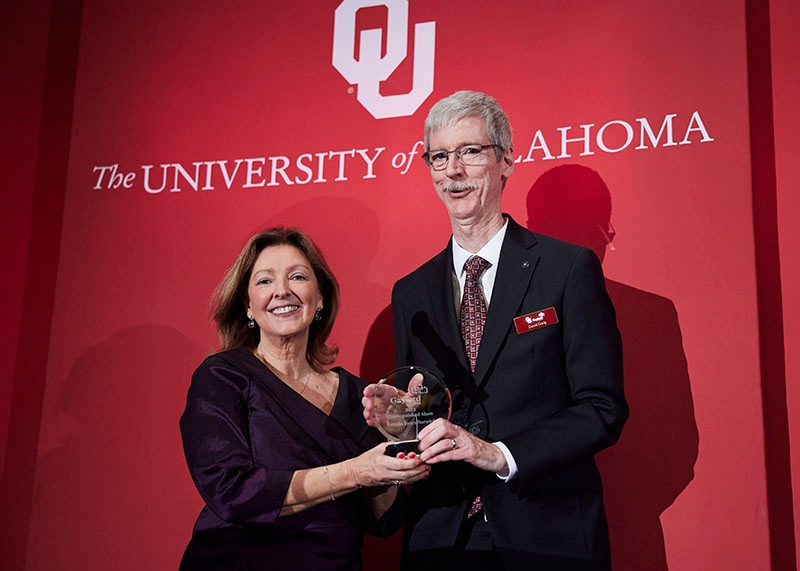
In November 2023, Gaylord College recognised Barwick as a distinguished alumna. At the celebration, she stood beside Interim Dean David Craig holding her award. A journalism graduate from 1980 had returned with a career that connected presidential writing, diplomacy, commercial campaigns and an Oklahoma company.
There is another, less ceremonial view of her in a 2022 conversation with Mimi Turner. Talking about Oklahoma City, Barwick described her excitement at seeing younger people stay and build careers there. She also noticed people gathering at Scissortail Park. After years of watching the city change, those ordinary signs of activity mattered to her.
That conversation helps explain why the return to Oklahoma belongs near the centre of her story. A city becomes a different place when people can imagine their working lives there. Her agency is one contribution to that possibility: a business founded locally, employing people locally, with relationships that extend further away.
In 2026, the firm marked 25 years and its Jones Strategies identity. The name reflects a business that spans public relations, marketing, branding and government relations. The original entrepreneurial question has had a long working answer. Barwick began with experience and uncertainty; a quarter-century later, there is a company.