The Profile
A Window With No Wall Behind It
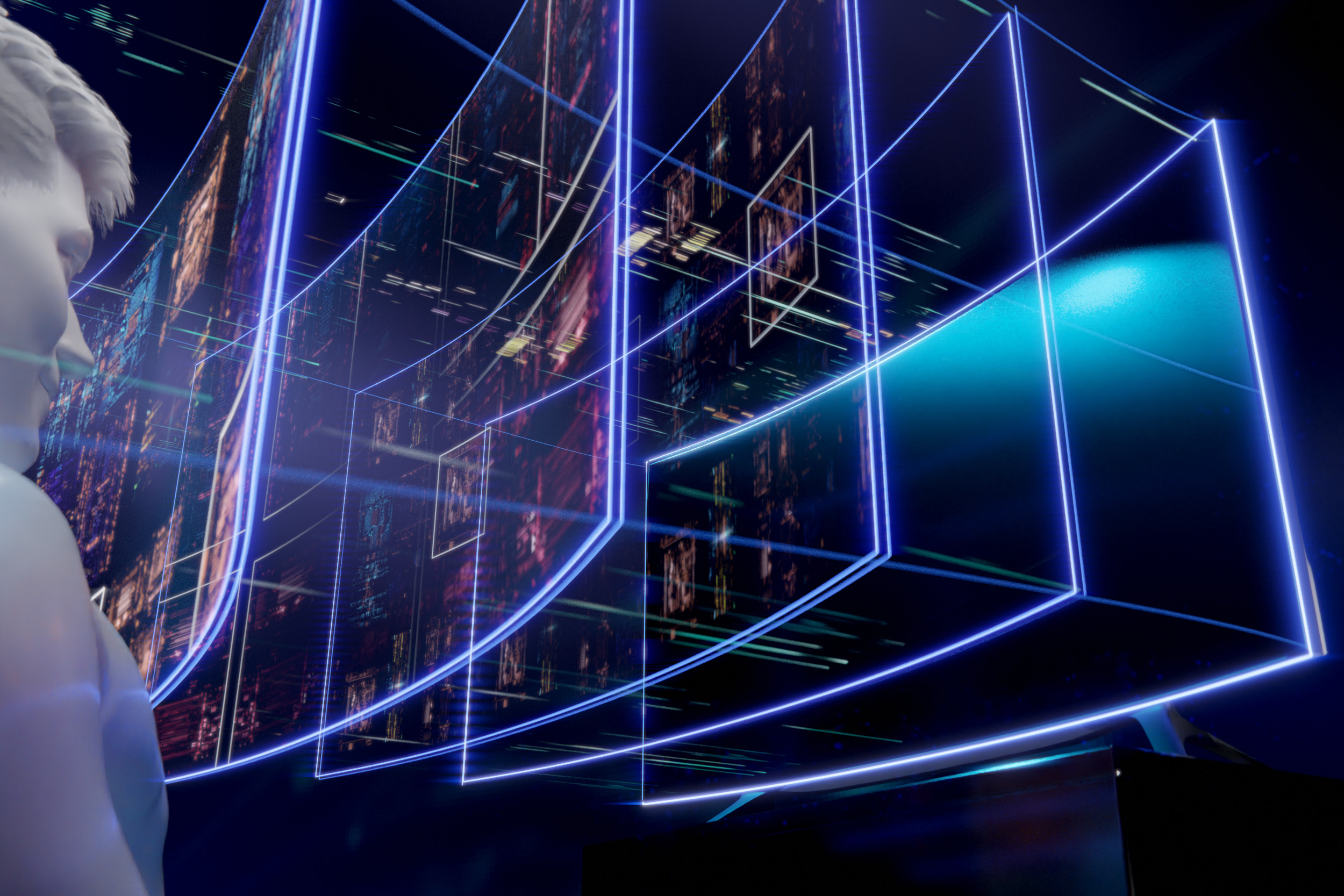
Sit down in front of a Brelyon. The frame in front of you is about the size of an ordinary monitor - the kind that ends up on a thousand identical desks. Then it switches on, and the desk seems to dissolve. The image is not on the glass. It is somewhere behind the glass, ten feet wide, curving gently past the edges of your vision, with a depth your eyes insist is real. Nobody has handed you a headset. There is nothing strapped to your face. You are simply looking, the way you look at a horizon.
That gap - between what the object is and what the eye reports - is the entire company. Brelyon does not make bigger screens. It makes the experience of a bigger screen, which turns out to be a very different, and much harder, thing to build.
Pixels with a mind of their own
The conventional display is an honest machine. It has a width, a height, and it shows you exactly that. Brelyon's pitch is that honesty is overrated. Its Ultra Reality monitors do not just light up pixels - they manipulate the wavefront of light itself, the shape of the electric field before it ever reaches your retina. Control the angle and the focus of that light, and you can place an image where there is no surface to place it on.
The founder, Barmak Heshmat, came out of the MIT Media Lab, where he was a research scientist, and brings a habit of describing the work in deceptively plain terms. "We are adding a new layer of control between the world of computers and what your eyes see," he says. It sounds modest. It is, in practice, an argument that the screen has been the dumbest part of the computer for forty years, and that this is finally fixable.
"We are adding a new layer of control between the world of computers and what your eyes see."- Barmak Heshmat, Co-Founder & CEO
Why this isn't a VR company
It would be easy to file Brelyon under virtual reality and move on. The company resists the label, and the resistance is the point. Headsets create immersion by isolation - they cover your eyes and substitute a world. They also create a well-documented discomfort: the accommodation-vergence mismatch, where your eyes focus at one distance while aiming at another, and your brain files a complaint in the form of a headache.
Brelyon's optics render depth the way the world does, so there is no mismatch to argue with. No head tracking. No goggles to charge, smudge, or lose. The display plugs in over HDMI or DisplayPort and works with the software you already run - flight simulators, control-room dashboards, games with FreeSync or G-Sync. "This is a plug-and-play solution that is much smaller than setting up a projection screen," Heshmat notes, which is the kind of sentence that sells units to people who manage simulation labs for a living.
The TARDIS problem
Engadget, reaching for a way to describe the thing, landed on a phrase that stuck: the TARDIS of monitors. Bigger on the inside. It is a useful joke because it captures the genuine strangeness of the product - the visceral mismatch between footprint and presence. A 30-inch frame stands in for a curved 122-inch screen. A desk's worth of space delivers a room's worth of view.
The latest twist arrived at CES 2025, where Brelyon showed Ultra Reality Extend and called it the world's first monitor with programmable depth. Instead of one fixed virtual plane, Extend places image layers anywhere from 0.7 to 2.5 meters of apparent depth, and uses transformer models - yes, the same family of AI that writes and draws - to assign depth to ordinary video in real time and to drop annotations into your field of view. The screen stopped being a surface. It became a volume that thinks about what it's showing you.
Who actually buys a window
The romance of headset-free immersion is consumer-shaped, but the cheques are enterprise-shaped. Brelyon's early adopters are the unglamorous, demanding markets where a better view is worth real money: flight simulators, defense, teleoperations, control centers, and high-end visualization. The company has said it works with some of the largest simulation-training companies in the world. Reported pricing - roughly $5,000 to $8,000 a unit, enterprise first - tells you exactly who the first thousand customers are, and it isn't gamers, yet.
The investor roster reads like a thesis. The $15 million Series A in 2022 was led by Lockheed Martin Ventures and the MIT-affiliated E14 Fund, with Corning (glass and optics), LG Technology Ventures (displays), UDC Ventures, and Franklin Templeton along for the ride. Defense wants the simulators. The glass and display giants want the optics. That is not a random cap table - it is a map of where this technology is expected to land.
"Wherever you want to increase visual efficiency with screens, Brelyon can help."- Barmak Heshmat
Small company, large claim
Brelyon is roughly 28 people. It is making a claim about the next forty years of how humans look at computers, with the headcount of a mid-sized restaurant. That tension - enormous ambition, deliberately small team, a product that has to be seen in person to be believed - is the most honest thing about it. You cannot screenshot a Brelyon. The marketing problem and the engineering achievement are the same fact: the magic only exists for the eye that's actually there.
So return to the desk. The frame the size of an ordinary monitor is still, physically, just that - a frame the size of an ordinary monitor. Nothing about the object has changed. What changed is the agreement between the machine and your eyes about how much world fits behind a piece of glass. Brelyon spent years renegotiating that agreement. The desk hasn't moved. The horizon, somehow, came indoors.