Bree Jensen usually asks the questions. On February 27, 2025, she handed that job to someone else. Guest host Arielle Estoria sat down with the founder of The Social Impact Firm to talk about the Eaton Fire, which had destroyed Jensen’s family home. The conversation turned to delayed housing assistance, insurance complications and the cost of temporary accommodation. A professional life spent helping people organize their ambitions had collided with the practical business of finding somewhere to live.
There is a temptation to hurry past that part of a founder’s story, straight to the uplifting outcome. Jensen’s work since the fire rewards a slower look. Alongside her consulting business, she helped establish a recovery organization and launched a publication for her neighbors. The tasks were concrete: explain the next update, connect people to resources, make a complicated process a little easier to follow.
Her career has taken her through schools, university partnerships, nonprofit projects and corporate social responsibility. In Altadena, those experiences acquired an immediate address. The person accustomed to helping other people navigate institutions was now navigating them herself.
A neighborhood needs an editor
The first issue of The Dena Report is dated April 16, 2025. Its contents have the useful specificity of a notice pinned to a community board: meeting recordings, upcoming events, funding information and updates on rebuilding. Readers could find eligibility details and application links in one section, then turn to town hall videos in another.
That arrangement makes an argument about what communication is for. A resident trying to rebuild has little use for an elegant sentence that conceals the deadline. The publication puts practical information beside local stories, letting recovery include both the official process and the people living through it. Its opening issue also acknowledged the contributors. There was a team behind the pages.
The Dena Report’s first issue gathered meeting videos, community updates, events and funding details.
Jensen launched the publication to simplify post-disaster information. The archive gives that intention a visible form: issues to open, read and revisit. Community members can submit events, while donations and merchandise help support the work. It is a small publishing operation with a substantial assignment. Every new development needs to become something a neighbor can actually use.
Newsletters rarely enjoy the glamour attached to leadership. They arrive in inboxes, compete with discount codes and ask someone to click. Here, that ordinary format has a civic purpose. Jensen’s contribution is partly editorial judgment: deciding which scattered pieces belong together, and giving them a place people can return to.
Two jobs, one community
At the Eaton Fire Collaborative, Jensen serves as public information officer, leading communications, public engagement, media relations and community messaging. Before that, she was vice chair of its board. As part of the founding leadership, she helped establish governance, organizational structure and direction during the early stages of long-term recovery.
The sequence matters. Building an organization requires decisions about who is responsible for what. Communicating its work requires those decisions to make sense beyond the meeting room. Jensen has worked on both sides of that exchange. She also brings the experience of losing her own home to a role concerned with keeping survivors’ needs central.
Her community work has included serving as a neighborhood captain and a liaison for Habitat for Humanity. Those responsibilities put her among people dealing with rebuilding at different scales: a household, a block, an organization. The challenge is to keep the relationship between those scales understandable. A policy can occupy a paragraph; living with its consequences takes considerably longer.
Before the fire, the listening
Jensen’s work in advocacy reaches back more than two decades. Education and housing have been recurring concerns, with experience across K–12 schools, higher education and social enterprise. She earned a master’s in Social Entrepreneurship and Change at Pepperdine University and now serves on the program’s advisory board. The connection has grown beyond the degree.
Her earlier work at Pepperdine included outreach and partnerships. She also worked as a presenter for Rachel’s Challenge and contributed to Family Circle. These are different kinds of public-facing work, but each asks a person to consider an audience carefully. A school assembly, a prospective student and a reader arrive with different questions. The speaker has to notice.
In 2021, Jensen spent two weeks in Paraguay conducting community focus groups with Indigenous and non-Indigenous families through Poverty Stoplight. She and her collaborators assessed the needs of teenagers and young adults and presented recommendations to Fundación Paraguaya. It is a useful early episode in a career concerned with turning conversations into something an organization can act on.
Her LinkedIn account also describes a crowdfunding project that helped fund a community garden for people transitioning out of homelessness. The campaign combined social media materials, a testimonial video and email marketing. The finished object was a garden; getting there involved the less picturesque work of explaining the idea and persuading people to contribute.
The firm behind the assignments
The Social Impact Firm gives that collection of skills a business home. Jensen and her team work with nonprofits, businesses, public agencies and mission-driven founders. The assignments include communications, fundraising, organizational development, community engagement, events and program management. A client may have an idea that needs structure, or an existing organization that needs help carrying out its plans.
The client relationships make the work more tangible. Michelle Young has described Jensen’s help in bringing her foundation from inception to launch, including fundraising, partnerships and program development. Latinas in Beauty founder Emily Perez has credited Jensen and the team with supporting that organization’s launch. The names differ; the recurring assignment is to help an intention become an operating project.
In September 2024, the firm announced Meagan Schmidt as a business partner and chief operating officer. Schmidt brought a background in nonprofit operations, fundraising and government contracts. The partnership added another kind of experience to a business that asks clients to work across disciplines. Jensen was building the capacity to manage the work, as well as bringing it in.
A room with more than one profession
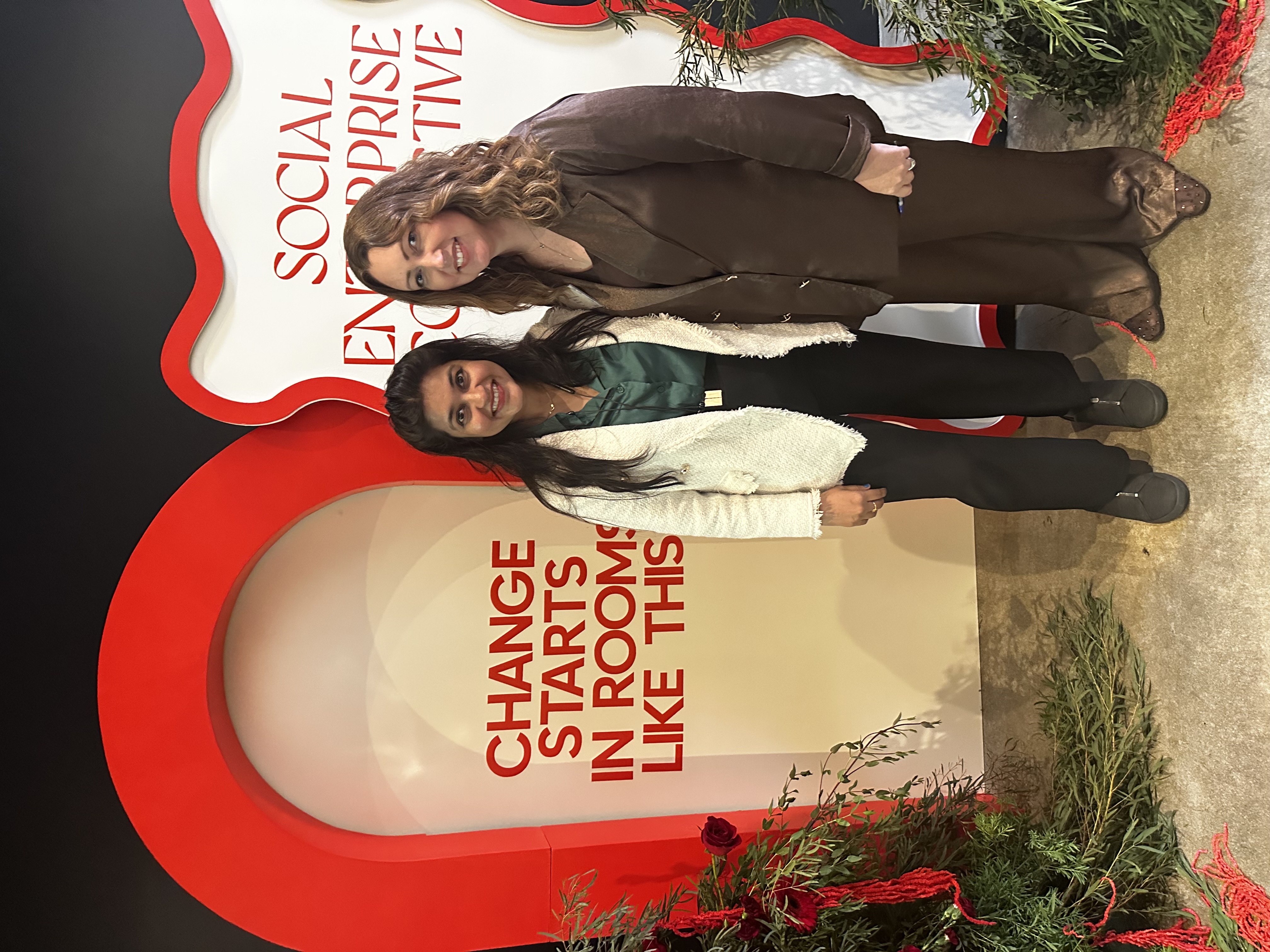
One expression of Jensen’s approach is the Social Enterprise Collective, which the firm hosts in partnership with Pepperdine. Its gatherings bring people from business, nonprofits, government and philanthropy into the same conversation. Students can put ideas in front of people who have experience funding, running or evaluating organizations.
The Washington, D.C., gathering in 2023 included panels, networking and a student pitch competition. Michelle Young was the emcee. The event’s structure gave students a reason to prepare their ideas for an audience beyond the classroom, while giving practitioners a chance to hear what was being developed there. Jensen was listed as the event contact.
The April 10, 2026 Social Enterprise Collective in Los Angeles, co-hosted by Pepperdine and The Social Impact Firm.
By April 2026, the Los Angeles event had drawn more than 300 registered participants. The program included GoFundMe’s Tim Cadogan, Los Angeles County Supervisor Kathryn Barger and Paramount Pictures’ Jennifer Lynch. Students again presented ventures in a pitch competition. The point of putting these groups together becomes apparent in the arrangement: people developing ideas can meet people whose daily work might help test them.
Jensen’s own invitation emphasized time for roundtables, partnerships and actual conversation. There is a difference between seeing someone’s name on a program and having enough time to ask them a useful question. Her event design makes room for the latter. Even networking benefits from someone taking charge of the timetable.
The host keeps a student’s curiosity
Her podcast, now called Impact Archives, extends those conversations beyond the event venue. The guest list crosses sectors: social entrepreneurs, nonprofit leaders, investors and people working in corporate responsibility. Episodes available from 2022 include conversations about sustainable food, technology and ethical leadership. It is a record of Jensen asking how other people do their work.
One guest was Denise Berger, her former Pepperdine professor. Jensen joked that the interview was effectively another class. Another conversation explored responsible technology with All Tech Is Human founder David Polgar. With Airly co-founder Jennifer McKnight, she discussed sustainable food and the problem of communicating an environmental message clearly. The subjects change; her interest in the practical explanation persists.
In June 2025, the podcast published an advocacy panel Jensen moderated in Washington. Participants included Demara Catlett of Bryson Gillette Advocacy, Isabel Carlotta Robbie of Robert F. Kennedy Human Rights and Allison Gilmore of its John Lewis Young Leaders program. Jensen brought the discussion back to a question organizations had been asking her: whether their work was making a difference.
“Whether you’re a professional advocate or not by title, we’re all advocates in some way.”
Bree Jensen, closing the Washington advocacy panel, 2025
The coach who kept showing up
A smaller story offers another view of what Jensen notices. In a 2024 podcast conversation with Erika Hanafin Feldhus, she recalled her softball coach. He had retired, then returned to throw the first pitch for a field dedication. More than twenty years after school, she was still thinking fondly of someone who had shown up season after season and cared about the players.
Softball had been a large part of Jensen’s life, and her daughter was now playing. She wondered how much the coach understood about the difference he had made. The anecdote is affectionate and specific. A field ceremony becomes a way of recognizing the accumulated value of ordinary attention.
Jensen is a mother of four, and her biographies repeatedly mention adventures with her children. Her firm’s stated values also include fun, alongside community and collaboration. Those details give some texture to a career described in institutional terms. The person arranging panels and programs also remembers a coach, enjoys family excursions and knows that being serious about a task need not require a permanently solemn face.
The next invitation
The firm’s newer student work carries the same interest in access. Its UN Leadership Immersion program is designed to bring university students into conversations with international practitioners and leaders in New York. The published model includes briefings, facilitated reflection and advocacy training, with fifteen students selected per cohort. The ambition is to help students enter rooms they might otherwise encounter only through coursework.
That concern runs through Jensen’s work at several distances: the student preparing a pitch, the founder developing a program, the neighbor looking for a recovery update. Each needs an intelligible way into a process. Jensen’s career has become a succession of efforts to provide one. In Altadena, the invitation may be as simple as a publication that opens with the information someone has been trying to find.