An Instagram like was worth ten cents. In Aneesh Dhawan’s early business, that was the arrangement: students posted about participating brands, attention accumulated, and money went to a cause. The transaction had an appealing neatness. The thumb did what it was already doing; a company picked up the bill.
The business was PurPics, which Dhawan built with Victor Layne at the University of Virginia. Its beginnings included a Page House dorm room, student organizations looking for fundraising money, and brands looking for a way into young people’s lives. Dhawan had already been experimenting with cause marketing through Feed A Friend, an agency he launched at 16.
Today he is the co-founder and CEO of Knit, a consumer research business that pairs human researchers with AI. The clients include large enterprises. The questions concern products, audiences, and decisions with considerably more at stake than a social post. Yet there is a recognizable thread through the work: Dhawan keeps returning to the relationship between a business and the people it hopes will care.
Ten cents for a like
A school trip to Haiti helped inspire the original fundraising idea. Back in Norfolk, where he attended Norfolk Academy, Dhawan recruited friends to make and share photos connected to local businesses. Those businesses donated to causes. PurPics carried the arrangement into college life, where a student group’s need for money could meet a brand’s need for distribution.
By June 2019, PurPics was operating at more than 50 schools and working with more than 30 brands. It had helped raise over $30,000 for student organizations’ philanthropies. The company charged brands for access to its software. The charitable purpose and the commercial purpose occupied the same photograph.
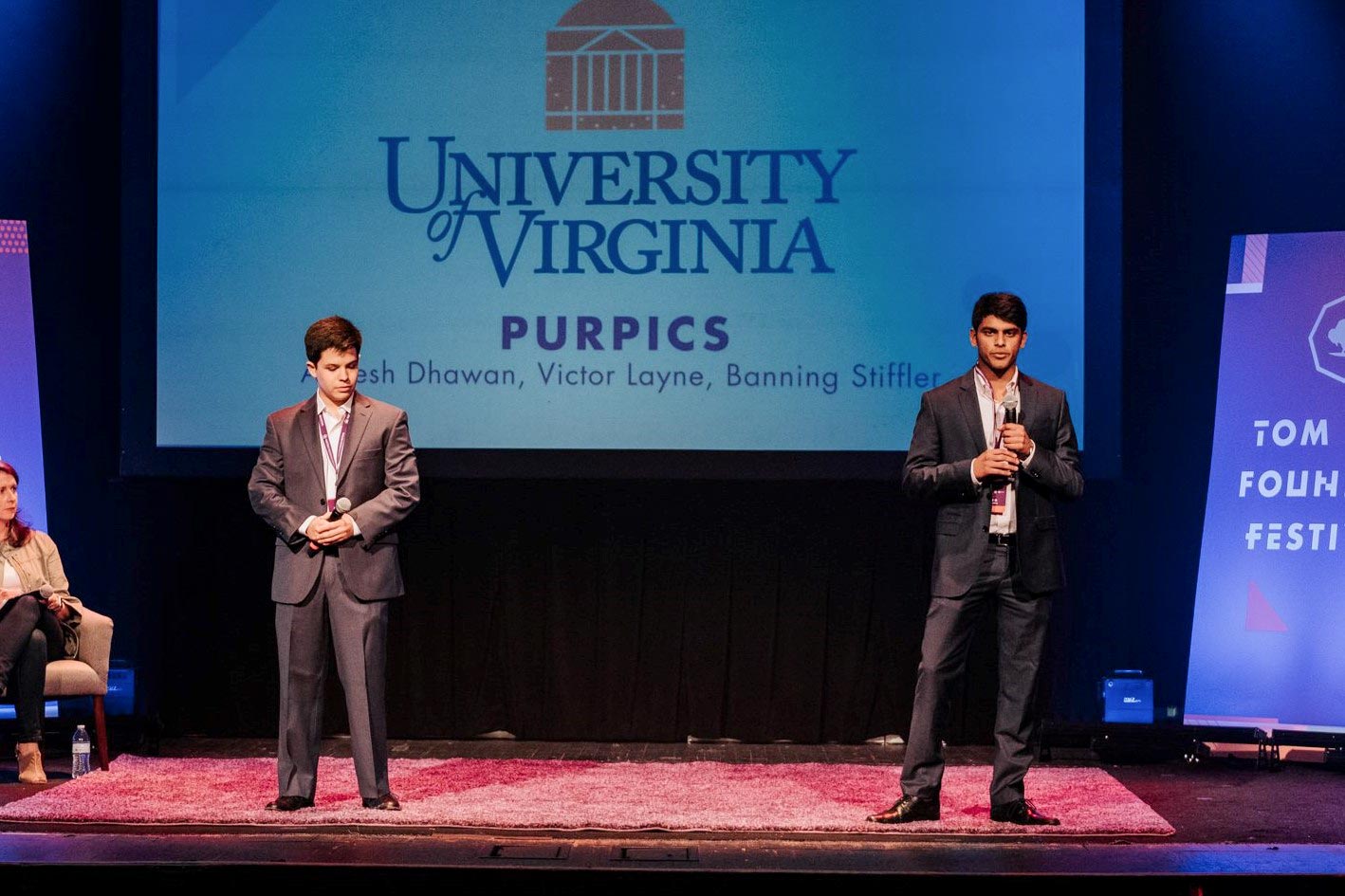
There was a practical difficulty behind the tidy proposition. PurPics needed businesses and students at the same time. A generous supply of one could do little without the other. Larger clients also meant longer sales cycles, leaving the young team working toward deals whose finish lines were difficult to see. The app could make fundraising look easy. Building the business supplied the complications.
The sensible career could wait
Dhawan had expected to pursue investment banking or consulting. In 2018, he described discovering an enjoyment of uncertainty that surprised him. A startup had interrupted the orderly career he once imagined, and he liked the interruption.
“I love taking risks a lot more than I thought I did.”
Aneesh Dhawan, 2018
At UVA, he studied economics with an entrepreneurship minor. His company’s work was bringing him into contact with the university’s startup community, including the i.Lab. In 2019, PurPics received the Kathryne Carr Award for Entrepreneurial Excellence, a $25,000 prize recognizing commercial promise and the founders’ qualities as entrepreneurs.
In January that year, Dhawan took leave from the university and moved to Austin to work on PurPics full time with McKenzie Layne. He later described a year that included adding more than 20 clients, growing to ten full-time employees, and participating in Techstars’ Farm to Fork accelerator. He thanked mentors, investors, colleagues, friends, and family, with a particular mention for his mother.
The move gives his story a useful hinge. A college venture can remain an extracurricular achievement, something polished for a future interview. Dhawan made it his job. The venture would subsequently change direction, which makes the decision more revealing: he committed to doing the work before its eventual form was settled.
From getting noticed to paying attention
The marketing business gave Dhawan experience connecting brands with everyday consumers. Its later shift toward research asked something different of that connection. Rather than having someone promote a product, a company could ask what they thought about it. A network built to help businesses speak could also help them listen.
Knit developed around asynchronous feedback: people answering questions on video, alongside conventional survey responses. That approach loosened the requirement to assemble everyone in the same room at the same time. A respondent could explain a choice in their own words. A researcher could look across many such explanations without scheduling a small touring production of focus groups.
Dhawan’s early argument was closely tied to Gen Z, his own generation. He wrote about young consumers wanting a voice and expecting brands to understand the values behind their purchases. The premise was personal as well as commercial. He was helping companies interpret the people around him, whose media habits and expectations were familiar to him.
Over time, the work broadened. In a 2024 presentation with Mars innovation researcher Cassie Jackson, Dhawan discussed combining quantitative and qualitative feedback for product research. Knit’s account described studies delivered in two to three days, against a previous vendor process of four weeks or more. That is a customer example, rather than a universal stopwatch setting. It shows the kind of scheduling problem he wanted the business to solve.
In February 2025, he appeared with Amazon researcher Sarah Kling to discuss hybrid research for its Apps & Games team. The underlying problem was familiar: a small research team faced questions from many colleagues. The enterprise setting had changed the scale of the work. It had also made the cost of waiting easier to understand.
An AI company with researchers on the payroll
Dhawan’s Knit co-founder is Raahish Kalaria, its CTO, who had previously built businesses in India. Their approach puts researchers in charge of the work, with AI assisting across survey creation, fielding, analysis, and reporting. The expertise is part of the service, as well as a feature of the software.
One hiring choice makes that position concrete. For customer success, the founders brought in Angel Mira, an experienced researcher. Someone who has done the customer’s job can recognize a concern that a product demonstration might miss. A question about a report can really be a question about methodology, or about persuading a skeptical colleague.
Colleagues have described Dhawan as combining humility with conviction. Mira has praised the way he considers several possible paths ahead. These are the observations of people working with him, and they fit a business whose proposition requires an unusual combination: confidence in automation, accompanied by a willingness to put another person’s expertise around it.
Knit’s announced Series A, led by GFT Ventures and Sound Ventures.
The funding announcement set out plans for product development, a larger research team, and international support. Dhawan also described research available in more than 50 countries, in native languages. The ambition extended beyond faster individual projects. He wanted research to become easier to use repeatedly, across more of an organization’s decisions.
The answer still needs a reader
By September 2026, Dhawan was discussing a different bottleneck: trust in what AI produces. In a conversation with Mike Linton, he explored findings from Knit’s survey of more than 150 enterprise research leaders. The concerns included decisions made from AI outputs without sufficient expert review.
His explanation emphasized business context, transparency, and judgment. A technically plausible answer can miss the purpose of the question. An average finding can conceal an interesting customer segment. A polished report can make weak reasoning look comfortably dressed. These are problems a faster first draft does little to settle on its own.
Dhawan suggested treating an AI research tool as a new employee who needs onboarding. The company’s priorities, the team’s methods, and the standards of good work have to be explained. Capability does not arrive with an understanding of the business attached. His argument gives the researcher an active job: establish the context, inspect the evidence, and decide what deserves attention.
- FrameWhat does this business need to know?
- InvestigateGather numbers and people’s explanations.
- InterpretApply context, methods, and judgment.
- TellMake the finding useful to the decision.
Storytelling runs through his writing on the subject. In 2025, he argued that research can sit unused because people cannot find it, understand it, or translate it into action. A delivered report is an incomplete measure of success. The person receiving it needs to grasp why the finding matters and what it changes.
He has also argued for empathy in automated research. That connects his later work to the original interest in causes and consumer values. In both settings, the business question depends on understanding people as more than an audience count. The tidy metric is useful. So is the untidy explanation behind it.
A small question, asked in company
There is a quieter detail from 2020 that makes Dhawan’s priorities easier to picture. Asked about his technology stack, he wanted a tool that could recreate spontaneous office conversations: the moment when an idea occurs and someone nearby helps think it through. He liked the casual question, “Hey, what do you think about this?”
For a founder building research technology, it is an apt wish. The conversation arrives before the report, before the meeting invitation, before anyone has prepared their answer. It leaves room for another person to alter the direction. His later emphasis on human interpretation gives that small exchange a larger professional setting.
Away from the product vocabulary, Dhawan’s public biographies mention travel, triathlons, and a fondness for goldendoodles. He has completed an Ironman 70.3. The last preference is perhaps the easiest to appreciate without a slide deck.
His career began with a measurable exchange between a student, a brand, and a cause. It now turns on the harder exchange between evidence and judgment. Dhawan has spent years working around people’s attention. The question that keeps becoming more interesting is what happens when someone pays it back.
Keep the conversation going
Explore Dhawan’s work, writing, and conversations.