Brandon Card’s breaking point came with a PowerPoint. In 2018, while working at Microsoft, he was assembling 95 slides of contract screenshots for an automotive customer operating across 95 countries. The technology business could discuss extraordinary futures with a straight face. Keeping track of its own agreements apparently required a slideshow.
There is a particular indignity in selling the future while spending the afternoon copying and pasting. Card had encountered the problem often enough to recognize something beyond an irritating assignment. His customers needed to understand what they had bought, what they owed and when their obligations changed. Getting those answers involved hunting through documents. Eventually, he decided to build a business around the hunt.
Today, Card is the co-founder and chief executive of Terzo. His subject is contracts, which sounds like an excellent way to empty a dinner party. His real interest is what happens to money after the signatures dry. That question has carried him from enterprise sales to an AI company, and from corporate procurement into arguments about public spending.
A linebacker, a midfielder and Harry’s Bar
Card grew up in Central New York and graduated from Syracuse University in 2010 with a bachelor’s degree in economics and finance. He played linebacker for Syracuse from 2006 to 2010, during a period that included coaches Greg Robinson and Doug Marrone. Before the cloud portfolios and contract databases, there were practices, teammates and the demands of college football.
Another Syracuse athlete would become central to the next chapter. Al Giocondi played midfield for the lacrosse team. He and Card met at Harry’s Bar and Grill in 2008. They discovered a family connection of a different sort: Card’s mother and Giocondi’s father came from the same region of Italy. A friendship formed well before there was a company to name.

That university network later supplied more than nostalgia. Former Syracuse players Rich Scanlon and Andrew Robinson became investors and advisers. Jake Flaherty joined business development. Card described the appeal in terms of trust built over years: he had watched these people develop in college and in their working lives. The familiar faces came with a history he could actually inspect.
The connection also helps explain a founder whose business revolves around relationships. A network can be an address book, or it can be a record of how people behave when something is difficult. Card’s early Terzo circle drew on the latter. The company’s Italian name adds a small family echo to a decidedly unromantic software category.
The seller who kept hearing the buyer’s complaint
Wall Street had initially appealed to Card. The 2008 financial crash changed the attraction of that route, and he turned toward software. His career began at Oracle and continued through IBM and Microsoft. Those jobs put him close to large organizations buying complicated technology, with all the organizational machinery that accompanies a major purchase.
The attraction endured. He has described his enjoyment of an industry that keeps changing and his enthusiasm for bringing products to market. He also singled out the opportunity to employ people around the world as a source of pride. His public account of entrepreneurship contains both appetites: building the product and building the organization that makes it possible.
“I made a bet on technology”
Brandon Card, 2022
From the seller’s side, Card could see an imbalance. Sales organizations had customer relationship management systems to organize their accounts. Buyers dealing with those same organizations lacked an equivalent view of their suppliers. CIOs were being asked to deliver more through outside partners, while the information needed to manage those partnerships remained awkward to assemble.
Card teamed with Giocondi, whose enterprise sales experience included IBM and Oracle. Pradeep Thangavel, an engineer from Freshworks, joined them as a third co-founder. Terzo took shape in March 2020 around vendor relationship management: give the buyer a usable view of the other side of the transaction. The proposition grew out of conversations they had already been having at work.
A conceptual view of the information Card wants business teams to connect.
The idea sounds almost impolitely obvious once stated. A buyer should know what it has agreed to buy. Yet obviousness does not make a problem small. In large organizations, responsibility passes between departments, documents multiply, and a useful answer can require cooperation from people who use entirely different systems. Terzo’s opening was in those handoffs.
The signatures were only the beginning
By November 2022, the company was describing a more specific financial problem. Budgeting teams could examine past transactions, but future commitments were already sitting in multiyear contracts. Terzo aimed to bring those two views together. The distinction matters: an expense history tells a finance team what happened; an agreement can tell it what is coming.
That month, Terzo announced a $16 million Series A led by Align Ventures, with participation from TYH Ventures, Engage Ventures and Human Capital. Ryan Breslow and Daniel Saks also joined as angel investors. The announcement reported more than $20 billion in contract value managed across customers. That figure described agreements on the platform, rather than money earned by the company.
Funding announced for Terzo’s next stage of contract intelligence.
The company described a combination of automation and human oversight, with integrations into the systems enterprises already used. Card’s original irritation had become a product question with consequences: how do you turn the language of an agreement into data a finance team can use? Copying the text is the beginning of the assignment. Understanding the commitment is the harder part.
A contract has an unusually successful double life. It can be perfectly accessible to the department that negotiated it and practically invisible to the colleague making a forecast. Nobody has to lose the document for the organization to lose its meaning. Card’s business rests on making that meaning available after the ceremonial moment of signing has passed.
He chose the long queue
Card’s route to customers was deliberately demanding. He pursued large enterprises from the outset, despite warnings about slow sales cycles and the difficulty of winning trust without an established brand. His explanation was experience. These were the customers he and his co-founders understood, and these were the organizations where they believed the problem warranted the effort.
He also insists on charging for proofs of concept. His reasoning is behavioral: payment encourages the customer to assign people, attend meetings and treat a trial as a real project. In his telling, even a modest transaction changes the level of attention. An enterprise may have ample money and very little spare concentration. Winning the latter is part of the sale.
He has talked about finding internal advocates prepared to drive change and hiring people able to think over longer periods. These are revealing preoccupations for an AI founder. The technology must work, but someone still has to navigate the customer’s organization. A model cannot attend every meeting on its own behalf, however attractively the demonstration has been staged.
The choice gives his career a certain continuity. He spent years learning how large companies buy, then built a company that depends on that knowledge. The training was expensive in the currency of time. It also gave him a reason to hold his ground when advice pointed toward smaller customers and quicker wins.
A filing cabinet reaches the finance office
In his 2026 conversation with Daniel Robbins, promoted by Terzo as a Bloomberg Television appearance, Card returned to the gap between legal ownership of contracts and financial visibility. His argument treats the agreement as an asset containing commitments that matter to the business. The filing cabinet, physical or digital, is an inadequate final destination.
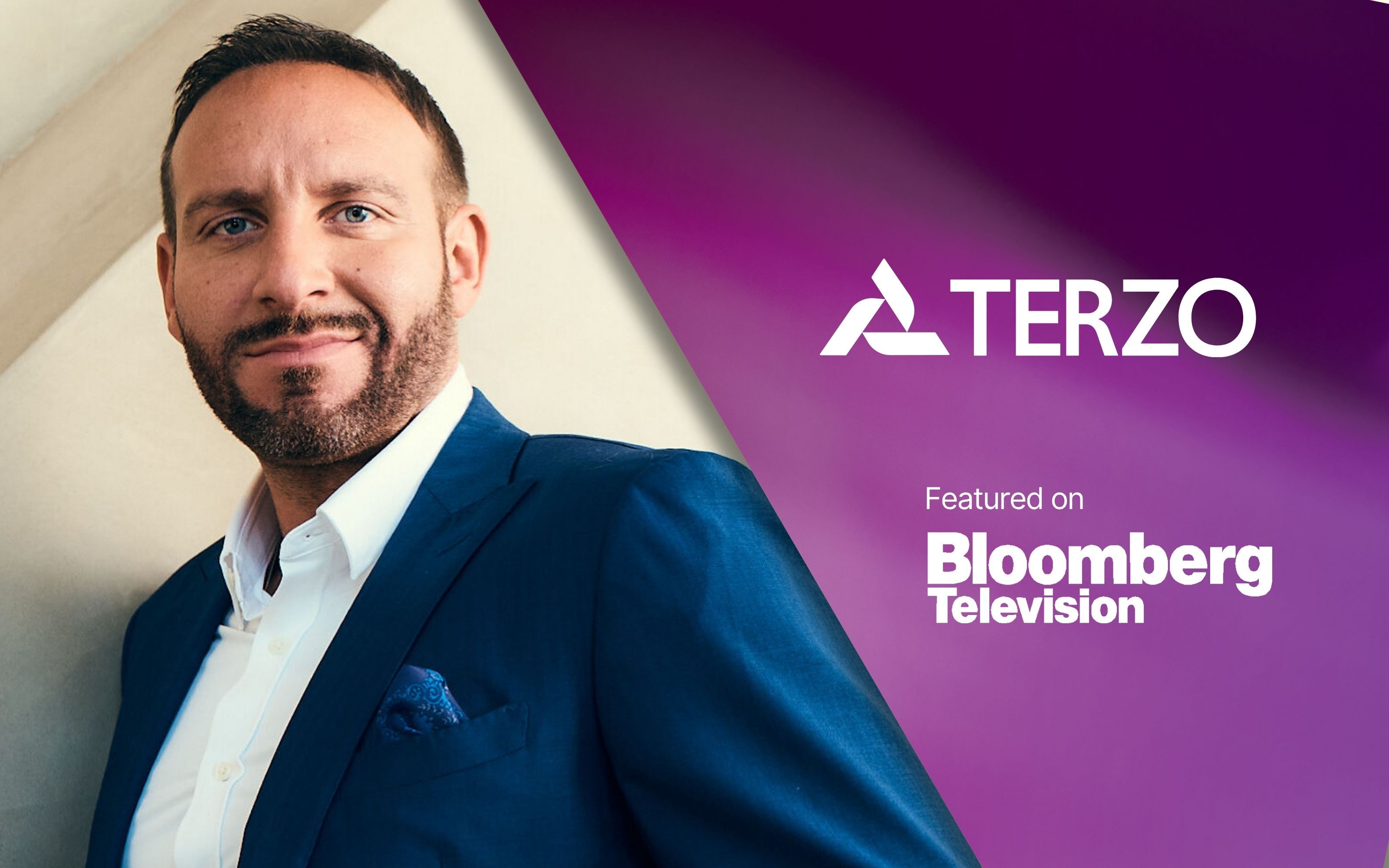
Terzo’s June account of that interview said the company was preparing for a Series B. Card’s ambition extends toward a broader role in enterprise finance, where contract intelligence feeds decisions about spending and revenue. His forecast for the business is a founder’s aspiration. The practical proposition remains easier to picture: let teams see the financial promises they have already made.
His current leadership biography describes Terzo connecting contracts with invoices, purchase orders and enterprise spending data. The purpose is to compare what was agreed with what actually occurred. That is a useful way to understand his progression from vendor management. The relationship remains important, but the comparison gives the relationship a ledger.
The next buyer has a public budget
In June 2026, Terzo announced that former U.S. Ambassador to NATO Douglas Lute had joined its board alongside Card and Align Ventures’ Neel Chary. The company tied the appointment to an expanding public-sector focus. Corporate obligations and government obligations differ in many respects, but both create the problem Card keeps returning to: commitments distributed across documents and systems.
By September, Card and Lute were appearing together in a company-published conversation about financial visibility at the Pentagon. For Card, the expansion carries his familiar sales argument into a different institutional setting. Before people can question an expense, renegotiate a term or check a delivery, they need a dependable account of what was promised.
There is something pleasingly stubborn about the through-line. A young man drawn toward finance found his working education in software sales, then returned to financial questions through the least glamorous entrance available. Contracts rarely receive applause. They do, however, contain promises with prices attached, and Card has spent years insisting that someone should keep reading after the signature page.
The 95-slide presentation offers a fitting measure of the distance traveled. It began as a task one employee had to finish. Card made it a question large organizations might pay to answer. Somewhere between the screenshot and the spreadsheet, he found his subject. He appears quite content to keep pressing it.