Recruiters are supposed to recognize patterns in unruly lives. Brandon Brock has made the exercise difficult by living one. His working history includes Facebook in its early years, two social apps, a video-chat startup, a drone that carried piñatas over Oslo, a documentary about a sailor, a natural-wine bar in northern Idaho, a recording studio, Coinbase, a recruiting agency and, now, Ambience Healthcare. There is no tidy industry ladder here. There is, however, a remarkably consistent human impulse: build the room, invite the right people and see what they make together.
On his own site, Brock uses the phrase “professional friend.” It sounds like a joke tossed across a crowded table. It is also a useful job description. He says he is not one for silence, loves social activity and is always learning. The evidence is scattered through a career that treats conviviality less as a personality trait than as operating infrastructure.
Today he is a Staff Recruiter at Ambience Healthcare, helping build teams behind software for clinical documentation, coding and administrative work. He also co-founded Ponto Talent, a boutique recruiting firm for early-stage technology companies. The current titles are sober. The route to them contains a disco ball, a Bernese mountain dog and airborne party favors.
Culture before it had a department
Brock was born in Menlo Park, an only child, and grew up within the weather system of the Bay Area. He attended Menlo-Atherton High School and graduated from Sonoma State University in 2005. After a brief marketing role at analytics consultancy Semphonic, he joined Facebook in April 2007. The company was young enough that “culture” was not wallpaper or an annual memo. It was being made in real time.
He stayed until May 2011, moving across culture, marketing and advertising work. Those four years sit near the beginning of his adult career, but they supplied a lasting vocabulary: products can create social behavior; companies are groups before they are brands; a gathering needs an organizing idea. When he left, he did not abandon technology so much as begin testing those ideas in less predictable forms.
Player's View, which Brock founded and managed from 2012 to 2014, gathered the social posts of athletes and teams so fans could discover and discuss them together. Challenge Accepted turned everyday contests among friends into shareable events. At Chime, he led marketing, growth and recruiting for an asynchronous video app built to make distant friends and family feel close. Raya later acquired Chime's small team.
The products differ, but each begins with the same question: what small piece of design will make contact easier? Brock's later move into recruiting feels less like a pivot when viewed from there. A candidate search is also a designed encounter. It has an audience, a story and a moment when curiosity either catches or does not.
Chief executive of airborne candy
In 2016, the Norwegian studio Bakken & Bæck combined two resources it had in suspicious abundance: drones and roughly a thousand piñatas. The resulting iPhone app let people in Oslo order a piñata to be delivered by air. The studio asked Brock, a friend and former Facebook marketer, to serve as Flying Piñata's public-facing chief executive.
At the launch, more than 250 people assembled at the studio. Brock took the stage to speak grandly about professionalism and synergy. Then a drone arrived at the roof terrace with the merchandise. It was both a functioning experiment and an elaborate corporate gag. The team had rebuilt a crashed drone overnight, warmed its parts with a hair dryer in the Norwegian cold and learned plenty while appearing not to take itself seriously.
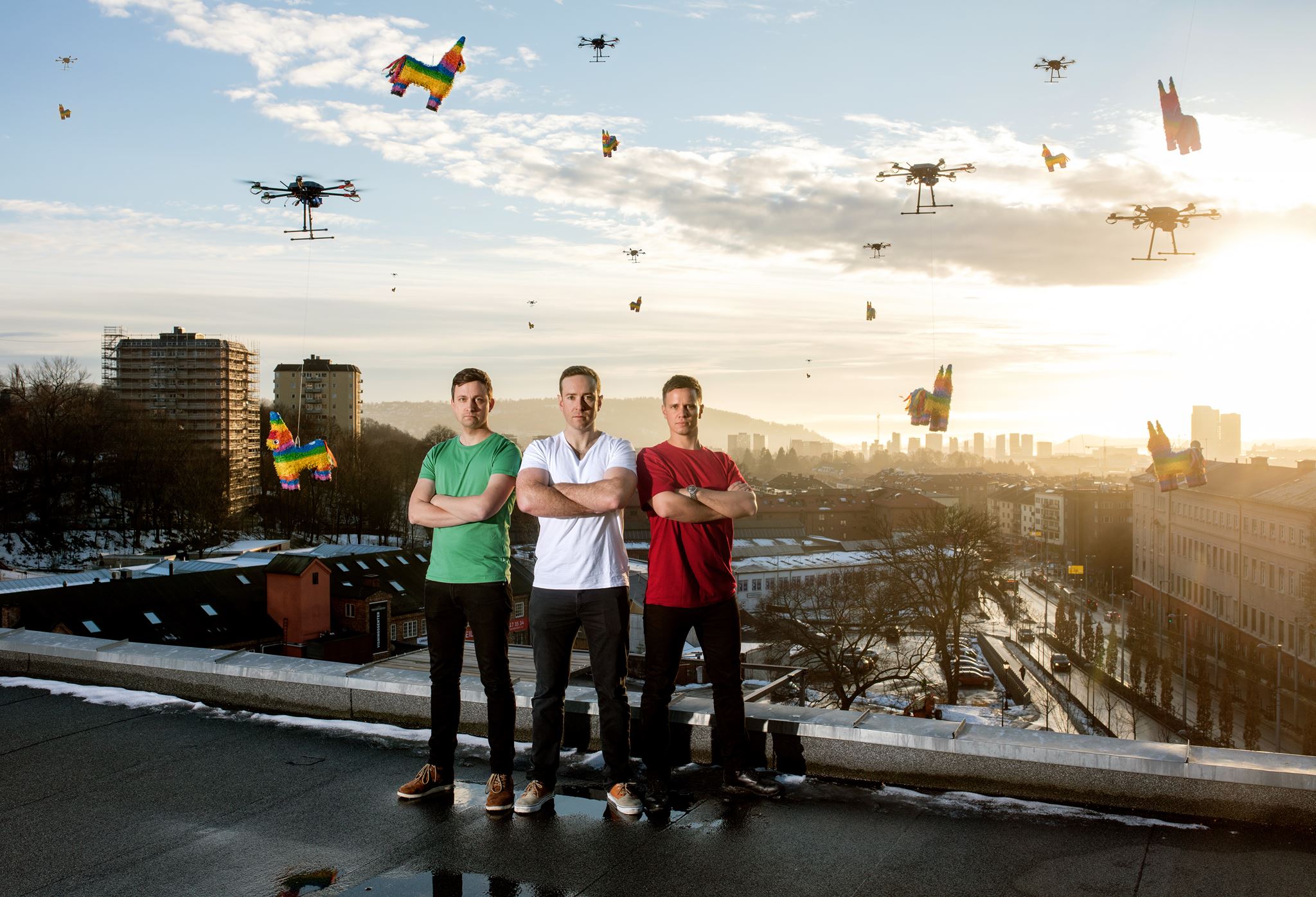
The episode reveals something sturdier than whimsy. Brock is comfortable being the hinge between a strange idea and an audience. He can inhabit the theater of a launch without mistaking theater for the product. The joke lands because the delivery works. That distinction travels well, from marketing to hospitality to recruiting.
A former gun shop becomes a conversation
Travel changed Brock's sense of fit. After moving to Bondi Beach in 2011, he began collecting places: Tokyo, Hanoi, Barcelona, Oslo, Tel Aviv, the Canadian Rockies, Kauai and others. He liked settings with a distinct feeling, the sort that make a visit seem unrepeatable. Eventually he brought that collector's eye to Sandpoint, Idaho.
There, at the busy corner of Boyer Avenue, Pine Street and Highway 2, a former firearms training and retail shop became The Longshot. Brock opened it on September 7, 2019, after a months-long renovation. The all-day café, natural-wine bar and live-music space mixed midcentury modern and Scandinavian cues with touches drawn from bigger cities. Yet the central design decision was social, not decorative. He created small areas that encouraged actual conversation rather than rows of bowed heads and open laptops.
The menu moved from coffee and avocado toast to charcuterie, beer and thoughtfully chosen wine. A disco ball hung overhead. Lucy, Brock's dog, could sit in the middle of the room with the serene authority of someone who understood the floor plan. The Longshot was a hospitality business, certainly. It was also Brock's recurring thesis made physical: atmosphere can alter the probability that people will speak.
He sold the business in 2022. The attachment outlasted the transaction. In 2023, while traveling through southern France and northern Spain with his partner, Jacey Lawson, he found himself inspired by a bar in Toulouse. The service was casual, fresh and carefully done. They began sketching a pop-up on their barstools.
That November, they brought Fresh to Sandpoint, pouring a short flight of natural wines and serving a charcuterie spread at Bluebird Bakery. Brock described the values as fun, care, sustainability and intention. He also returned to the part he remembered most from The Longshot: relationships with the customers, collaborators and friends around it.
A room earns affection through dozens of modest decisions. So does a hiring process.
Film, restaurants and the pleasure of making
Brock's side projects are not merely side hustles arranged for maximum professional usefulness. Some are closer to declarations of taste. He was a co-executive producer of the 2017 documentary Coyote: The Mike Plant Story, about the American solo sailor. The film's festival run included the Twin Cities Film Festival audience award for nonfiction. It is a fitting project for someone drawn to exploration, risk and lives that resist a standard map.
He also invested in Wake, a design-feedback tool later acquired by InVision, and in Brooklyn restaurants The Four Horsemen and i Cavallini. The Four Horsemen later earned a Michelin star and a James Beard Award for its wine program. In North Idaho, Johnny Long Station extends the theme in another direction: a destination recording studio inside a 3,000-square-foot cabin on seven rural acres, built as a place where musicians can make honest work.
Then there is metal. At Makerpoint Studios in Sandpoint, Brock has experimented with fabrication and built a custom fire pit for his cabin. “What can I say, I love doing this stuff,” he writes. It may be the least strategic line on his site, which is why it explains so much. The projects accumulate because curiosity needs somewhere to go.
The recruiter as host
After operating The Longshot, Brock joined Coinbase's core recruiting team, sourcing hires across sales and general and administrative functions. A former colleague described the value of his background in sales, marketing, operations and business ownership: he could translate that range into sourcing for institutional sales and the people team. It was the untidy résumé doing useful work.
Ponto Talent made the idea explicit. Brock co-founded the boutique agency to work with early-stage technology companies on the hires that shape their beginnings. Its client list on his site includes Defy VC, Prepared, Compa, Funcoach, Almanax, Ambience and Gamma. The promise is tailored recruiting, but the deeper advantage is firsthand empathy. Brock knows what it is to stare at an unfinished product, an empty room or an odd plan and ask another person to see what it might become.
At Ambience Healthcare, that experience now meets a narrower mission. Brock says he helps build the teams developing and scaling AI products intended to reduce administrative work around care. The companies and tools are technically complex. The recruiting problem remains stubbornly human: find people who can do the work, tell the truth about the setting and create enough mutual confidence for a consequential move.
A career like Brock's tempts a clever label: polymath, serial founder, renaissance operator. Those labels polish away the useful mess. He has simply kept following an aptitude that appears in many costumes. At Facebook, it was culture. In consumer apps, it was participation. At The Longshot, it was hospitality. In recruiting, it is fit.
The rooms have grown more virtual and the stakes have changed. Still, somebody has to decide how the invitation sounds. Somebody has to notice who is missing. Somebody has to make a stranger feel that the conversation could be worth their evening, or perhaps the next few years of their working life. Brandon Brock has been practicing that part all along.