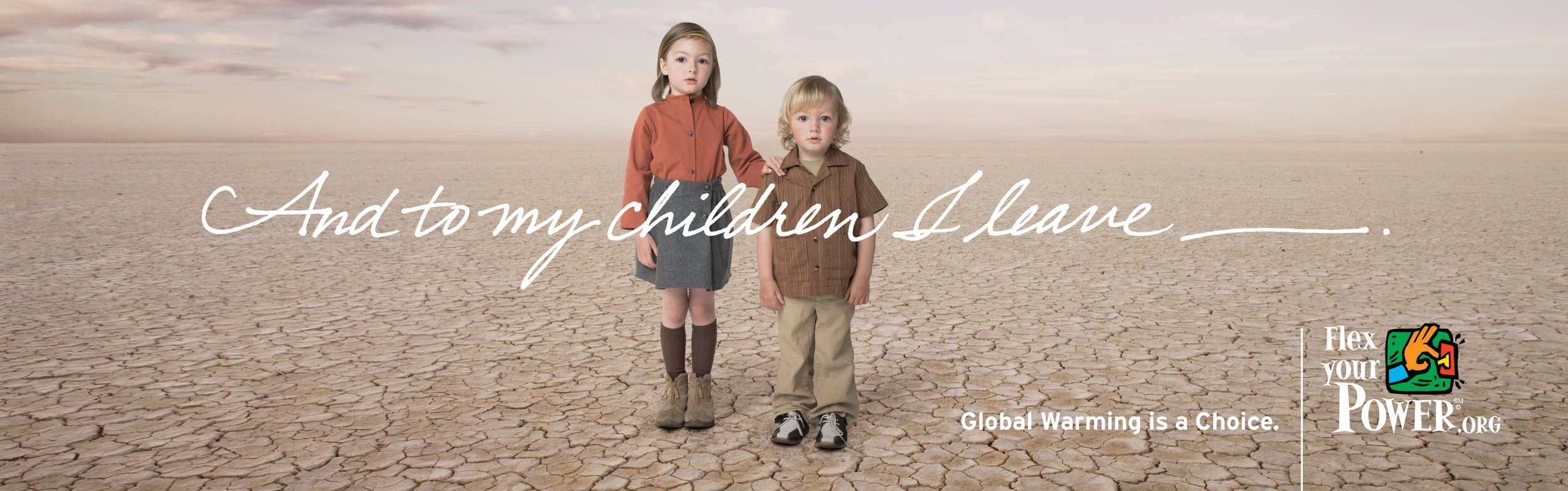
Two children stand on cracked earth. Across the image, a sentence begins like a will: “And to my children, I leave”. The landscape finishes the thought. An energy-conservation message has become an uncomfortable family portrait. Before anyone explains electricity demand or asks for a change in habits, the picture gives the viewer a reason to care.
The outdoor work, for California’s Flex Your Power program, carries the credits of creative directors David Swope and Jef Loeb, photographer Curtis Myers and agency Brainchild Creative. Other executions place children in floodwater and a diminished snow landscape. Read together, the images offer a useful introduction to the agency: find a human relationship inside the complicated subject, then give it a form people can grasp.
A room at home, a team on demand
In September 2001, a San Francisco Chronicle report found Loeb and his wife and business partner, Deborah Notestein Loeb, running Brainchild from a room in their home. Work materials were spreading into the living room. Their organizing idea was to assemble creative teams sized to each assignment. The wider advertising industry was shedding jobs; experienced people were becoming available outside conventional agencies.
There is an appealing reversal here. Ordinarily, a client evaluates the organization an agency has already built. Brainchild’s proposition makes the assignment part of the organization’s design. Which skills does this particular problem require? Who needs to work together? A public-issue film and a corporate rebrand might share a creative lead while asking for very different collaborators.
Its current service offering includes branding, advertising, design, content, production and media. Research comes before a tailored creative and media exploration. The company calls on a wider talent network to deliver the work. For a buyer, the attraction is access to several disciplines through one agency relationship. The practical question is whether the proposed people and process fit the brief.
“Clarity is the new currency.”
Brainchild Creative’s positioning line
Thirty seconds takes more than a writer
The television side of Flex Your Power makes the collaboration tangible. A 2007 production announcement describes four thirty-second spots, directed by the duo Riess/Hill through Gartner, with editorial and visual effects by Phoenix Editorial & Designs. Brainchild and the directors chose people with limited acting experience and relatively loose dialogue to pursue believable performances.
That decision moved responsibility into the edit. Bob Frisk had to shape the material into coherent stories. The campaign used children beside television sets carrying messages from adults about the damaged world they were leaving behind. Phoenix also created a computer-generated jumbotron for one shot. Simplicity at the receiving end required coordination among several crafts at the making end.
The 2007 television campaign turned one central idea into several short executions.
For someone commissioning advertising, that is the detail to steal. Ask where the idea becomes vulnerable during production. A loose performance might need an especially good editor. An image that looks obvious in a presentation might need careful effects work. Choosing a collaborator is a creative decision because it changes what can survive the journey from concept to finished piece.
Drug information, power plants and peewee hockey
Brainchild’s portfolio includes Hearst’s FDB and FDB Vela, Blue Shield of California, NextEra Energy, PG&E, Chevron, Recology and Yale New Haven Health. It also includes the California State Senate, Colorado River Indian Tribes, XL Construction and Minnetonka Peewee Hockey. The hockey entry gives an otherwise institution-heavy list a welcome pair of skates.
The company describes an international rebrand for FDB and work for other agencies on brands including Land Rover, Health Net and Ubisoft. That distinction matters: a portfolio relationship can mean direct agency responsibility or a contribution to someone else’s team. Brainchild occupies both positions. Its work is sold to organizations that need marketing expertise, including fellow agencies.
Look across those assignments and an editorial interpretation emerges. Many involve explaining an organization or an issue that takes more than a product photograph to understand. A healthcare brand needs a credible promise. A public-affairs campaign needs a position people can follow. The agency’s claimed specialty in reducing complexity fits that territory, although each campaign still has to earn attention on its own.
- 01Audience problem
- 02Specialist team
- 03Creative idea
- 04Production + media
A reading of the agency’s stated approach, not a performance chart.
The relationship beneath the roster
Flexible staffing still needs a durable center. In advice published by The Drum, Loeb brought the discussion of first hires back to the person sharing the business. His partner was also his spouse. He emphasized agreeing on core values, what success means and the balance between creative work and client service. He also urged founders to think about an eventual exit.
“Make damned sure you’re both starting on the same page,” he said. It is unusually domestic advice for an industry that enjoys talking about disruption. Yet it fits the model. The people joining a project need a clear decision-making relationship to join. If the core partners disagree about what they owe the client, adding talented specialists will give the disagreement more participants.
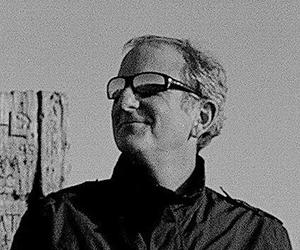
The company’s personality has a less solemn corner, too. Its LinkedIn specialties include Martini shaking. On The Reductionist, Loeb calls the agency’s compact self-promotional ads “fortune cookies.” The joke is also a description of format: a short piece intended to leave an idea behind. His writing gives prospective clients a sample of the sensibility attached to the services.
A power plant reaches the radio finals
The energy thread continues in the 2025 Radio Mercury Awards finalist list. “See the Light Diablo Canyon,” credited to Brainchild for Diablo Canyon Power Plant, appears in the competition. The credits name Loeb as writer, Erica Kozocas as producer, Loeb and Bob Brihn as creative directors, Frank Verderosa as engineer and Jim Conroy as talent.
Those credits provide another small working diagram of the agency. Writing, direction, production, engineering and performance are distinct contributions. A finalist placement recognizes the submitted creative work; it should be read as craft recognition. The useful continuity is the subject matter and the team behind its expression, reaching from conservation advertising to a power-plant assignment.
Bring a problem you can describe
Brainchild sells professional services, with people assembling the strategy and execution around a client assignment. The sensible buying unit is therefore a defined scope. A brand-positioning exercise, a film production and a media campaign create different demands. In a proposal, separate the strategic work, production requirements and distribution spend so that everyone knows what the budget is meant to achieve.
For a prospective client, a useful opening brief would name the audience, the belief or behavior that needs to change, the evidence available, the deadline and who can approve the work. Ask which specialists will participate and who remains accountable through revisions. These are practical implications of a project-built model, rather than a published Brainchild checklist.
The approach makes most sense when a problem benefits from several kinds of expertise and someone can make clear decisions. It becomes harder to use when the brief keeps changing, approvals have no owner or the organization cannot supply credible evidence for its message. An elegant sentence cannot settle an unresolved business decision. The work begins when the client can say what, exactly, needs to become clearer.