At seven, Brad Sugars found a market for his Christmas presents. The buyers were his brothers. It is a pleasingly economical origin story: merchandise supplied by someone else, customers already acquainted with the seller, and no need to rent premises. Family Christmas, with a small commercial interruption.
The anecdote offers an early glimpse of his commercial instincts. Before the books, seminars, and coaching franchises, there was a child interested in getting a transaction to happen. The adult Sugars would spend decades thinking about a harder question: how do you build something that keeps working after you stop doing every job yourself?
That question connects the Australian entrepreneur’s career more neatly than any list of ventures. He founded ActionCOACH in Brisbane in 1993. The business grew by teaching other people to coach, then by franchising. His own company had to solve the problem he was asking clients to confront: a founder has a finite supply of hours, however persuasive the founder happens to be.
The customer was his brother
As a teenager, Sugars saved his allowance to attend a seminar by Jim Rohn. The purchase became a recurring reference point in his account of his life. He had bought access to someone else’s experience, and the experience stayed with him. Years later, teaching would become the product he sold.
There is something revealing about the direction of that early ambition. A seminar ticket promises no possession to carry home. Its value depends on what the listener does afterwards. Sugars’s later work returns repeatedly to that awkward interval between understanding an idea and putting it into practice. An audience can nod enthusiastically and still arrive at work on Monday to do everything exactly as before.
Sugars attended Queensland University of Technology from 1989 to 1993. During university he ran small businesses, including a self-service photocopy shop. The detail suits the career that followed: practical enterprise alongside formal study, with a service that other people could understand and use. Business was already something to operate, as well as something to learn about.
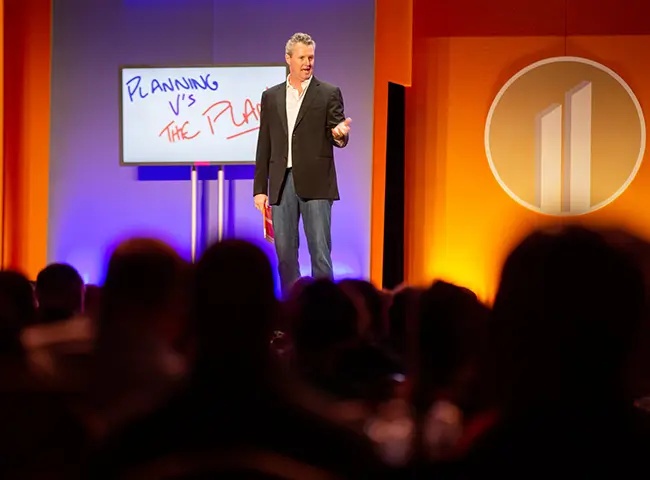
When the teacher runs out of hours
Speaking brought Sugars requests for more help. Owners wanted advice on sales, marketing, teams, and the machinery of running a company. A talk could introduce the ideas; applying them required repeated attention. His business developed around that continuing relationship, with coaching sessions that brought an owner back to decisions, commitments, and results.
The distinction matters to the story of his growth. When the product depends on one person explaining things, success creates a queue. A fuller diary can look like progress right up to the point when there is nowhere left to put another appointment. Sugars began training coaches to deliver the work. In 1997, ActionCOACH awarded its first franchise.
Franchising gave local owners a part in carrying the model into their communities. It also required the teaching to become transferable. Someone besides Sugars had to understand the approach, use it with clients, and build a business around it. A method that lives entirely inside its founder’s head has a rather restrictive travel policy.
ActionCOACH now describes a presence in more than 80 countries. The geographical spread is the visible result. The operating choice beneath it is more interesting: Sugars expanded a service built around personal guidance by making room for other people to provide that guidance. His own response to demand became an example of the lesson he was selling.
Five dials, rather than one wish
Listen to Sugars for long and the conversation tends to arrive at numbers. In his teaching, vague reports of being busy give way to questions about leads, conversion, repeat transactions, average sale, and margin. These are separate parts of a business. Treating growth as one large wish makes it harder to see which part needs attention.
His five-part formula is particularly suited to a whiteboard. Each measure affects the next stage of the calculation, so modest improvements can multiply. Raise all five by 10 percent in a simplified model and the combined factor is 1.1 to the fifth power, or about 1.61. The illustration explains why a conversation about profit need not begin with buying more advertising.
The arithmetic is easy enough. Finding the improvement might involve changing a sales conversation, giving customers a reason to return, or examining the money left after a sale. A neat formula still leaves a business owner with work to do. Its value is in giving that work a place to start and a result to measure.
This preference for visible measures also explains his approach to accountability. A coaching meeting has to come back to what someone agreed to do and what happened afterwards. An owner’s confidence may rise after an encouraging conversation. The business still needs a better process, a completed action, or an observable change. Optimism is welcome; it should bring its working papers.
A shelf full of instructions
Sugars’s books carry the same practical preoccupation. Titles such as Instant Cashflow, Instant Team Building, and The Business Coach tell the reader which difficulty is on the agenda. The titles have little interest in mystery. Someone looking for a useful business book usually has a sufficiently mysterious afternoon already.
In 2019 he and Monte Wyatt published Pulling Profits Out of a Hat. Its subtitle, Adding Zeros to Your Company Isn’t Magic, makes the premise explicit. The book organizes growth around five disciplines: strategy, business development, people, execution, and mission. It moves the discussion beyond the founder’s individual ability to sell or solve problems.
The word “disciplines” is doing work here. It describes things that require continuing attention. A company cannot settle its people decisions once, file a strategy away, and assume the work is complete. Growth asks the organization to keep adapting. Sugars’s contribution is to put those recurring responsibilities into a form owners and their teams can discuss together.
Books also solve a distribution problem. An explanation on a page can travel without its author. So can a recorded conversation. Seminars, publishing, and podcasts give Sugars different ways to teach beyond whichever room he happens to occupy. Across those formats, the recurring subject is the machinery that allows useful work to continue without one person supplying every answer.
“You don’t grow your business; your people do.”
Brad Sugars
The calendar gets a vote
His definition of success has long included the ability to choose his company and his surroundings. He has described it as “being free to do what I want, where I want, with whom I want”. He also explained that his attention had shifted over time toward family, friends, and the life the business could make possible.
Sugars is a father of five. That fact gives his argument for owner independence an ordinary, recognizable purpose. There are other people to spend time with. A company can produce an impressive number and still monopolize the person who built it. His version of the ambition leaves room for being elsewhere without requiring the whole operation to wait.
Las Vegas is his base. In 2019 he recalled becoming a United States citizen and volunteering to speak at the naturalization ceremony. His children, he said, had anticipated that their father would volunteer. The anecdote supplies a family’s concise assessment of a professional speaker: offer him a room and an occasion, and the odds are fairly good.
The smaller details are useful company too. He follows the Vegas Golden Knights and enjoys a Greggs sausage roll. An international business education can evidently coexist with a fairly direct answer to the question of lunch. These are modest details, but they help bring a stage-and-seminar career back to human scale.
Still asking who can leave the room
The current work keeps returning to the same tension. On October 12, 2026, Sugars published an article about founder freedom: revenue can increase while the founder becomes less free. More employees and more opportunities can generate more decisions for the same desk. Independence has to be designed into the company rather than expected as a reward for its size.
A day earlier, his writing about a conversation with Jeb Blount examined the systems required to reach $100 million. The number is large; the questions underneath are familiar. Can the market support the ambition? Can the management team carry more responsibility? Can the organization produce results without routing everything through its founder?
He now hosts The $100M Entrepreneur Podcast, extending those discussions through interviews and teaching. The title announces an appetite for scale. Alongside it sits ActionCOACH’s stated ambition to have a coach in every business. Both suggest plenty of unfinished work for someone whose central message involves becoming less necessary to the daily operation.
That is the useful tension in Brad Sugars’s story. The child selling presents became an adult teaching people how to build companies, then had to teach other people to carry his own work further. The next sale can increase a business’s income. The next capable colleague can change what its owner is free to do on Tuesday afternoon.