Brad Simpson had spent more than forty years at work when he announced a new qualification. The Marsh executive had completed a master’s degree in Risk, Crisis and Resilience Management at the University of Portsmouth. The order of events is the interesting part. Here was an established adviser choosing to become a student, with all the awkwardness that the word can bring to someone accustomed to having answers.
A career usually arrives on the page as an orderly procession: education, employment, promotion, responsibility. Simpson’s offers a small correction to the typography. Education can turn up again, several paragraphs later. It can interrupt a settled account of who a professional has become. In his case, the interruption belongs to the same subject that occupies his working life: how to think and act when the next development is uncertain.
The qualification at the other end
The certificate he shared carries his full name, Bradley James Simpson, an award with Merit and the date 4 March 2026. He published the news nine days later. He had entered employment straight from school at eighteen; at fifty-seven, he decided to take on formal study. He described the challenge of fitting it around work and life.
There is a pleasing lack of ceremony in that sequence. An old intention becomes a practical undertaking. A practical undertaking becomes something finished. The certificate is an unusually compact object for such a long personal arc. Institutions put a date on an award. The person receiving it brings a much longer calendar.
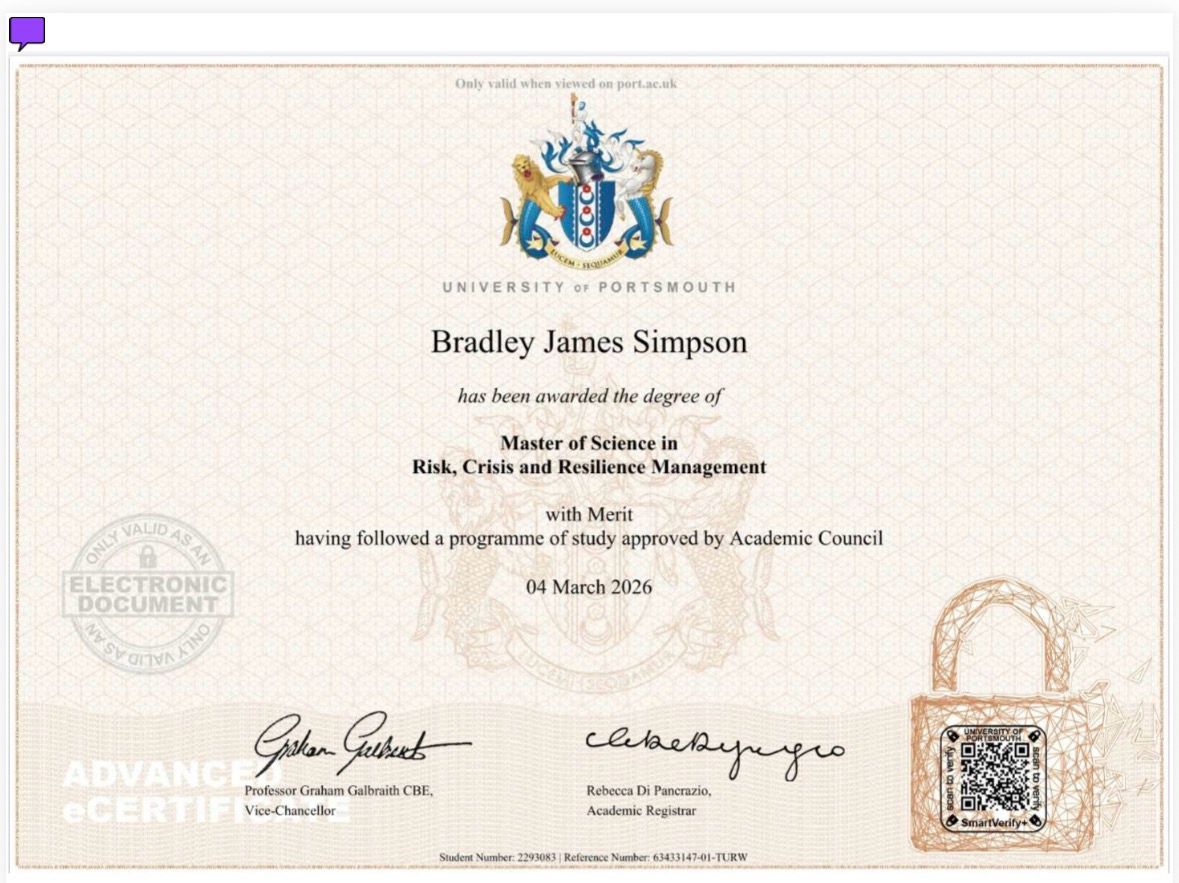
For readers accustomed to treating a qualification as permission to begin, this is an appealing reversal of sequence. The working life was already well under way. The decision was to make space for something else within it. Seniority, it seems, need not exempt a person from homework.
A name in the working papers
Simpson’s professional trail includes a decidedly unromantic artifact: a conference programme. In 2014, Marsh listed him as a Senior Vice President at its National Oil Companies Conference in Dubai. The event ran from 18 to 20 March at the InterContinental in Festival City, under the theme of managing the next frontier of risk.
A programme captures a career differently from a celebratory biography. It fixes a person among colleagues, clients and questions requiring attention at a particular moment. The 2016 programme again carried his name and senior vice president title. Those entries establish continuity without pretending that a job title tells the whole story of a working day.
They also place him in the regional business conversation well before his more recent public writing. The setting matters. An oil-company risk discussion has to make room for physical assets, financial decisions and the consequences of interruption. Even before a policy is discussed, there is the difficulty of agreeing what deserves attention. A conference can assemble the people. Understanding still requires work.
The deadline that returns every year
By 2020, Marsh publications identified Simpson as Risk Management Segment Leader for the Middle East and North Africa. One named him as the regional contact for guidance on insurance renewals in a challenging market. Its practical concerns included programme structure, the range of insurers approached and the participation of senior leaders in negotiations.
Renewal is a wonderfully modest word for a consequential decision. It suggests that something familiar will simply continue. Yet a company may have changed since its last agreement, and an insurer may have changed its appetite. The calendar supplies a deadline; it does little of the thinking.
The guidance made room for the business to explain its circumstances directly. Numbers require context. A company’s description of itself has to survive the questions of somebody being asked to accept its risk. That is an exchange between people, even when it begins with a great deal of paperwork.
Simpson’s place in that material connects regional leadership with a recurring client problem. Before the grand language of resilience comes the narrower question of what a business needs, how clearly it can explain that need and what arrangements it can secure.
When several problems arrive together
In January 2023, Simpson commented publicly on the economic concerns of UAE executives. His focus included the combination of inflation, debt and supply-chain pressures. The point was their convergence. A company could face several demands on its resources at once, with each making the others harder to manage.
Consider the structure of that problem, rather than any particular company. A higher input cost can change a budget. A delayed delivery can change a schedule. A financing decision can change how long a business can tolerate either. These are illustrative connections, but they explain why a list of separate concerns may leave a decision-maker with an incomplete picture.
This is where the profession becomes interesting to people who never expect to buy a complex insurance programme. A good question about risk asks how one difficulty travels. Where does it go next? Who feels its effects? Which assumption becomes less reliable? The answers can cross the organizational boundaries that made the first problem look manageable.
The adviser’s challenge is to give those connections a form that people can discuss before circumstances make the discussion urgent.
A regional view, with differences intact
Simpson’s July 2023 article on emerging risks examined views gathered from Middle Eastern risk professionals and executives. The cost of living stood high among short-term concerns. The article also distinguished responses across Bahrain, Oman, Qatar and the UAE rather than treating the region as a single voice.
Its wider argument connected preparation with shared responsibility, organizational strategy and continued assessment. The useful element is the insistence on returning to a question. A decision can be reasonable when made and still need another look as circumstances change.
The questions keep moving
- NoticeWhat has changed?
- ConnectWhere could it travel?
- DecideWho can act?
- RevisitDoes the answer still fit?
That gives a risk conversation a different rhythm from an annual form. The form has a completion date. The business continues afterward. Customers change their behavior, contracts change their obligations and plans encounter circumstances their authors did not choose. A useful answer has to remain available for revision.
At the table in Dubai
The agenda for Marsh’s Multinational Risk Forum in November 2024 listed Simpson as MENA Risk Management Leader and Managing Director. He and Bharat Kansal were named for the panel discussion with risk managers and experts. The panel included Meera Shah of Emirates Global Aluminum, Brenda Foster of Kerzner International and Norbert Bonnet of Sunset Hospitality.
The programme ranged across climate and natural catastrophes, political risk, and regulatory, contractual and tax questions. Its breadth explains something about the setting in which a regional adviser works. A multinational business can require several kinds of expertise in the same conversation.
An agenda is a plan, so it should not be mistaken for a transcript. Still, the proposed gathering has a revealing shape. Business representatives sit alongside specialists, bringing questions from different operating environments. A useful panel gives those differences enough room to become visible. Agreement is easier to announce than to make meaningful; the interesting work begins when a familiar answer meets a detail it does not quite cover.
From a forum to a workshop
An attendee’s account of the 2025 Qatar Risk Forum recorded Simpson’s closing remarks around scenario planning, dependencies, the connection between risk and strategy, and authority during a crisis. A separate public account of a client workshop in Jeddah identified him as IMEA Risk Management Practice Leader and Deputy CEO of Marsh UAE, discussing strategic account planning.
Those are different rooms and different tasks. The closing speaker has to leave an audience with something usable. A planning workshop has to make the conversation specific enough for people to work with afterward. Both settings make an adviser’s role easier to understand than a string of industry nouns does.
There is also a test hiding inside the word planning. Could another person pick up the result and know what to do? Could they explain why? A plan becomes more useful when its meaning survives the absence of the person who wrote it. That is a demanding standard for any professional document, however handsome its cover.
Room for another question
Read together, these episodes show a career spent around consequential conversations: a renewal, a regional risk discussion, a multinational panel, a client planning session. The later qualification adds a personal decision to that professional record. Simpson chose to submit some of his own understanding to a formal course of study.
“learning truly never stops”
Brad Simpson, March 2026
The interest lies in the choice itself. Experience gives an adviser material to draw on. It can also make an answer feel finished before a fresh question has been considered. Returning to study puts a different demand beside the authority of having done the work: explain it, examine it, see whether it holds.
Simpson’s certificate has an award date. His profession offers fewer opportunities to stamp a question complete. Another client will need a decision, another meeting will assemble people with different concerns, and another familiar assumption will need inspection. For an adviser whose work concerns preparation, leaving space to learn again is a fitting way to proceed.