A driver stranded more than 200 kilometres from home has a fairly precise definition of useful insurance. A contribution towards a hotel room might qualify. So might transport home. A handsome brochure is unlikely to make the shortlist. During Rakesh Nayar’s time as Zurich’s general manager for the UAE, those practical details appeared in the company’s motor offering. They provide a good place to begin his story: with the distance between a policy and the circumstances in which somebody needs it.
Nayar, now a Doha-based Deputy Chief Executive Officer at Marsh, has worked across distribution, commercial leadership and insurance management. The company names change along the route. A recurring question is how protection reaches its customer. That is partly a question of products, partly one of partnerships, and partly the unglamorous business of getting people to understand one another. Insurance supplies ample occasions for all three.
The 200-kilometre detail
The Zurich arrangement brought together motor insurance and vehicle finance through United Arab Bank. Its proposition included three levels of cover, called Essential, Extra and Elite. The roadside assistance provisions recognized journeys within the UAE and travel elsewhere in the Gulf. For customers stranded far from home, the offering described a contribution to accommodation or return transport; outside the UAE, assistance could be reimbursed within the GCC.
These are small details with unusually concrete consequences. A price is easy to compare while sitting comfortably at a desk. The usefulness of a room, a lift or a reimbursement becomes clearer when the journey has stopped. The partnership placed insurance beside another decision the customer was already making: how to finance the car. Nayar represented Zurich’s UAE business in explaining that arrangement.
“we hope to help even more motorists to access the cover which is right for them”
Rakesh Nayar · Zurich / United Arab Bank announcement
There is a practical ambition in that sentence. Suitable cover and access to it belong together. An insurance product can contain a thoughtful provision and still have a journey to make before the buyer understands it. A banking relationship creates another setting for that conversation. The product designer, distributor and customer each see a different part of the transaction; the work lies in bringing those views close enough to be useful.
The distance from home above which Zurich’s described roadside provision could contribute to a stranded customer’s accommodation or return transport. A historical product detail, not a statement of current cover.
Distribution comes before the boardroom
Nayar’s reported earlier roles included agency distribution at Cholamandalam MS and national agency responsibilities at Royal Sundaram in India. Later came RSA and Zurich, followed by Seib in Qatar and Marsh. This progression makes distribution a useful lens on the career. Before an executive has a conversation about the direction of a business, somebody has to work out how its offer will reach people.
Distribution is an exceptionally plain word for a complicated relationship. It includes the route by which a promise becomes a purchase, and the people who explain that promise along the way. In insurance, those explanations matter because the purchase concerns an event the customer hopes will never happen. The buyer is being asked to consider an unwelcome possibility and pay attention to its details. That is a considerable assignment for a sales conversation.
His Gulf experience includes Bahrain, where a central bank insurance review lists him with Royal & Sun Alliance, and the UAE, where the bank partnership announcement identifies his Zurich role. Qatar became the setting for his Seib and Marsh work. These are concrete points on a regional career, rather than a claim that one market supplies a ready-made answer for another.
- IndiaAgency distribution
- BahrainRSA
- UAEZurich
- QatarSeib → Marsh
A commercial chapter in Doha
A Seib company presentation updated in January 2016 names Nayar as chief commercial officer. It places him alongside the company’s executive, underwriting, finance and claims leadership. The document is a business presentation, but its management list offers a helpful reminder of the company around the commercial role. Selling cover sits beside the work of deciding what to insure and responding when a customer needs the policy.
The different functions bring different questions to the same promise. What does the customer need? What can the business offer? How will the arrangement be explained and administered? An organization needs those answers to remain compatible. The commercial title occupies one part of that shared work. Seen against Nayar’s earlier distribution roles, the Seib chapter extends the career’s attention to how insurance reaches a market.
His move to Marsh brought a further setting for that work: insurance broking and risk advisory. The professional vocabulary widens, but the familiar practical test remains. A business facing uncertainty needs to turn a broad subject into choices it can discuss. Who should participate? What needs protection? Which questions should be answered before cover is arranged? A useful conversation makes the next decision more intelligible.
A chapter built around conversation
In July 2023, the Institute of Strategic Risk Management announced a Qatar chapter webinar on strategic risk management challenges from 2023 to 2030. The panel included executive director David Rubens, Qatar chair Abrar Ashraf, and vice-chairs Nayar and Boris Perisic. The format brought together an institute, a local chapter and practitioners considering a longer horizon than the next insurance transaction.
Nayar’s stated agenda for the chapter in 2024 emphasized cooperation between members, professional learning and the development of skills. It is a revealing choice of emphasis for a risk discussion. Communication can look rather modest beside a model or a technical framework. Yet somebody must still ask the question, explain an assumption and recognize when another participant knows something useful.
There is room here for a less theatrical account of professional influence. Convening people, making space for learning and keeping a discussion open are recognizable forms of work. They do not require a prediction to come true on schedule. Nayar’s chapter agenda put those activities into the same conversation as technology and changing risks. Expertise, in this account, has somewhere to circulate.
The room gets bigger
By Qatar Risk Forum 2025, Nayar was describing a Marsh gathering that included clients, industry leaders and policymakers. His account highlighted resilience, risk transfer, digitalization and cyber risk. The list spans business decisions and technical questions. It also illustrates why the participants matter: a conversation about uncertainty can move quickly between the systems an organization uses and the choices its leaders have to make.
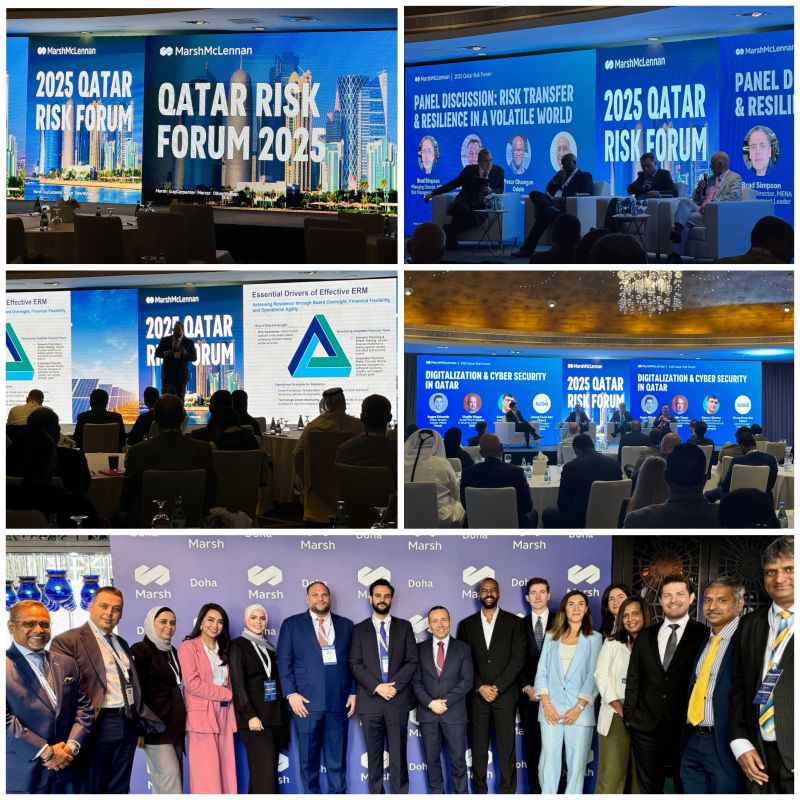
The forum supplies a later view of the access question raised by the motor partnership. Here, access means bringing different kinds of experience into the discussion. The client has a business to run; the specialist has a subject to explain; the policymaker contributes another perspective. Getting them into a room creates the opportunity. The value depends on what they can usefully ask each other once they arrive.
Another Doha exchange in 2024 brought Nayar together with Marsh and Mercer colleagues, including Lisa Lyons, Milan Taylor and Andrew El Zein. Lyons thanked him for hosting. Nayar’s response welcomed the discussion and the prospect of further sessions. It is a small professional moment, but a fitting one for this career: the next conversation is treated as something worth arranging.
In a 2026 post about Mercer’s Middle East talent findings, Nayar turned to workforce change, scarce talent and the effects of artificial intelligence on organizational capability. He described these as changes already affecting businesses. The subject extends the range of his public commentary beyond a particular insurance product. It brings attention to the people an organization needs in order to do its work, and to the challenge of keeping their capabilities aligned with changing demands.
For a reader following this career, that is an interesting widening of the discussion. The familiar insurance questions concern what might interrupt a business and how it prepares. Workforce questions ask who will perform the work, how they will learn and what happens as their tools change. These subjects give colleagues with different specialties something concrete to discuss together. The usefulness of the exchange depends on the questions they bring and the care with which they listen to the answers.
The promise still has to arrive
Insurance executives work with language that can make an ordinary problem sound remote. Distribution. Resilience. Transfer. Each word contains decisions that eventually touch a customer’s day. A driver needs to get home. A company needs to discuss its exposure. A practitioner needs to learn enough to recognize a new question. The vocabulary earns its place when it helps someone act.
Nayar’s career can be read through those connections: between a product and its buyer, a company and its partners, a professional chapter and its members. That reading does not turn every job into the same job. It draws attention to a recurring piece of practical work across them. Protection must be designed, explained and brought within reach. Somewhere along that route, a promise leaves the brochure and meets a person.