John Tolson expected a thirty-minute introduction. He got an hour and a half. The president of Ideal Steel, a Louisiana manufacturer of steel-building components, was considering what would happen to the business he and his partners had spent two decades building. His broker had connected him with Brad Crawford. Somewhere along the way, the scheduled call lost its grip on the clock.
The conversation relied on the least futuristic equipment imaginable: a telephone. Before a company can change hands, somebody has to understand what its owners care about. In this case, that meant the company’s name, its employees and the culture that would survive after the founders stepped back.
Crawford preferred to meet and work through the issues before involving lawyers, Tolson recalled. The deal eventually brought Ideal Steel into Ambassador Supply in November 2023. Tolson later described investment in equipment, software and expertise, alongside the retention of staff. The thirty-minute call had opened a conversation about continuity.
Now put that conversation beside another part of Crawford’s work: robotic manufacturing for houses. At Rival Holdings, the Fort Wayne investment and holding company he leads, established building businesses sit alongside experiments in automation. The connection is practical. Buying a company brings responsibility for its daily work. Buying into a technology brings a question: can the people doing that work actually use it?
An Indiana career, with a return to robots
Crawford was born and raised in Indianapolis and earned a Bachelor of Science in Business Administration at Indiana Wesleyan University. His career passed through executive roles in financial services and advanced manufacturing before he became CEO of Ambassador Supply in 2014. The manufacturing business specialized in robotic systems serving industries including automotive and consumer electronics.
That earlier experience gives the construction-robotics chapter a longer history. Crawford had already worked around businesses that turn automation into a product before homebuilding became the setting. His path brought together financial services, manufacturing and building supplies - three fields that meet whenever a new machine needs financing, a production process and customers.
At Ambassador Supply, he led the organization’s expansion from a single business unit into an investment and management company. His later role at Rival added responsibility for acquisitions across the broader group. The work involves translating separate companies’ ideas into a shared direction, while making that direction relevant to the people inside each business.
Away from those responsibilities, he has described an interest in mentoring and challenging his teams. He also directed youth basketball at White River Sports in Noblesville from November 2011 to February 2014, a program serving 450 children. Coaching and managing businesses are different occupations, though both offer frequent reminders that assembling a roster is only the beginning.
A new company with an old-business backbone
Rival launched on August 1, 2023, bringing Ambassador Supply and VIA Developments under a parent company. At launch, the group reported 16 companies operating in 10 states, more than 800 employees, a real estate portfolio valued at $200 million and two million square feet under management. Those figures describe its starting position, rather than a current scorecard.
The arrangement connected manufactured building products and materials with real estate development and management. It gave Crawford an operating base from which to pursue acquisitions and new technologies. A construction idea could be considered alongside the businesses that might supply it, manufacture it or eventually use it.
There is an appealing tension in that structure. Established businesses have customers waiting for deliveries. Technology investments ask those businesses to consider changing the way they work. Crawford’s job places both demands on the same desk. Any useful experiment has to earn room beside the ordinary obligations of running the companies.
The portfolio’s growth also came through familiar materials. Hitek Truss, acquired in April 2023, manufactures roof and floor trusses in Brooksville, Florida. Ideal Steel added components and pre-engineered steel buildings from Broussard, Louisiana. These are businesses with tangible products and regional customer relationships. Their place in Crawford’s story matters because his automation ambitions are attached to an existing building trade.
The investor who also places an order
In March 2024, Rival announced an investment in Automated Architecture, known as AUAR. Founded in 2019 by Mollie Claypool and Gilles Retsin, the UK company develops robotic micro-factories for timber construction. Its approach links design and manufacturing so that compact production systems can make components locally.
Crawford described Rival as both an investor and a customer. The pairing creates two kinds of accountability. As an investor, Rival has an interest in AUAR’s development. As a customer, it has to decide how the technology fits its own operations. A promising demonstration is the beginning of that second relationship.
Rival had joined Plug and Play’s Real Estate & Construction program in Silicon Valley the previous month. That partnership widened its access to startups and industry collaborators. Together, the two moves show Crawford’s organization looking beyond its own portfolio for ideas, while keeping an operating business available to try them.
The distinction becomes especially useful in construction, where a component must ultimately meet a site, a schedule and a crew. An investment announcement can travel quickly. A change in working practice takes a different route. Rival’s customer role puts it along that route, with the opportunity to learn from the awkward details that arrive after the announcement.
“We are both an investor and a customer.”Brad Crawford · March 2024
A factory packed for delivery
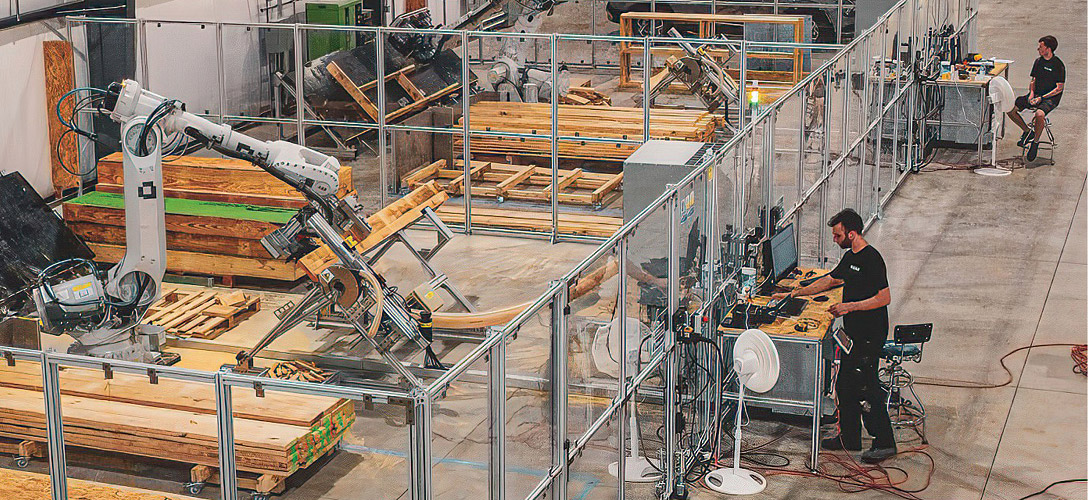
In September 2024, AUAR announced that two micro-factories were shipping to Rival for its first North American deployment. The systems use ABB robotics and arrive in standard shipping containers, with components pre-assembled for installation. They manufacture timber-frame panels for walls, floors and roofs, which are then assembled on site.
The deployment announcement described a hardware-as-a-service model intended to limit the upfront capital required from builders. It also laid out a modest first assignment: an accessory dwelling unit, or ADU, to help Rival’s team get started with the technology. A small home can carry a large amount of learning.
That sequence is worth lingering over. The initial task was a particular building, with a team learning a particular system. The subsequent ambition was broader production across the Midwest. Between those two points lie the decisions that make a factory useful: preparing the work, understanding the software, handling materials and making the output fit the next stage.
Rival Lab, located in New Haven, Indiana, provides a place for that work. Led by Crawford and Jerod Hevel, Rival’s vice president of innovation and strategy, it tests emerging automation under operating conditions. Its purpose includes learning what the machinery requires of people and workflow. The robot has arrived; the organization still has homework.
The surprisingly interesting life of a nail
By December 2025, robots were assembling wall and roof panels in the Fort Wayne operation. Crawford described the underlying construction unit as a “single block,” usable in different types of buildings. Repetition is central to the appeal: the machine can perform recurring manufacturing tasks while the building takes shape from those components.
He also drew attention to the information created during production. The system, he said, could record nail counts, placement accuracy and the force used to drive the nails. A fastening normally disappears into a structure. Here, it can leave a record. For someone accustomed to managing manufacturing businesses, that is a consequential detail.
The humble nail rarely gets invited into a discussion of technological change. It deserves a chair. Quality in a building depends partly on small actions performed repeatedly, and automation’s promise includes making those actions measurable. Crawford’s example turns a broad claim about innovation into a question a production team can examine.
Rival Lab also hosts demonstrations and industry conversations, including its Building Together event. Its work brings builders, suppliers and investors into contact with the production systems and a showcase ADU. A visitor can encounter the machinery alongside the people expected to operate it. That combination gives the discussion something sturdier than a slide deck to lean on.
- 01Digital designPrepare the timber structure
- 02Robotic productionManufacture the panels
- 03Site assemblyBring the components together
The people beside the production line
In April 2026, Rival hired Eric Johnson as Rival Lab’s production manager, with responsibility for manufacturing operations, cold-formed steel framing and robotics. Johnson brought more than 15 years of manufacturing leadership experience. His appointment added a specific person to the task of increasing production and improving efficiency.
For Crawford, whose public profile emphasizes mentoring teams, that appointment belongs in the same story as the equipment. Machines introduce new capabilities, and managers turn those capabilities into working routines. The personnel decision shows an organization building the supervision required around its technical experiment.
The wider leadership structure has also developed. Alicia Wilkins became chief people officer and Brandon Koenig became chief financial officer in 2026. July additions included Brice Urschel in finance and treasury and Adam Hughes in learning and organizational development. Capital, training and workforce development all have named responsibilities alongside the technical work.
That breadth follows the acquisitions. Rival bought Michigan general contractor Laux Construction in June 2024. Its Defy Investments business later acquired Indianapolis-based Davis Homes in February 2025, with Bradley C. Davis continuing as CEO and retaining minority ownership. These transactions extended the group into the companies that carry building projects through to customers.
A house is the next test
From January 1, 2026, Rival united its portfolio branding around Rival Residential, Rival Commercial and Rival Rural. The change gave the expanding group a shared name across its principal building markets. Crawford’s responsibilities now stretch from maintaining relationships inside acquired companies to making room for new methods of production.
A June 2026 update followed a Fort Wayne house being built with AUAR’s micro-factory technology. Rival pointed readers to a local television report and said more would follow as the project wrapped up in the fall. The dated update matters: it places the experiment in an actual construction project, with work still progressing.
Crawford’s stated ambition is to make building easier, improve quality and address the pressures of housing cost and availability. Rival’s operating approach gives those aspirations a series of tests. Can the factory perform reliably? Can the team run it? Can the components serve the people who eventually build with them?
The questions connect back to the owners on the other end of an acquisition call. Change has to make sense to people with something at stake: a business they built, a job they do or a home they hope to occupy. Crawford’s work brings those concerns into the same enterprise. The future he is pursuing has a delivery address, a production manager and nails that can be counted.