The first version of Bounce involved two founders, two bicycles and somebody else’s suitcase. Cody Candee and Aleksander Rendtlsev had put up a New York landing page for bag storage and delivery, bought a $5 Google ad, and received a request within five minutes. Demand had introduced itself. Then it asked to be met at an exact place and time, with a bag in tow.
The founders climbed onto Citi Bikes and did the work themselves. Candee later described the problem plainly: they were spending their days riding around, and the time required made it hard to imagine paying someone else to do it at a viable rate. A customer could love this service and still be asking for an impossible business.
- Bounce lets people book temporary bag storage at nearby shops, hotels and selected lockers.
- Partners earn money from spare space while travelers recover the hours between checkout and departure.
- The company ended package acceptance in January 2026, then acquired Nannybag and partnered with Airbnb.
The answer was already on the street
By the fourth day of the early test, the founders had changed the handoff. Customers could take their belongings to a designated local business and collect them from another. Soon, they noticed something even more helpful: plenty of people were content to pick up a bag from the very shop where they had left it. No courier. No moving target. Just a reliable place to pause a suitcase while its owner did something else.
This is the small, almost comic insight at the center of Bounce. Its original idea was a sort of remote control for possessions. The product that took hold was a place for possessions to wait. Candee and Rendtlsev built the first web booking platform in about a month; the mobile app followed in February 2019. The company dates its founding to 2018, though the founders’ test began in late 2017.

A hotel with a luggage room had long offered a version of this courtesy to its own guests. A train station locker offered another, usually tied to the station’s location and capacity. Bounce’s proposition was to make many small businesses searchable and bookable as one network. If the nearest useful spot was a café by a museum or a shop near a train station, the map could show it. Stasher, Radical Storage and Vertoe are other marketplace alternatives; hotel storage and station lockers remain the obvious substitutes.
The customer buys back an afternoon
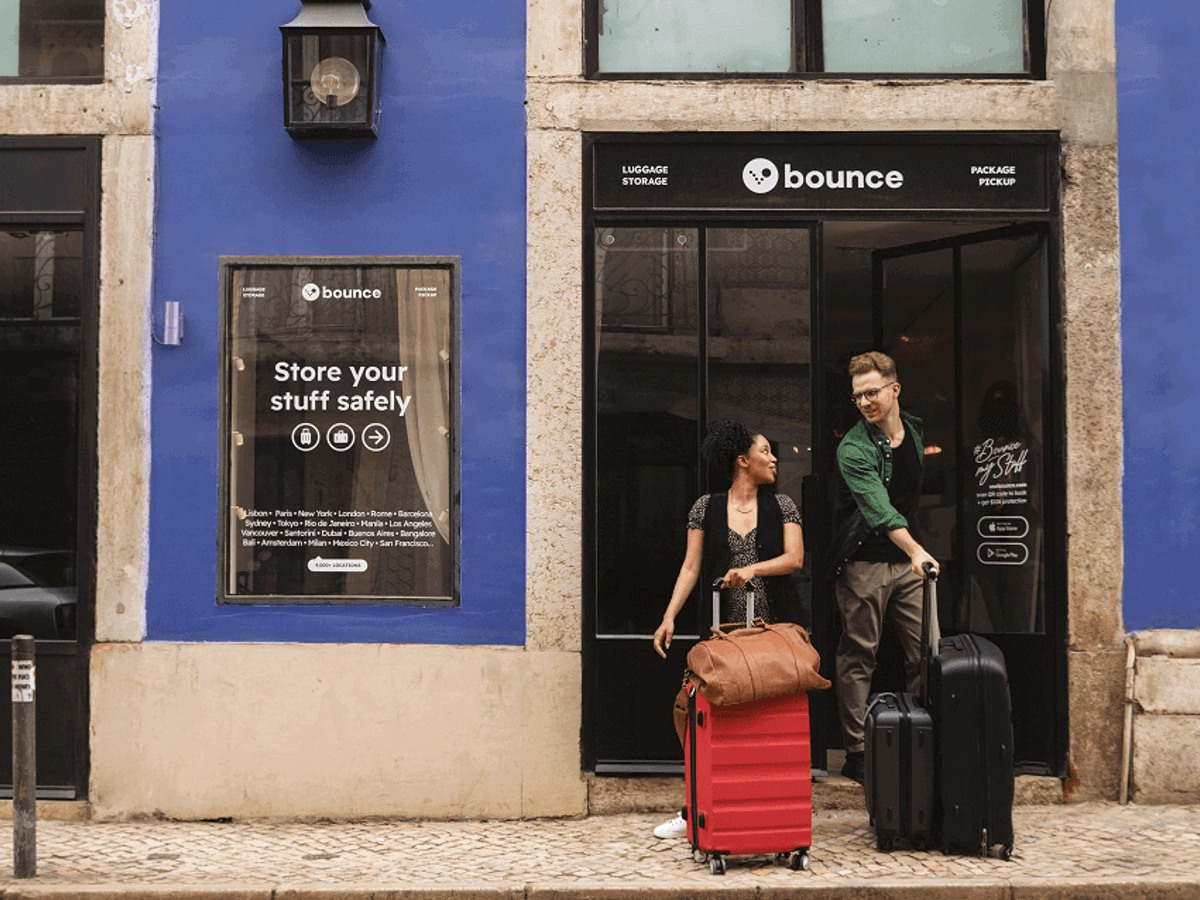
Consider the familiar travel arithmetic. Checkout is at 11 a.m. The train leaves at 7 p.m. Eight hours are available, provided a suitcase does not come along to lunch, a gallery and a crowded pavement. A Bounce customer searches by location and time, pays online, and receives a booking confirmation. At the partner business, staff verify the reservation, tag the bag, store it in a secure area and return it at collection. Some markets also offer self-service lockers. The company’s site says it supports everything from a small bag to bulky items such as bicycles or surfboards, subject to finding a suitable location.
The other customer is the business behind the counter. Bounce brings the booking; the business supplies the space, staff and opening hours. Partners can set capacity and receive notices of arriving customers. Candee said in 2022 that the revenue split was typically 50-50, with Bounce paying for customer acquisition and processing. That historical figure is useful for understanding the model, although a prospective partner should check current terms. A spare room is only profitable inventory if it does not disrupt the shop’s main trade.
Distribution is literal here. A location needs to be close to where a traveler wishes to be, and open when the bag needs to come back. A dot on a map across town is not much help to someone catching a train. The network also depends on local staff following a routine every time: confirm, tag, store, retrieve. That routine is less glamorous than an app, and rather more important to the person whose passport is inside the case.
The year the bags stopped moving
When travel halted in 2020, Bounce’s core demand froze for roughly three months, Candee told TechCrunch. The company looked for travel pockets as rules shifted, from parts of Europe to Australia and domestic destinations. It also kept adding partner locations and search content. The bet was that people would look for storage again when they could travel again. Andreessen Horowitz, which led Bounce’s $12 million Series A in 2022, said bookings grew almost 40 times in 2021. That is an investor’s account, but it fits the company’s subsequent expansion: more than 7,000 partner locations by spring 2022 and over 13,000 by late 2024.
Bounce had also tried another use for the network: package acceptance. Launched in 2021, it let customers receive parcels at participating shops. For a city resident tired of missed deliveries, the idea was attractive; one address could serve packages from different couriers. Yet in January 2026 Bounce ended the service. Its notice to partners says the decision followed a business and product review and would let the company focus on core services and consistent quality. The company did not publish a more detailed postmortem. The honest lesson is narrower than a sweeping verdict about packages: Bounce decided this particular service should no longer run on its network.
The $19 million Series B, led by Sapphire Sport, was meant to extend the company’s footprint and develop storage at hotels and venues. Bounce said revenue had increased 20 times since its 2022 Series A. Those are company-reported figures; they say little about profit or the economics of an individual location. What they do show is how far the business had travelled from two founders ferrying bags on bicycles.
A tighter map, and more doors into it
The next move made the focus visible. In February 2026 Bounce acquired Nannybag, a European luggage storage rival, for an undisclosed sum. Nannybag kept its name, while the deal added coverage in France and Italy and brought partners including Carrefour France and Fermopoint. Around the same period Bounce announced a Priority Pass benefit, and Airbnb added a route for eligible guests to find Bounce storage from their Trips. Airbnb pre-fills the listing area and check-in date, then sends the guest to Bounce to choose a location and pay.
The Airbnb path is especially neat. The problem Bounce solves is often created by the shape of a stay: a guest arrives before check-in or remains in town after checkout. Putting storage beside the booking means the answer appears where the awkward interval becomes apparent. It is a distribution lesson from the founder’s interview, made into a product integration.
Bounce now advertises more than 32,000 storage spots across more than 4,000 cities, plus bag delivery in Japan with expansion planned across Europe. Those figures come from its own site and can change. The larger point is easier to hold: the company is a travel marketplace with a physical obligation. Software can find an empty back room; a human still has to take the bag and give back the right one.
What the bicycle test still teaches
There is a practical recipe in those first four days. Put the offer in front of customers quickly. Do the ugly manual work yourself. Measure the part that hurts. Then change the handoff so someone already positioned to do the job can do it economically. Bounce’s $5 ad was cheap; the founders’ time on bicycles was the revealing expense. Many startup tests prove desire. This one also exposed the operating cost before code concealed it.
Copying the method requires conditions that suit it. There must be a recurring, local demand; trustworthy businesses with spare capacity; enough density that a convenient location is genuinely convenient; and a simple way to verify that belongings come back to their owners. Where a hotel already holds bags freely, a shop is too far away, or a partner cannot staff the handoff, the marketplace has less to offer. Bounce’s advantage is not that every bag needs an app. It is that, on a day when yours does, the useful place to leave it may be one street away.