The awkward thing about craving a particular chili sauce is that another chili sauce will not necessarily do. Alex Zhou encountered this problem while studying in Kansas. The nearest Asian market was a two-hour drive away. America had supermarkets, delivery trucks, and websites. What it lacked, in his corner of the country, was a convenient connection between those things and the food he wanted.
- Yami sells Asian food, beauty, wellness, and home products online.
- Its business combines direct retail, marketplace sellers, and fulfillment.
- A 2026 Mitsubishi alliance adds supplier access to an established U.S. audience.
Zhou moved to the Los Angeles area and launched Yamibuy, now Yami, in March 2013. He began with roughly 200 snacks, using savings and family money. He ordered the stock, packed the boxes, shipped the orders, and answered customers. Before this was a platform, it was one person doing the chores.
01 The wrong place for the right snack
There is a useful distinction between a product being available somewhere and being available to you. An Asian supermarket in Southern California does little for a homesick student in Kansas. Yami’s proposition was to move an existing appetite online, then do the physical work required to satisfy it. The website made the distance less consequential.
The first obstacle was getting suppliers to take a tiny operation seriously. Zhou recalled suppliers hanging up on his calls. Early growth was slow. Neither problem could be fixed by making the checkout button prettier. He needed inventory, supplier relationships, and enough persistence to secure both.
That starting point explains Yami’s position in retail. Amazon offers breadth; H Mart and neighborhood Asian markets offer an in-person grocery trip; Weee! competes for online grocery orders. Yami’s particular appeal is a cross-category Asian shopping basket: noodles, skincare, a kitchen appliance, the familiar brand that requires no introduction inside a household.

02 The customers rewrote the shopping list
Students were an obvious first audience. Instant food suited dorm rooms. But customers began asking for cosmetics they could not find locally. Others wanted products for mothers and babies. Zhou followed those requests. The company’s own history dates its beauty and household expansion to 2014, followed by the marketplace in 2015.
This matters because “Asian products” is a remarkably imprecise retail category. A shopper may know the exact noodle flavor, cosmetic brand, or seasoning they want. Getting the country right is only the beginning. Yami’s expertise lies in assortment, sourcing, and recognizing that customers’ familiarity can be more specific than a general retailer’s shelf labels.
“You have to provide value first.”
Alex Zhou · 2017 founder interview
The lesson for another business owner is practical: record requests that your catalog cannot satisfy. Look for repetitions. Test a neighboring category against demonstrated demand. Yami’s early expansion suggests that customers can reveal the next aisle, provided somebody is listening closely enough to stock it.
03 Somebody still has to pack the box
Growth creates an unglamorous question: who gets everything out the door? In a 2017 interview, Zhou described the pressure of rising order volume and the need to recruit experienced managers. His company had outgrown the founder’s ability to supervise every task. Customer knowledge had to become an organization capable of acting on it.
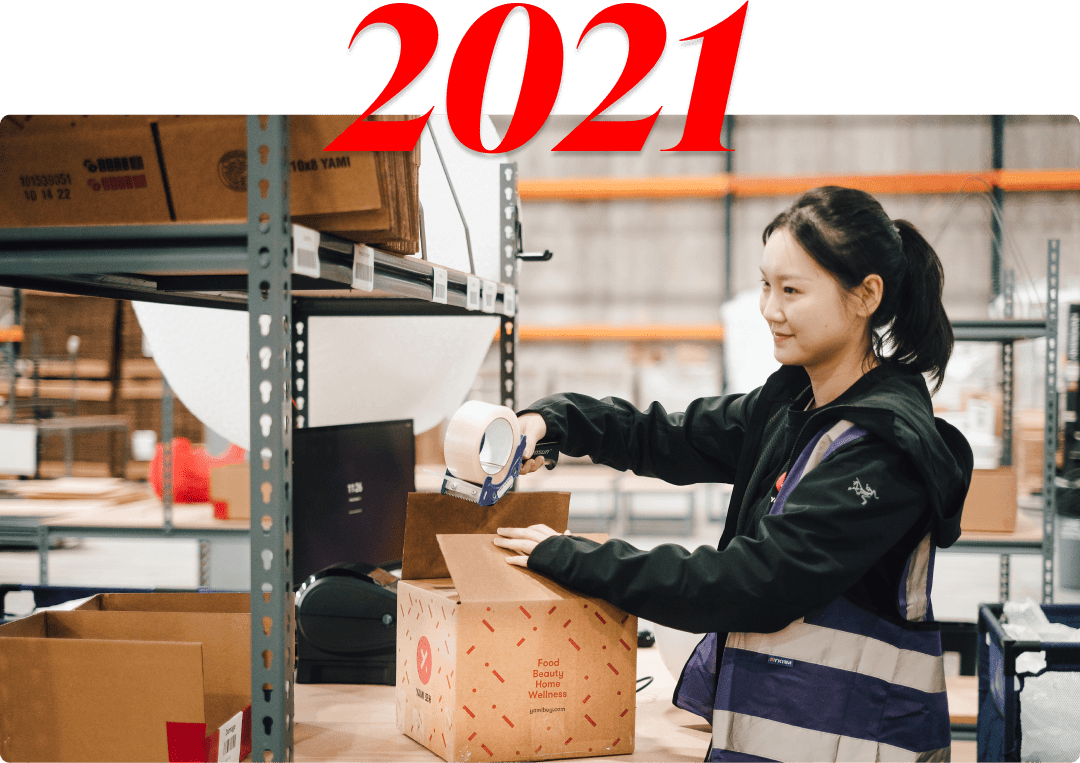
Money helped fund that transition. Yami announced its first institutional financing in July 2017: $10 million led by GGV Capital, alongside New Oriental and K2VC. In March 2022, it announced a $50 million Series B led by Altos Ventures and Balsam Bay Partners, with J.P. Morgan and GGV participating. The stated uses included faster delivery, broader selection, vendor support, and supply-chain technology.
04 The other customer is the seller
For shoppers, Yami is a place to buy. For merchants, it sells access to an audience and a choice about operations. Under Fulfillment by Yami, sellers send bulk inventory to Yami’s warehouses; Yami handles storage, fulfillment, shipping, and customer service. Dropship sellers keep fulfillment in their own warehouses.
The published economics make this concrete. Yami advertises no monthly or setup fees and says commissions generally range from 15% to 20%, depending on category, fulfillment model, and operational factors. Direct retail sales sit alongside that marketplace business. These arrangements distribute the work differently, even when products appear on the same screen.
Published general marketplace commission range. Sellers still need room for their own product and operating costs.
For a brand, the decision starts with the margin left after commission, inventory, and delivery costs. For a shopper, the useful habit is checking who sells and fulfills an item. A platform-wide assortment does not mean every product travels through the same warehouse or arrives on the same timetable.
05 Japan finds a shorter route
In April 2026, Yami announced a Mitsubishi Corporation strategic investment marking its Series C. The accompanying operating alliance connects the marketplace with Mitsubishi Shokuhin’s network of 6,500 suppliers. Yami reported more than four million registered users and over 500,000 stock-keeping units. Those are company-reported figures; registrations do not measure active shoppers.
The partners plan to expand Yami’s Japanese assortment and support a move into Canada. For manufacturers, the attraction is a route to consumers beyond the negotiations required to win physical shelf space. Yami had already pursued this supplier-facing role: a 2022 Yoshitsu agreement covered fulfillment services and Japanese product listings.
06 Give the basket a purpose
A smaller collaboration shows the same instinct at kitchen scale. Yami and Ivan Ramen assembled Japanese pantry ingredients around recipes inspired by The Gaijin Cookbook. Dashi, curry, kombu, panko: the products came with an explanation of what a home cook could do with them.
That is a useful standard for Yami’s next chapter. More listings help when the right products remain easy to find, economically viable to sell, and dependable to deliver. The approach is less convincing where shoppers already have convenient local access or sellers cannot absorb the costs. The original customer wanted something simple: a familiar taste without the long drive. Every added aisle still has to earn its place in that order.
Open another aisle
Shop Yami ↗Sell on Yami ↗LinkedIn ↗Twitter / X ↗Instagram ↗Facebook ↗Yami videos ↗Watch: Alex Zhou interview ↗Explore the Ivan Ramen collaboration ↗The Mitsubishi announcement ↗