Borui Wang received a camera as a gift and acquired a second occupation: correcting its work. The camera’s limitations sent him into editing software, where he spent time adjusting and improving the pictures he had taken. A present had come with homework. It also supplied the problem that would occupy him as a founder: how to close the distance between an image someone imagines and the file a camera produces.
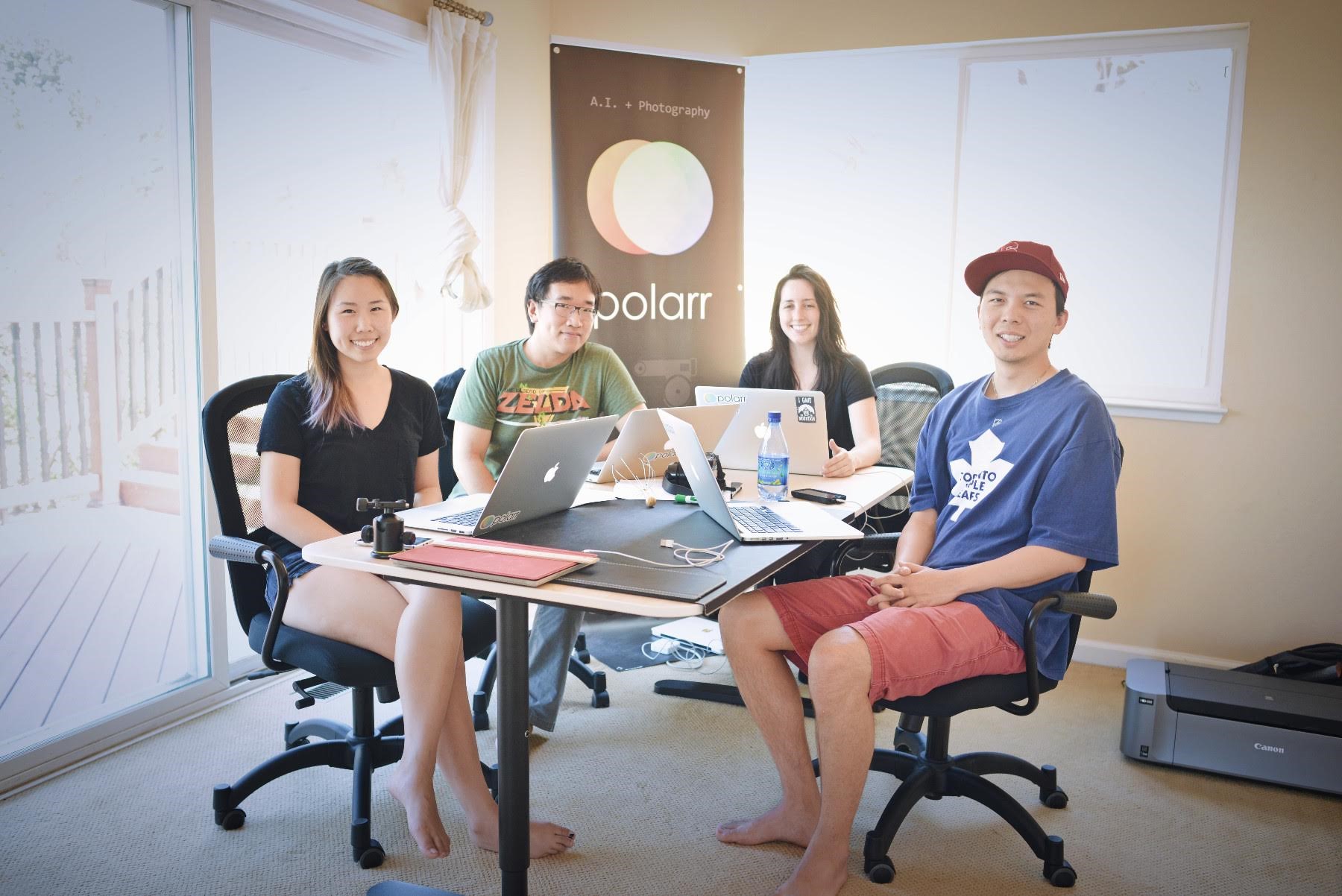
At Stanford, Wang met Derek Yan and Enhao Gong. They founded Polarr in 2014. Their timing depended partly on a prediction about the unglamorous machinery inside a phone. Yan expected mobile processors and graphics chips to become capable enough to run the image algorithms Wang wanted. Better photographs would require better computation, and that computation was moving toward the device already in the photographer’s pocket.
There is a pleasing imbalance in this origin. Wang wanted a picture to look right; the route there involved chips, models, interfaces, and a company. Anyone who has lost an afternoon adjusting the warmth of a photograph will recognize the initial complaint. Far fewer people would respond by spending the decade building the editor.
A portfolio of useful detours
Wang’s early work wandered cheerfully across the border between programming and art. His personal portfolio describes an experiment called Decay, made in May 2014, in which a visitor could post a message and watch it deteriorate as more people arrived. Another collection, Time Shifts, used browser technologies for small works about time and space. The computer was already a place to make an experience, rather than merely complete an assignment.
His 2013 photography portfolio grouped images through their dominant colors. A separate camera visualization compared 229 models. He also described himself as an audiophile and an aspiring professional photographer. Looking at these projects together, the recurring concern is perception: what people hear, see, select, and understand when an interface gives them a different way in.
His training gave that curiosity some structure. He earned a computer science bachelor’s degree at the University of Wisconsin-Madison before studying computer science at Stanford, concentrating on human-computer interaction and artificial intelligence. An early résumé records a monitor color-calibration prototype, a music-labeling project using colors, and research into visualizing browsing history with barcode-like stripes. Even the browser’s history could apparently benefit from an art department.
There were conventional engineering apprenticeships, too. At Google in 2013, he worked on JavaScript performance and tools for detecting memory leaks in YouTube. At Qualcomm in 2012, he built a code analysis and validation tool. At Intuit in 2011, he prototyped software connecting QuickBooks transaction data with eBay. These were practical jobs inside existing systems, with the particular discipline of making somebody else’s complicated machinery behave.
Fewer buttons, more looking
Polarr’s mobile debut brought an attention-grabbing number: a reported 250,000 downloads in its first 48 hours in 2015. Wang’s explanation of the product was quieter. He thought ordinary users could handle professional editing tools, and he preferred a small set of carefully chosen features to a menu stuffed with possibilities. The number made a launch story. The restraint made a product philosophy.
“Writing code - that’s almost secondary,” he said in 2015. Understanding what users needed came first. He warned programmers about becoming their own app’s sole audience and treated friends voluntarily using a product as a useful early signal. His team watched people use the software, revised it, tested again, and sometimes put fresh ideas away. He also described protecting personal time rather than treating long hours as proof of useful work.
That preference for looking before building matters in a visual business. An engineer can demonstrate that a control functions; a photographer must decide whether it helps. Wang’s position left room for a user’s intelligence without requiring every user to become an imaging specialist. The difficult work belonged partly in the interface, where an excess of cleverness could become another thing to get past.
“Writing code - that’s almost secondary.”
Borui Wang · 2015
The editor disappears into the phone
In 2019, Polarr announced an $11.5 million Series A led by Threshold Ventures, with Cota Capital and Pear Ventures participating. The company reported more than four million monthly users of its editor and 20 million app downloads. Those were company figures at that moment, rather than a running count of Wang’s later audience. They describe how far the original editing complaint had traveled.
Another part of the business was less visible. Polarr developed composition guidance for the Samsung Galaxy S10’s native camera app, using deep learning trained on professional photographs. Its Vision Engine was designed to let device makers run image intelligence locally. A person following a composition prompt on a Samsung phone might encounter the company’s work without ever opening an app called Polarr.
The engineering problem was stubbornly physical. Different phones had different sensors, processing capabilities, battery constraints, and thermal limits. Wang discussed the challenge of making the technology work across manufacturers. An algorithm could be elegant in principle and troublesome in a handset. Polarr had to account for the handset.
Wang’s own account of the financing supplies a useful counterweight to the headline amount. He wrote that Polarr reached profitability in mid-2016 with $1 million in seed funding and remained cash-flow positive until its team reached 20 people in 2018. Building more AI research and deployment capacity required more people. The money had a specific job: pay for the moving parts that a small team could no longer cover.
A financing round and an audience, measured at the same moment. Company-reported historical figures.
Whose taste does the machine learn?
By 2022, Wang was discussing a different kind of ownership: a creator’s visual identity. Polarr’s filter-sharing community let people distribute a look they had made. In a podcast appearance that April, he addressed the divide between creators who earned money and those who did not, and the role platforms could play in helping people develop their work. The program described more than three-quarters of Polarr’s users as Gen Z at the time.
A filter gives taste a portable form. Someone’s choices about color and contrast can travel to another person’s photograph. That opens a social question alongside the technical one: when a look circulates, who receives the credit and the value? Wang’s interest in creator ownership put the people making those choices into the discussion. A software company selling creative tools has reason to care about what its users get to keep.
For professional photographers, the next problem arrived by the thousand. A wedding produces a collection that must be selected, adjusted, and delivered with a coherent appearance. In a January 2024 conversation, Wang and Yan described their focus on wedding photographers, whose work combines demanding visual standards with repeated post-production tasks. An appealing demonstration on one frame had to survive an entire job.
Polarr Next learned from a photographer’s reference edits and applied that style across a batch. Its tools also brought image selection into the workflow. The proposition was personal: teach the software through your own decisions, then review what it does. The photographer remained the person with an opinion. The software was being asked to remember it.
The arrangement also depended on where the work happened. Polarr said Next stored photographs, edits, and AI training data locally, even when the interface appeared in a browser. Its learning extended to global adjustments and local masks. That placed demanding photographic work inside a familiar window while keeping the working material on the user’s computer. The browser had been in Wang’s experiments years earlier; now it was carrying a professional assignment.
- 01SelectChoose the photographs worth keeping.
- 02TeachMake reference edits with your own judgment.
- 03ApplyLet the software carry those choices across a batch.
- 04ReviewRefine the results and keep the final say.
The photographer supplies the taste. Corrections keep the process personal.
One more handoff to remove
In May 2025, Pixieset acquired Polarr. By 2026, Wang’s public professional profile listed Pixieset, where he was reported as director of products. The change gives his story a new setting inside a business already helping photographers deliver galleries and manage client work. Editing could sit closer to the place the finished pictures were going.
Pixieset announced Photo Editor in June 2026, combining culling, RAW editing, personal AI styles, and gallery delivery. Its description emphasized that photographers could refine the results and make final decisions themselves. Wang shared the launch on LinkedIn, drawing attention to the browser and desktop workflow, graphics performance, and AI running on the device. Those are familiar preoccupations from a founder who began with a camera’s shortcomings.
Polarr Next’s transition notice set October 13, 2026 as the end of its standalone availability. For a photographer, that is a concrete change of working address. For Wang, it marks another version of the same task: reduce the distance between making an image and finishing the work around it. The product now reaches into delivery as well as the edit.
There is a practical standard for the next chapter: can a photographer understand the machine’s choices well enough to correct them? A finished gallery has to carry a consistent point of view. Speed only becomes useful when the person delivering the work is satisfied with what has been delivered. That leaves human judgment with a very ordinary, very durable job.
The young programmer who made a message decay on a website was willing to let a computer alter something a person had made. The product leader building editing software must make that bargain more carefully. A photographer’s corrections become instructions; the resulting pictures remain subject to the photographer’s judgment. Wang’s career keeps returning to that exchange. There is a picture in somebody’s head, a device on the desk, and still a little work between them.
Keep looking
Explore Wang’s work and conversations.
Personal portfolio ↗Borui Wang on LinkedIn ↗Wang’s Medium blog ↗The 2015 Stanford conversation ↗Listen: Wang and Yan on VatorNews ↗Watch: Polarr Next on YouTube ↗Watch: Wang’s early portfolio-tool demo ↗Pixieset Photo Editor’s next chapter ↗