Before Boris Krastev began selling employers on a world without hiring borders, geography had already made itself the central problem of his life. He grew up in Svishtov, a Bulgarian town on the Danube, and spent his first seven years in nearby Vardim. As a teenager, he played basketball, studied languages and computers, and decided he wanted to build a business. The ambition was vivid. The route was not.
Denmark offered an appealing bargain: university without tuition and the legal possibility of working while studying. Krastev's parents paid 100 Bulgarian lev for his English exam and told him the remainder was his responsibility. He went first to the fields near Cambridge, England, where he picked strawberries and lived frugally enough to save about £4,000. He arrived in Horsens in 2011 with tuition solved and nearly everything else uncertain.
The work available was the sort that vanishes from founder biographies once the founder acquires a flattering headshot. Krastev unloaded heavy boxes, cleaned warehouses and took shifts in factories making cookies, sausage, cheese and printed magazines. He has said he worked in at least a dozen factories. He also made a private calculation with the grim comic precision of an accountant: before becoming an entrepreneur, he had cleaned 3,500 toilets in Denmark.
The night shift had a morning lecture
There was little romance in the timetable. During one stretch, he would attend university, take a Danish class, work overnight at a cookie factory, shower there and return to lectures. He walked long distances when a bus ticket was beyond the budget. The point is not that exhaustion confers wisdom. It often confers only exhaustion. The revealing detail is that Krastev kept rearranging the plan when the current version was inadequate.
He transferred to Aarhus University, finished business-focused undergraduate studies and completed a master's degree in quantitative finance. His thesis became a peer-reviewed article in the Journal of Cleaner Production, co-authored with Klarissa Lueg and Rainer Lueg. The paper studied the two-way relationship between corporate sustainability disclosure and risk across 59 South African public companies. He was invited toward doctoral work, but the academic life did not hold him.
By then, the business itch had already produced an instructive non-start. In 2015, at 23, he and a friend attempted to create Chance Tur, an agency that would bring Danish tourists to Bulgaria's mountains. Danish registration and capital requirements stopped it from launching. This is where the clean version of a career would jump directly to RemoteMore. The useful version keeps the rubble.
Two Borises and two ideas that did not stick
A professor introduced Krastev to another Bulgarian in Denmark who wanted to build a company: Boris Borisov. The repetition of first names would become a durable company joke and an occasional editorial hazard. In 2017, Krastev persuaded Borisov to leave his job and move from Copenhagen to Aarhus. They pooled savings, placed several monitors in a spare room beneath a Bulgarian flag and began.
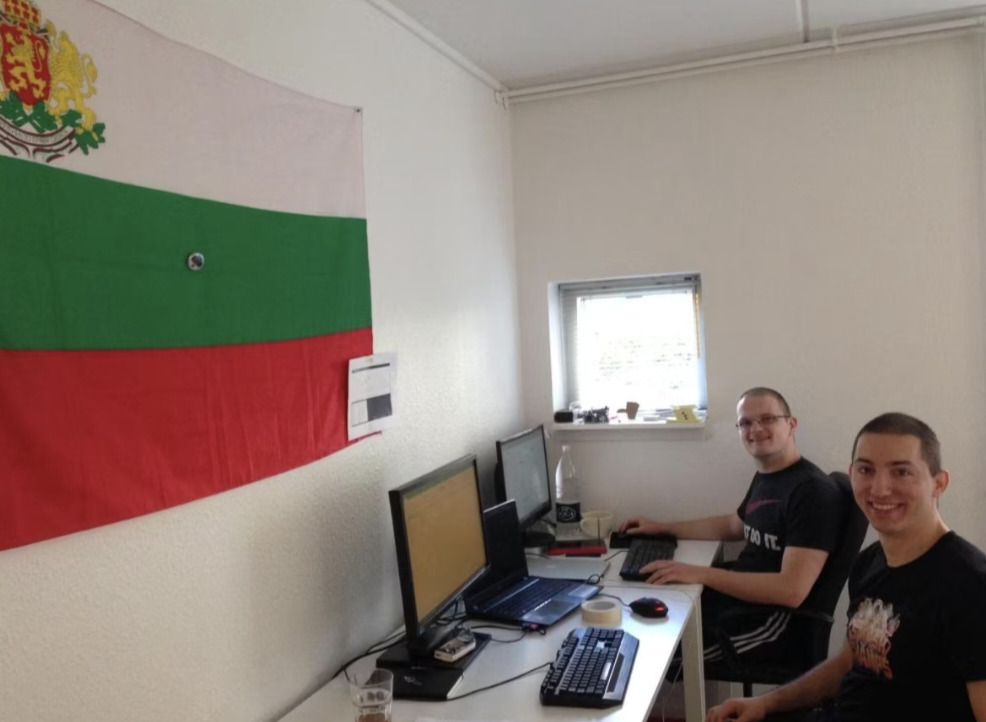
They did not begin with RemoteMore's eventual model. SkillAchieve was designed to help companies measure workforce skills. JobDisrupt used machine learning to match CVs with job descriptions. Both names had the overeager efficiency of two business words pushed together. Neither became the answer. But each kept the same question alive: how could ability find opportunity more efficiently?
RemoteMore moved the founders closer to an outcome somebody would buy. Developers wanted meaningful work without relocating. Employers wanted capable technical people without months of searching. A matching algorithm might help, but the valuable unit was not a clever score. It was a credible interview with a person who could take the job. Over time, the company added the practical machinery around that meeting: screening, scheduling, contracting and payroll across borders.
The distinction is easy to miss and useful to steal. A mechanism can be impressive while an outcome remains inconvenient. Krastev and Borisov did not discard everything when their first concepts failed. They retained the problem, surrendered their preferred answers and moved nearer to the transaction.
Ninety-five knocks, one Berlin door
For roughly two years, the co-founders paid themselves little or nothing and lived on constrained monthly budgets. When their savings thinned, they sent 95 applications to investment programs. Denmark yielded no investor. APX, the early-stage program backed by Axel Springer and Porsche, did. It invested and required the founders to move to Berlin.
The condition was a gift disguised as logistics. Krastev found Berlin welcoming and dense with other ambitious company builders. RemoteMore reached the finals of Denmark's Venture Cup and entered a network that gave a tiny hiring company institutional legibility. Then 2020 made remote work an operating reality for employers who had treated it as a perk. Demand met the product at speed.
Early RemoteMore still involved wonderfully manual labor. In late 2020, a developer in Serbia needed a capable laptop to begin a placement. Krastev and a colleague put the machine in an old Volkswagen and drove from Bulgaria toward Nis. Their plan for crossing the border and returning without a particular document was optimistic enough that border officials laughed. They continued, delivered the computer and discovered on the way home that the car's engine had its own objections.
A global platform, in this telling, briefly looked like two friends, one laptop and a questionable Volkswagen. It is hard to design a better illustration of the word “operations.”
The transaction was not an exit
Krastev moved to Chicago in March 2021. That September, Professional Diversity Network, a Nasdaq-listed recruiting and networking company, acquired a 45.62% interest in RemoteMore for an estimated $1.363 million. The deal brought both co-founders aboard. Krastev stayed CEO rather than treating the transaction as a curtain call.
The next set of public numbers shows what the capital was intended to accelerate. For the first nine months of 2022, RemoteMore reported about $1.882 million in gross revenue, six times the comparable 2021 period. Registered company users grew from 650 to 1,500. The pre-screened developer pool expanded from 6,300 to more than 24,000. Employers could schedule interviews on the platform and add payroll support without establishing a local legal entity.
In March 2023, PDN acquired another 20% and reported ownership of approximately 66%. In February 2025, Boris Krastev Ventures UG agreed to sell PDN one million RemoteMore shares for $300,000, paid in restricted PDN stock. The filings are less romantic than a founder profile and more useful about ownership. They also complicate the familiar startup phrase “sold the company.” Krastev sold equity in stages and remained at work.
The analytical optimist learns Sunday
People who worked with Krastev describe high standards, extreme focus and an appetite for iteration. A colleague's early company portrait called him half gym enthusiast and half PC nerd, with a taste for bad jokes and practical advice. It also noted that the CEO answered customer-support messages. The combination is revealing: analysis without too much ceremony.
His public writing returns to skills, knowledge and the long view. In a 2023 podcast, he argued that founders mistake funding for the prerequisite to building something meaningful when capability should come first. In a later post, he admitted catching himself thinking too narrowly about short-term setbacks and urged a wider time horizon. He reportedly read 380 entrepreneurship and self-development books over the decade beginning in 2014. One hopes at least a few were funny.
There is an obvious danger in turning Krastev's student years into a morality play about working harder. No one needs to clean thousands of toilets to earn the right to start a company. His record offers a subtler lesson. He learned languages, changed universities, let dead ideas remain dead, crossed borders and kept reducing a large dream into the next concrete task. Sometimes the task was an academic regression. Sometimes it was the ninety-fifth email. Sometimes it was putting a laptop in a car.
After years of 70-hour weeks, he told a Bulgarian interviewer that he had finally begun protecting at least Sunday and making more room for life in Chicago. Even persistence needs an edit. RemoteMore's stated ambition now is to make global hiring repeatable rather than exceptional. Krastev's own journey has followed the same pattern: not one grand leap, but a sequence of systems built around whatever the next border demanded.