Peter Rawlinson had an awkward answer to an appealing question. Why not make a cheap electric car? In the first installment of WSJ’s Bold Names, the then-chief executive of Lucid explained why a low-priced vehicle was not the business he wanted to build. Here was an engineer associated with Tesla, leading another electric-car company, declining the proposition that seemed most obvious from outside it.
That is a useful place to begin a business podcast. A familiar ambition meets an inconvenient constraint. The listener gets to examine the gap. Bold Names, hosted by Wall Street Journal columnists Tim Higgins and Christopher Mims, occupies that gap: the space between what a company promises and the choices its leaders say they must make.
- Business and technology interviews from WSJ, with audio and video editions.
- Free public audio; the real investment is your attention.
- Listen for the decision, the constraint and the evidence behind the answer.
The question is the product
The name borrows the language of a newspaper page. Bold names are the people and companies whose actions become news. The show gives some of those people room to explain themselves. Its product is an interview, packaged for listening on podcast platforms and, since September 2025, watching on WSJ.com and the WSJ Podcasts YouTube channel.
The problem it addresses is familiar to anyone who follows business news. Headlines report a move: an AI bet, a new product, a strategic reversal. Understanding the move requires another layer. What did the executive believe? What alternative did the company reject? What would have to be true for the bet to pay off? An interview can make those assumptions audible.
Higgins and Mims bring the perspective of working business and technology columnists. The editorial promise is to challenge conventional wisdom. That gives the format a clear place among executive interviews: a conversation conducted within a reporting institution, connected to columns, newsletters and coverage beyond the recording. Access gets the guest into the room. The follow-up determines whether the room was worth entering.
A new show with an old address
Its origin contains a small internet oddity. The official address still reads “wsj-the-future-of-everything.” The public feed contains older episodes from that earlier show. Consequently, podcast directories can display a history beginning in 2017. That history belongs to the feed; Bold Names itself debuted as an interview series in November 2024.
Rawlinson’s conversation appeared in the Tech News Briefing feed on November 16. Salesforce’s Marc Benioff followed with a discussion of AI agents and claims about what artificial intelligence could actually do. In February 2025, WSJ announced a new season. In September, the series added video. The sequence matters because it shows a newspaper developing an interview property through existing distribution before widening its presentation.
For a publisher, this is an intelligible use of existing resources: reporters already have expertise and executive access, while podcasts offer another way to encounter their work. For the audience, it reduces friction. You can hear a conversation while walking, then follow the same subject into an article or a video when you have a screen.
Scarcity meets the assembly line
By early 2026, the guest list offered an unusually good comparison exercise. Lamborghini chief executive Stephan Winkelmann discussed a company delivering roughly 10,000 vehicles worldwide each year. The episode’s title supplied the proposition: “We Sell Scarcity.” The interview also addressed hybrids, tariffs and the pressures of global trade.
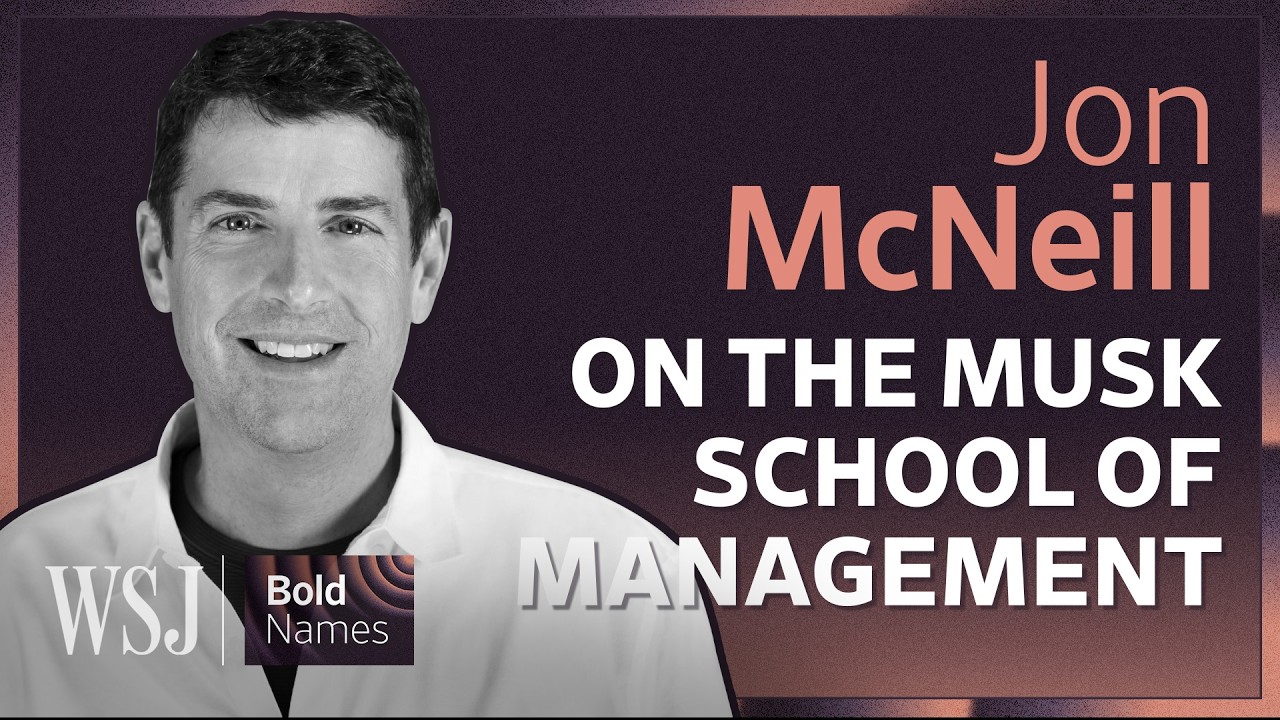
In March, former Tesla president Jon McNeill discussed the management approach associated with his time at the electric-car maker. Among the advertised lessons: automation should come last. Place the two conversations beside each other and an interesting distinction appears. One business guards exclusivity. Another conversation examines how to improve an operating process. Both concern cars; their useful questions are different.
This is where a manager, founder or student can extract something practical. Comparing interviews makes it harder to treat a confident executive as the owner of a universal rule. Scarcity makes sense when scarcity supports demand and pricing. It offers little guidance to a business whose customers chiefly want availability. Automation belongs in a discussion about a process that deserves to survive.
“We Sell Scarcity.”Lamborghini episode title · February 6, 2026
The bill, and the bet
Listening to the public audio costs nothing. Episodes carry advertising, and WSJ markets podcast advertising within its broader media portfolio. This is a media business serving two audiences: listeners seeking information and advertisers seeking attention. The show also points people toward WSJ’s technology newsletter and the hosts’ columns, giving the conversation a route into the publisher’s wider work.
Its economics should be understood at that scale. Bold Names is a WSJ editorial brand published by Dow Jones, rather than a standalone venture-backed startup. The guest may discuss billions of dollars; those billions belong to the guest’s business. For someone considering a similar format, the visible design is straightforward: reuse subject expertise, interview access and distribution, then give the result a recognizable identity.
The competitive alternatives include executive interview programs such as Bloomberg’s The David Rubenstein Show and Fortune’s Leadership Next. Choosing between them is partly a choice of interviewer and subject. Bold Names suits people who want business and technology decisions connected to a newspaper’s reporting. It is especially useful when a listener already cares about a company and wants to hear its leadership explain a disputed choice.
Bring a pencil to the podcast
The IBM interview supplies a good test of how to listen. Chief executive Arvind Krishna discusses quantum computing while the conversation also asks about lessons from Watson AI. An account of a future bet becomes more informative when it is placed beside an earlier disappointment. The question is whether experience changed the reasoning, rather than simply the vocabulary.
Try three columns on a sheet of paper: decision, constraint, evidence. Record what the guest says the company did, what limited its options, and what would demonstrate success. Then mark which statements describe observed results and which describe hopes. This is a listening method, not a claim that the show independently establishes every answer.
The method loses value when an interview becomes a substitute for checking results, or when a listener copies a tactic without the conditions that supported it. A CEO has a perspective and a stake in the story. Keep both in view. The episode earns its place in your week when it leaves you able to ask a sharper question about your own work.