Bobyard raises $35M Series A led by 8VCAI reads blueprints, contractors bid 5x more jobs70% of takeoffs now automatedNow live for electrical & finishes tradesFounded 2023 in San Francisco by Michael DingCustomers report 65% faster takeoffsBobyard raises $35M Series A led by 8VCAI reads blueprints, contractors bid 5x more jobs70% of takeoffs now automatedNow live for electrical & finishes tradesFounded 2023 in San Francisco by Michael DingCustomers report 65% faster takeoffs
Company Profile · Construction AI
Bobyard.
The company teaching machines to read a blueprint - so the people who build the world can stop counting by hand.
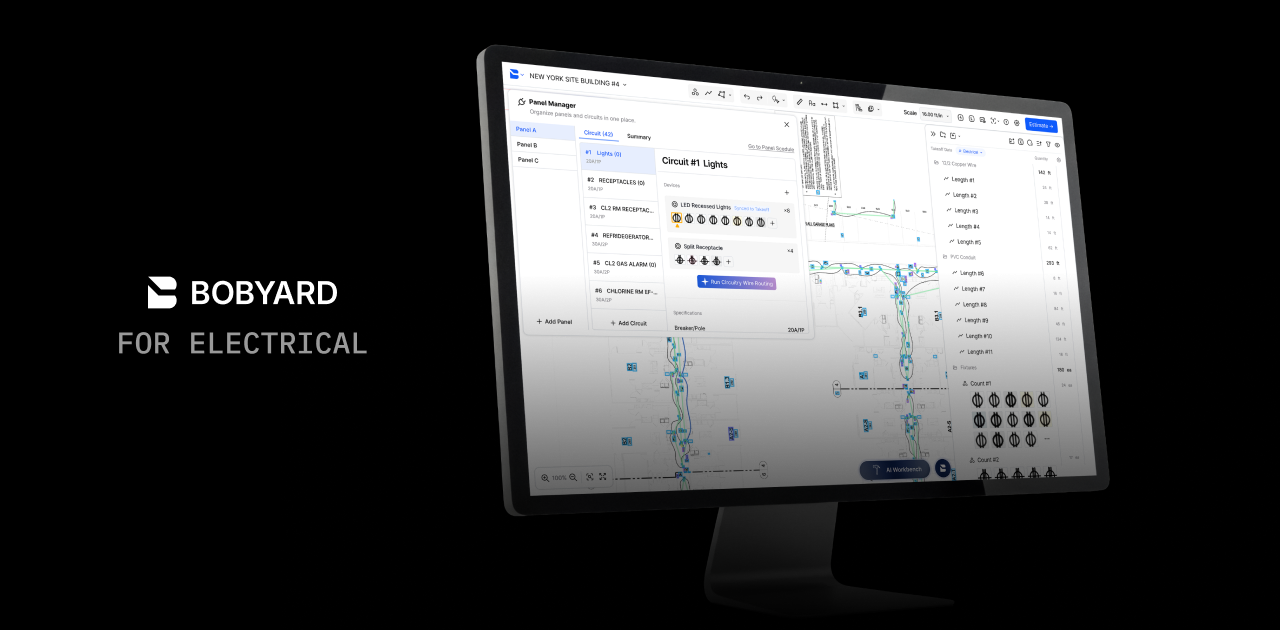
BOBYARD, FOR ELECTRICAL. A screen full of circuits, symbols and quantities that an estimator would once have tallied with a highlighter and a long night. The software counts; the human decides. San Francisco, 2026.
$35M
Series A · 2025
70%
of takeoff automated
2023
Founded
~33
Employees
The Dispatch
Somebody, right now, is counting plants on a PDF.
It is a Tuesday and an estimator is squinting at a drywall plan, clicking every door symbol, tallying every linear foot of edge, because a wrong number means a lost bid or a job that loses money. This is the takeoff - the unglamorous arithmetic underneath every building that has ever gone up. It is slow, it is thankless, and until recently it was stubbornly human.
Bobyard's whole proposition is that a computer can do the counting. Its models read the plan, detect the symbols, measure the areas and the lengths, and hand the estimator a structured pile of numbers in minutes. The human still makes the call. The machine just stops asking them to be a calculator.
It sounds modest. It is not. Construction is one of the largest industries on earth and one of the least digitized, and the takeoff sits at the exact choke point between "we could bid this" and "we don't have time." Remove the bottleneck and a four-person shop suddenly bids like a forty-person one.
This is literally the future of estimating in landscaping.
- John Barrett, Chopper Landscaping (a Bobyard customer)
The Founder
A contractor's license, earned as a teenager.
Michael Ding did not arrive at construction the way most software founders do - from the outside, holding a deck. He got a California general contractor's license as a teenager, partly out of curiosity, partly to actually understand how the industry works. The problem found him later, through his own remodeling projects, where the estimating felt absurdly manual for the year it was happening in.
Ding is a Stanford-trained engineer and an award-winning mathematician, which is a useful combination when the product you want to build is, at its core, computer vision pointed at a wall of blueprints. Bobyard went through Pear VC's PearX accelerator in the summer of 2023, raised a $3.5M seed that December, and started somewhere unexpected: landscaping.
Landscaping was a deliberate choice, not a default. It is among the least-digitized trades in construction - few tools, lots of manual measurement, a wide-open lane. Win the trade nobody else wanted, prove the model, then move outward.
By The Numbers
65%
faster takeoffs
3-5x
more bids per estimator
$1.1M
avg. added revenue / employee*
$73.9M
total raised
*Figures reported by Bobyard and its investors from customer outcomes. Approximate.
What It Does
One button where a long night used to be.
Bobyard builds a separate AI model for each trade rather than one generic do-everything engine. Here is what an estimator actually gets.
Detect & Count
Auto Count
Instantly finds and counts planting, irrigation, electrical and other symbols across a full plan set.
Measure
Auto Area
Automatically measures pavers, concrete and other material areas - no manual tracing.
Measure
Auto Length
Measures beds, edges, hardscape runs and linear quantities in seconds.
Workflow
Templates & Database
Reusable estimate templates plus vendor-quote and cost-database management.
Output
Flexible Exports
Pushes structured takeoff and estimate data into bid-ready documents.
Coverage
Trade Models
Landscaping, electrical and finishes today - mechanical and plumbing on the way.
The Money
From a $3.5M seed to a $35M Series A.
December 2023, Primary and Pear seeded it. Two years later, 8VC led a round ten times the size.
SEED · Dec 2023 · Primary, Pear VC$3.5M
SERIES A · Dec 2025 · 8VC (lead) + Pear, Primary, Tishman Speyer, RXR, Caffeinated, Merrick$35M
Bars scaled relative to the $35M Series A. Total reported funding across rounds: ~$73.9M.
The Trail
Two years, several trades.
2023 · SUMMER
Joins Pear VC's PearX accelerator (S23 cohort).
2023 · DECEMBER
Closes a $3.5M seed round from Primary, with Pear participating. Starts with landscaping.
2025 · AUGUST
Ships new features including Edge Finder and AI Item Callouts.
2025 · DECEMBER
Raises a $35M Series A led by 8VC to scale engineering, go-to-market and trade coverage.
2026 · JUNE
Launches AI takeoff and estimating for finishes: flooring, drywall, paint, insulation and doors/windows.
The Close
Back to that Tuesday.
The estimator squinting at the drywall plan is still there. But now the door symbols are already counted, the edges already measured, the quantities already stacked in a column waiting for a markup. The long night got short. The four-person shop sent out three bids instead of one, and won the one it would have missed.
That is the entire point of Bobyard, and it is a quiet one. It does not replace the estimator's judgment about what a job is worth. It just refuses to make a skilled person spend their afternoon being a tally counter. The world still gets built by people - Bobyard simply hands them back the hours that the highlighter used to steal.
Field Notes
Things worth knowing.
Founder Michael Ding earned a California general contractor license as a teenager - to learn the industry from the inside.
Bobyard started with landscaping on purpose: it's one of construction's least-digitized trades.
The problem found Ding through his own personal remodeling projects.
It builds a separate custom AI model for each trade, not one generic model.
The team nearly tripled in the year before its Series A.
Headquartered at 1800 Owens St, San Francisco, in the city's Mission Bay area.
Watch
See it run.
Product demos and interviews live on Bobyard's channels.