A horror film is an unusual place to go looking for administrative order. Bobby Balachandran went there anyway. When he began talking publicly about his Tamil production company, BTG Universal, in December 2023, one of his proposed innovations concerned getting the people making a film paid on time. Cinema had its monsters. Payroll, apparently, deserved attention too.
He was preparing to introduce his production venture with Demonte Colony 2, directed by Ajay R Gnanamuthu. Asked how he would manage another industry alongside Exterro, the software company he founded, he offered a compact answer: “I believe in people, process and technology.” It is a practical philosophy to bring to a business built around make-believe.
The interesting connection is the attention to what happens around the central performance. A film has actors, a director and a script; it also has payments, schedules and information that must reach the right person. A legal department has lawyers; its work also depends on evidence, permissions, records and the movement of tasks between teams. Balachandran has spent much of his career attending to that surrounding machinery.
A return ticket to Coimbatore
Long before the film credits, there was a government employee’s son in Coimbatore. His father, B P Balachandran, worked in the highways department and came from a farming family. A secure job helped him provide his son with an education. The eventual entrepreneur’s starting point was a household in which opportunity had to be earned and financed.
Bobby studied computer science and engineering at Government College of Technology in Coimbatore, then earned a master’s in computer science at Portland State University. His professional background included building critical software applications in financial services and telecommunications. These were environments where a broken process could become an expensive problem, and where software had already been put to work coordinating complicated operations.
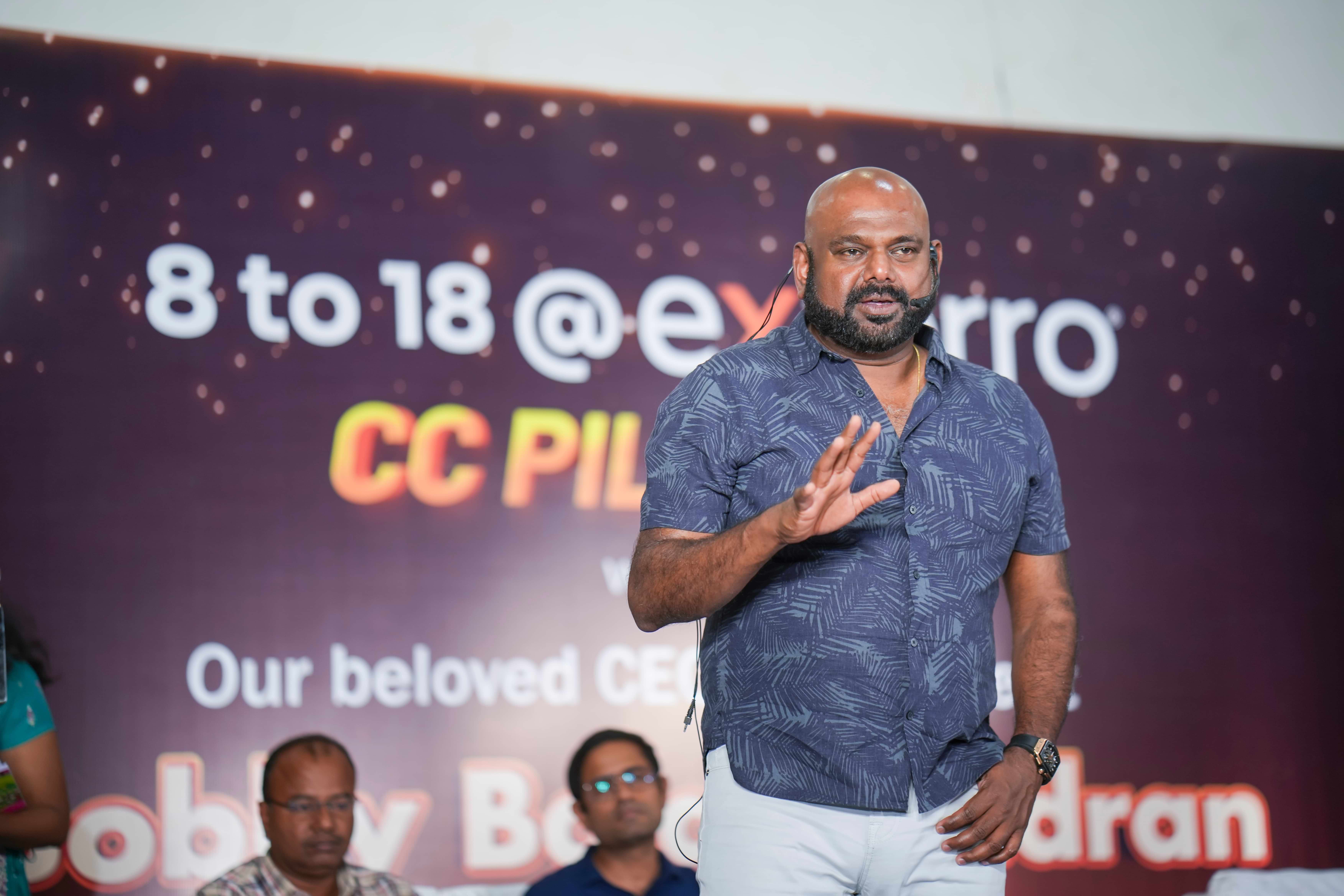
By September 2012, he was back in Coimbatore speaking to students at SNR and Sons College about entrepreneurship. He visited colleges looking for talent, offered internships and was willing to help students with an aptitude for business. The return mattered: a career built abroad had become something he could bring into a classroom at home.
He urged young people to consider the opportunities available to them and take some risk. It was advice attached to a working example, rather than a motivational poster. The student who had gone abroad was now recruiting students himself. The route out of Coimbatore had acquired a route back.
The department left waiting
In his own account, Balachandran and his team founded Exterro in 2008 because legal departments lacked the technology to deal with growing volumes of digital information. He saw a chance to apply lessons from other industries to legal work. The problem was concrete: companies needed to know what information they held and be able to act on it when litigation or other obligations arrived.
An early customer was a Fortune 100 company. That gave the young business a demanding place to test its ambitions. The vocabulary could be forbidding - e-discovery, legal governance, risk and compliance - but the underlying concern was familiar to anyone who has waited for another department to send the thing they need.
Balachandran wanted a broad software platform for legal operations. That meant connecting work that organizations often divided among legal, privacy, security and IT teams. Evidence might have to be found, preserved, collected and reviewed. Each step created another opportunity for a delay or a lost thread. Exterro’s business grew around making those steps work together.
A conceptual map of the connected work behind Exterro’s platform.
Buying the missing pieces
The expansion became visible through acquisitions. In June 2019, Exterro bought Jordan Lawrence, adding data privacy and information governance software. The rationale was overlap: the information a company needed to locate for a legal matter could also be the information it needed to understand for privacy and governance purposes. Separate obligations were arriving at the same filing cabinet.
AccessData followed in 2020, bringing digital forensics and the FTK product family into the company. Balachandran spoke about supporting investigators and the rule of law, alongside the commercial logic of combining forensics, privacy and e-discovery. He emphasized preserving evidence and maintaining its integrity. An investigation needs useful findings and a defensible account of how those findings were reached.
In January 2023 came Zapproved, a fellow Portland software business. Balachandran had known its CEO, Monica Enand, since the early days of their companies. He described the combination in terms of Exterro’s product development and Zapproved’s customer experience. The connection carried a local history within a business increasingly organized around global customers.
Later in 2023, Exterro acquired Divebell, whose technology had already powered Exterro Data Discovery through a partnership. Here the missing piece was knowledge of the data itself. A company cannot sensibly manage information it has failed to identify. For Balachandran, bringing that capability inside Exterro supported the wider plan to connect discovery, investigations, privacy and governance.
A billion dollars, and a hiring regret
In July 2022, Exterro announced a recapitalization transaction valuing the company at more than $1 billion. Leeds Equity Partners, which had invested in 2018, remained involved; Coller Capital and Glendower Capital co-led the supporting institutional investor group. Exterro said revenue had more than quadrupled since the initial Leeds investment and reported more than 3,000 customers worldwide.
Those figures describe a company valuation and a period of company growth. They are useful markers in a career that began with an operational complaint and developed into an international software business. They also give some scale to the less glamorous work of putting together products, teams and systems.
Asked about mistakes in 2022, Balachandran identified a hiring decision: he wished he had brought in an experienced chief revenue officer earlier. He thought that might have accelerated growth. He also singled out consolidating research and development in India as a difficult decision that had proved right. His account of progress was a series of choices, with room for misjudgment.
The same interview offered a quieter explanation for his persistence. He described curiosity about how things work, why they work that way and how they could improve. It is an appetite with rather inconvenient working hours: once a person starts noticing poorly arranged systems, there is no shortage of material.
At the July 2022 recapitalization transaction.
Room to make a mistake
Balachandran’s description of his preferred workplace is less stern than a process chart might suggest. In 2022, he spoke about an open, respectful culture, a relatively flat hierarchy and employees feeling valued. He argued that people needed enough security to make mistakes if they were going to attempt anything new.
He also called giving back a highlight of his role. Exterro’s initiatives included paid volunteering time, matching employee donations, subsidized FTK licenses for students and free FTK Imager training for law enforcement. These programs put some of the company’s resources behind access to skills and tools.
Recognition arrived along the way: Portland’s 40 Under 40 in 2010, an EY Entrepreneur Of The Year regional finalist place in 2019, LegalTech CEO of the Year in 2021 and the Fastcase 50 in 2022. When discussing the EY nomination, he credited the team and the work of assembling colleagues with different expertise. For someone who sells coordination, the emphasis was consistent.
“I don’t think of entrepreneurship as an individual endeavor.”
Bobby Balachandran · 2019
The second set of credits
BTG Universal gives that career a different public surface. Its website names Balachandran as founder, chairman and producer. The company’s activities include films and music, with ambitions extending across Indian cinema and Hollywood. The change introduces a different audience: people who may never encounter enterprise legal software can encounter his name in a film’s credits.
His producer credits include Demonte Colony 2 in 2024 and Chennai City Gangsters and Retta Thala in 2025. The titles alone make a lively addition to a résumé otherwise concerned with information governance. The work involves directors, performers and production teams, giving his interest in coordinating people another setting.
The attraction is easy to see in his public explanation of the venture. He sees entertainment as a field with growing demand for quality content and room for better ways of organizing production. His stated ambitions include entertainment beyond films. The producer’s business questions sit alongside the creative ones: who has the information, who makes the decision, and how does the work get completed?
The next handoff
By May 2026, Balachandran was describing another stage of Exterro’s software ambitions. ARMOUR, short for Autonomous Risk Management, Orchestration, and Unified Response, set out a framework for governed AI execution. Subpoena Manager was its first product application. In July, he discussed the framework with Mary Mack and Holley Robinson on the Illumination Zone podcast.
His May essay began with an ordinary organizational sequence: a subpoena arrives, emails go out, a spreadsheet opens, and teams begin coordinating. The proposed response was software that could carry out connected work while applying policy and recording its actions. The launch emphasized human oversight and defensibility. These are declared design goals, with trust central to the proposition.
Across the career, the recurring subject is the work between the visible milestones. A college visit becomes an internship. An acquisition becomes an integration job. A film requires a payment run. A legal request sets several departments moving. Balachandran keeps returning to the arrangements that allow other people to finish what they started. Even in a horror film, somebody has to settle the accounts.
Follow the work
Conversations, writing, films and public profiles.