Pull up any app on your phone, and sooner or later the same slab of keys slides up from the bottom of the screen. It is the most-used surface on a smartphone and the one nobody thinks about. Bobble AI thought about it. The Gurugram company spent a decade building a keyboard that types in 140-plus languages, turns your selfie into a cartoon, and reads the intent behind a half-typed message - and then it quietly turned all of that into a media and data business used by more than 100 million people.
Founded in 2015 by brothers Ankit and Rahul Prasad along with Mohd Wassem, Bobble started where most Indian keyboard stories start: language. Global apps could handle English fine, but typing Hindi, Tamil or Marathi on a phone was clumsy. Bobble leaned into transliteration - type "kaise ho" and get "कैसे हो" - and speech recognition across nine Indian languages. That was the wedge. The interesting part is what the company decided the keyboard could become once people were living inside it.
01 / THE IDEAA surface, not an app
Ankit Prasad, an IIT dropout, likes to describe Bobble not as a keyboard but as a "Conversation Media Platform." The phrasing is deliberate. A keyboard is a utility you install and forget. A media platform is something brands pay to appear on. Bobble's bet is that the space between your thoughts and your send button - the moment you are choosing words, stickers and GIFs - is prime, unclaimed real estate.
Out of that bet came a category the company named itself: conversation media marketing. Instead of interrupting you with a banner, a brand's sticker or GIF simply becomes available in the keyboard while you chat, ready to drop into a group thread. The ad is the message. You send it to your friends yourself.
02 / THE PRODUCTWhat you can actually do with it
On the consumer side, Bobble AI Keyboard is free and does the ordinary things well - autocorrect, prediction, voice typing. Then it does the less ordinary. You can shoot a selfie and get a "bobblehead," a cartoon avatar of yourself that becomes a set of stickers. You can generate memes, wallpapers and AI stories from a phrase. In early 2025 the company added "Always On Assistance" - floating AI pills that surface help inside whatever app you are using, not just the keyboard. Power users pay for Bobble Club, a subscription that unlocks the unlimited version of all of it.

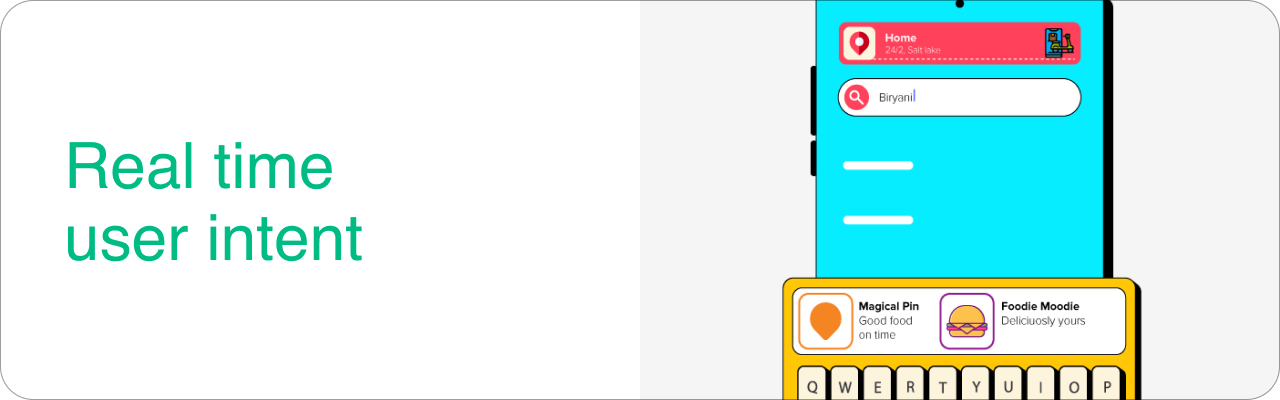
On the business side, the same keyboard splits into four products. Branding Solutions put branded content into conversations. Performance Solutions use real-time typing signals for contextual, intent-based ad targeting. Technology Solutions license the keyboard SDK, the selfie-to-avatar engine and the Indic language suite to phone makers and other apps. And Data-as-a-Service packages first-party mobile behavior into insights brands buy to understand what people actually do on their phones.
03 / THE CUSTOMERSTwo audiences, one screen
There are really two Bobbles. One serves the 100 million-plus people - roughly 50 million of them active - who type on the keyboard across India and Southeast Asia, skewing young but not only young. The other serves brands, agencies, phone manufacturers and app developers who want a way into conversations without buying another feed placement. Chief Business Officer Ravi Shharma has been blunt that while Gen Z is the loudest audience, conversation media marketing reaches every age group.
04 / THE MONEYA business built on quiet real estate
Bobble makes money from both sides: consumer subscriptions on one end, and advertising, licensing and data on the other. The numbers are those of a real, mid-scale business rather than a hype machine. Revenue was around 27.4 crore rupees in FY25, down from 40.6 crore the year before - a reminder that ad-adjacent revenue moves with the market. The company has raised more than $37 million across its rounds.
The most notable name on the cap table is Krafton, the South Korean game publisher behind PUBG. Krafton led Bobble's Series C in 2022 and returned in August 2025 with a ₹12.9 crore (roughly $1.5 million) Series D, lifting its stake to about 24.8%. That round came at a roughly $98 million valuation, down about 30% from the Series C mark - a haircut, but also a strategic investor doubling down rather than walking.
- 2025 / AugSeries D - ~$1.5MKrafton; stake rises to ~24.8% at a ~$98M valuation.
- 2022 / SepSeries C - ~$26MLed by Krafton; valuation around $138M.
- 2019Series BElevation Capital (formerly SAIF Partners), Xiaomi.
- 2017Series AElevation Capital (SAIF Partners).
05 / THE COMPETITIONFree is the rival
Bobble's competitors are not scrappy startups. They are Google's Gboard and Microsoft's SwiftKey - keyboards that are free because you are the product of a much larger business. Grammarly hovers on one flank; sticker-and-GIF apps like Touchpal and Heypster on another. Bobble's answer is not to out-polish the giants but to out-localize them: deeper Indian-language support, avatars, and a keyboard tuned for a market the incumbents treat as an afterthought. Its 23-plus patents and handful of research papers are the receipts for that depth.

06 / THE FITWhere it sits in the market
Bobble occupies an unusual seam: part consumer app, part adtech, part data business, all riding on a single keyboard. That breadth is its strength and its complication. The upside is optionality - the same install can be monetized four different ways. The pressure is focus, in a market where the free alternatives never sleep. For the next billion smartphone users typing in a language Silicon Valley still handles awkwardly, Bobble has built something the giants have not prioritized. Whether the keyboard becomes a durable media channel or stays a clever utility is the question the next few rounds will answer.