Consider a donation marked “scholarships only.” The payment clears. A thank-you goes out. Somewhere behind that pleasant exchange, someone must remember the restriction, recognize the donor, reconcile the deposit and explain the balance to a board. Generosity has created a small administrative puzzle. Multiply it across thousands of supporters and several departments, and the puzzle becomes a software business.
- The job: connect fundraising, finance and the people behind each gift.
- The buyers: charities, schools, universities, foundations and corporate giving teams.
- The decision: whether those connected workflows justify the cost and organizational effort.
Blackbaud occupies that space. Its name rarely appears in the emotional part of a fundraising appeal. Its products handle much of the work that follows. The company reports that customers raise, grant or invest more than $100 billion through its software annually. That is money moving through customer activity, not Blackbaud’s sales. The distinction matters: this company sells infrastructure for other people’s missions.
A school bill, then a sector
The origin is almost stubbornly practical. In 1981, founder Anthony Bakker answered a newspaper advertisement seeking someone to build student-billing software. Blackbaud’s anniversary account traces the company to that assignment. There was a specific job, a customer prepared to pay for it and a product that could travel beyond the original customer.
The early problem helps explain the later company. Schools need tuition records; development offices need donor records; finance teams need accounts that respect restrictions on money. These are related information problems with different rules. Blackbaud kept building around those rules. Today its expertise spans fundraising, nonprofit accounting, education administration, corporate giving and grantmaking.
Follow the gift
Raiser’s Edge NXT is the fundraising side: donor histories, campaigns, gifts, relationships and follow-up. Financial Edge NXT is the accounting side: funds, budgets, payables and reporting. Connecting them addresses a familiar institutional irritation: the fundraising department and the finance department should not need competing spreadsheets to describe the same donation.
- 01Know the supporterDonor record · giving history
- 02Receive the giftDonation · payment · acknowledgement
- 03Account for the moneyFund · deposit · general ledger
For a development officer, that means seeing past gifts before the next conversation. For a finance colleague, it means knowing where the money belongs. Neither task is glamorous. Both can become urgent when a supporter asks a question that crosses departmental boundaries. The software is useful when the answer survives that crossing.
The surrounding products follow the work outward. Altru combines ticketing, membership and fundraising for cultural organizations. Education tools manage admissions, student information and billing. YourCause supports corporate giving and volunteering; Grantmaking serves funders distributing money. Publicly featured customers include Boston University, Save the Children and Los Angeles Regional Food Bank. The common thread is organizational complexity, rather than one particular cause.
That breadth shapes its market position. Salesforce’s Agentforce Nonprofit offers fundraising within a broader CRM ecosystem. Bloomerang combines donor management, fundraising and volunteer tools. Blackbaud competes through sector-specific workflows and connections across departments. Its public SKY APIs let technical teams extend those connections. Buyers still need to decide which connections they will actually use.
The subscription behind the appeal
The economics look like an established software operation. Blackbaud reported $1.128 billion in 2025 revenue; 98% was recurring. That category includes subscriptions and transaction-linked income, so it should not be read as subscriptions alone. In the second quarter of 2026, revenue reached $290.6 million, up 3% from a year earlier.
Customer pricing is tailored by quotation. The sensible comparison therefore includes implementation, migration, training, payment charges and renewal terms, alongside the subscription. A useful October 2026 example is the direct Mailchimp integration: Blackbaud says it adds no integration charge for Raiser’s Edge NXT customers, but a paid Mailchimp plan and Manager-level access are required. “Included” still has boundaries.
For a small organization collecting straightforward donations, this range of software may exceed the work at hand. For a university coordinating advancement and finance, the same range may address expensive handoffs. That is a judgment about fit. A polished demonstration cannot make it for you.
The company’s own workplace reflects its sector focus. Blackbaud describes a remote-first culture with employee development and philanthropic participation. In June 2026, its Juneteenth observance included a learning session and virtual volunteering. Those are concrete practices behind the stated purpose, although a company’s description of its culture remains its own account.
A $750 million detour
Specialization did not prevent an ambitious expansion. Blackbaud announced its approximately $750 million cash-and-stock purchase of EVERFI in January 2022, pitching access to a larger corporate social-impact market and cross-selling opportunities.
The economics disappointed. Its 2024 annual report describes continuing underperformance despite leadership changes, restructuring and the disposal of a non-recurring business component. Management explored alternatives. On December 31, 2024, Blackbaud sold EVERFI for a nominal amount; YourCause remained. The report recorded $390.2 million in noncash impairment charges and a $15.2 million disposition loss. Those accounting charges are distinct from the original purchase price.

The database has a memory
There is another obligation attached to remembering donors: protecting them. Following the 2020 ransomware incident, the SEC found that Blackbaud’s disclosures misrepresented the scope of stolen sensitive information. Blackbaud agreed in 2023 to a $3 million penalty without admitting or denying the findings.
In May 2024, the FTC finalized a separate order settling allegations of inadequate security. It required a comprehensive security program, deletion of unnecessary data and a retention schedule. For customers, the lesson belongs in procurement: ask how information is protected, when it is deleted and how incident updates reach decision-makers.
Can the machine understand giving?
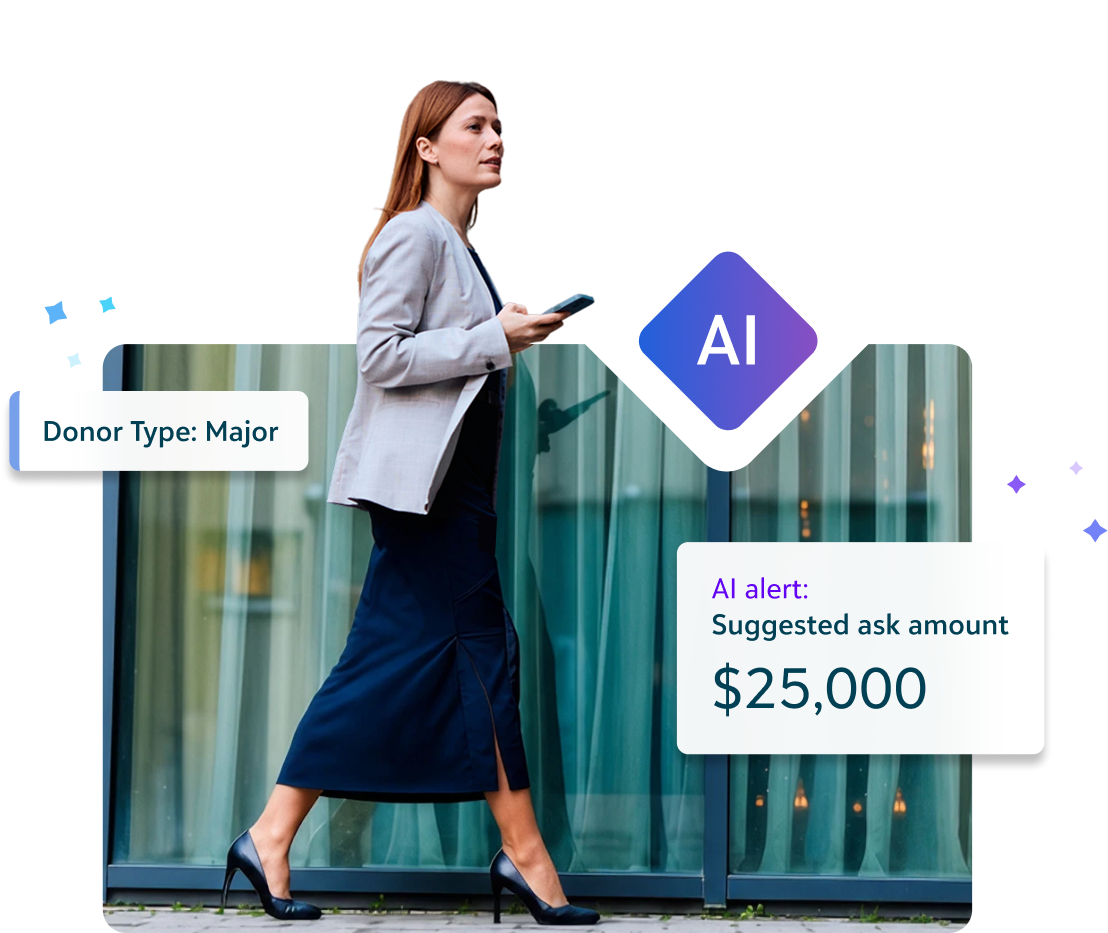
Blackbaud’s current wager puts AI inside these specialized workflows. Its Development Agent became generally available to U.S. Raiser’s Edge NXT customers in March 2026, supporting donor engagement under human oversight. Lantern, announced with Databricks in September, is a separate fundraising-specific model; initial product capabilities are planned for 2027.
“Lantern learns from philanthropy”
Mike Gianoni · September 2026
The practical test remains wonderfully unglamorous. Follow one gift from donor record to deposit to ledger. Assign someone responsibility for the data. Check what is available today. Then ask whether the people using the system have time to learn it. Blackbaud’s opportunity lives in those details: fewer handoffs, clearer records and more time for the next conversation.