The machine belonged in a convenience store. That was the insight. Bitcoin, a currency associated with invisible networks and difficult passwords, could be sold from a cabinet beside the things people already understood: snacks, lottery tickets, a cash register. Bitcoin Depot built a business around that small act of translation. By December 2025, it reported approximately 9,700 owned and leased kiosks. Five months later, its network went dark.
- The proposition: turn physical cash into bitcoin through familiar retail locations.
- The economics: customer markups paid for machines, floorspace, software and cash handling.
- The reversal: regulatory pressure and weaker transaction activity preceded a May 2026 bankruptcy filing.
A machine that could work while its founder slept
Brandon Mintz founded Bitcoin Depot in 2016 after graduating from the University of Georgia. His previous venture, Cash To Crypto, involved manual work. In a 2023 podcast interview, he described putting a few bitcoin ATMs in Atlanta and discovering something pleasing: the machines could make sales while he slept. Automation offered a way to expand beyond his own working hours.
The customer problem was straightforward. Online exchanges generally assumed a connection to conventional financial services. Bitcoin Depot offered another entrance: bring cash, complete the required verification, supply a wallet address and buy bitcoin. Its stated mission centered on people who preferred cash. The intended audience included consumers poorly served by banks, alongside anyone who wanted a purchase they could make in person.
This was a retailer of cryptocurrency with a physical distribution system. Its expertise had to include store relationships, kiosk maintenance, cash collection and transaction screening. A cabinet that cannot accept a bill is a surprisingly effective way to make digital finance stop working.
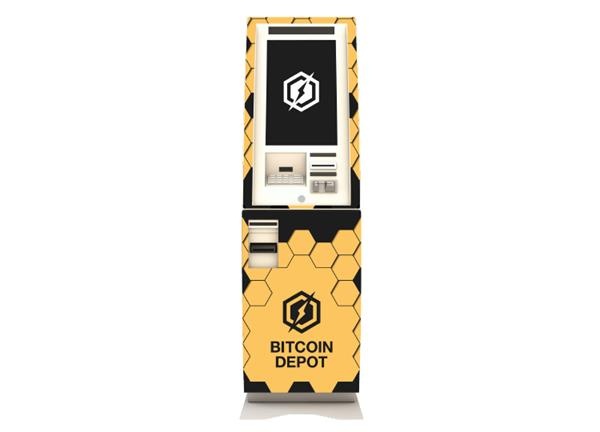
The checkout counter became another entrance
Circle K supplied distribution at a different scale. When the companies announced their partnership in July 2021, more than 700 machines were already installed across 30 states. Bitcoin Depot could enter an existing stream of shoppers rather than persuade people to visit a dedicated cryptocurrency shop. Retailers gained another use for their floorspace.
Then came a useful question: did every new location need a machine? Launched in June 2022 with InComm Payments, BDCheckout used the Bitcoin Depot app and the VanillaDirect retail network. A customer generated a barcode, handed cash to a cashier and completed the bitcoin purchase through the app. Existing checkout infrastructure could do part of the work of a new kiosk.
There was an equally practical improvement behind the screen. In February 2023, Bitcoin Depot announced that roughly 7,000 kiosks had moved to BitAccess software. The conversion eliminated outside licensing fees that had exceeded $3 million over the preceding measured twelve months. Technicians swapped in preloaded hard drives; approximately 6,000 machines were converted in ten weeks. This is a business lesson worth keeping: standardize the field operation before sending people into the field.
Convenience had a price
Bitcoin Depot earned money by selling bitcoin above its acquisition cost and charging transaction fees. Its 2025 annual report disclosed kiosk markups ranging from 15% to 50% of the dollar transaction amount during the periods presented, reflecting pricing tests. BDCheckout's disclosed markup was 15%. Those figures describe historical pricing, rather than a universal quote for every customer or jurisdiction.
That made the product a particular kind of convenience. Someone comparing prices with a bank-funded online exchange might find the premium difficult to justify. Someone holding cash faced a different set of choices. CoinFlip and other kiosk operators competed for that physical transaction; online exchanges competed where customers could comfortably use banking rails.
The revenue headline also needed unpacking. Bitcoin Depot reported $614.9 million for 2025, up from $573.7 million in 2024. Revenue included the bitcoin being sold, rather than consisting entirely of fees. The subsequent annual filing recorded approximately $4.7 million in net income. A large sales number could coexist with a much narrower financial cushion.
The trouble arrived before the shutdown
By year-end 2025, Circle K had notified Bitcoin Depot that it would not renew its contract. Its locations accounted for approximately 800 deployed kiosks and 18% of annual revenue. Distribution had created reach; concentration now created a relocation problem. A machine count alone could not tell an investor how durable the business was.
The public-market milestone had arrived on June 30, 2023, when Bitcoin Depot closed its combination with GSR II Meteora Acquisition Corp. Trading under BTM began July 3. The distinction matters when reading its history: GSR II was the merger vehicle that became Bitcoin Depot Inc., rather than a separate operating parent still sitting above an unchanged private business.
Consumer protection posed a deeper challenge. In February 2026, Massachusetts sued Bitcoin Depot, alleging deceptive practices and facilitation of cryptocurrency scams. These were allegations, not established findings. That month, the company separately announced a phased rollout requiring identification for every kiosk transaction. A familiar store setting could simplify access, but it could not establish whether someone directing a customer's payment was legitimate.
Management's language changed quickly. In March, then-CEO Scott Buchanan presented tighter rules as constructive for the industry's future. In May, CEO Alex Holmes described transaction limits, restrictions, enforcement and litigation as pressures that had made the business model “unsustainable.” On May 17, Bitcoin Depot and affiliates filed for Chapter 11 to wind down and sell assets.
The company’s current business model is unsustainable.Alex Holmes, CEO, May 2026
What survives a switched-off network?
In September 2026, Bitcoin Bancorp announced that it was acquiring assets including approximately 2,446 kiosks, floorspace agreements, intellectual property and the BitcoinDepot.com domain. Some portions had closed; remaining closings were still conditional. An asset purchase did not establish that Bitcoin Depot's former service had resumed.
The Canadian proceedings followed a parallel legal path. Ontario recognized the U.S. proceedings in May 2026, with Alvarez & Marsal Canada acting as information officer. The geographic reach that had once been a growth statistic now meant coordinating a wind-down across jurisdictions.
The transferable ideas remain concrete: enter existing customer routines, reuse checkout infrastructure and own software where the savings justify it. They depend on affordable distribution, workable customer protection and demand that survives tighter controls. For former customers, the practical destination is now the bankruptcy claims process. Bitcoin Depot made buying digital money tangible. Its ending makes the obligations of selling it tangible, too.