In 1977, a cassette tape offered an accountant something a classroom could not: control of the clock. Bisk, founded six years earlier to prepare people for the CPA exam, put courses on tape. A learner could decide when to press play. Long before anyone discussed an online learning experience, the company was working on a stubborn problem. Education had to fit around employment.
The useful version
- Bisk helps universities build, market and support online programs.
- Employers use its Amplified platform to connect workers with education benefits and university courses.
- The university supplies the academic authority; Bisk supplies much of the machinery around it.
That distinction explains a business whose name can be less familiar than the institutions it serves. Bisk operates behind university brands, where a lecture must become a usable course and an interested adult must become an enrolled student. Its product includes the unglamorous steps that make those transitions possible.

The work around the lecture
A professor knows the subject. That leaves a considerable to-do list: assess demand, design the online experience, produce materials, attract applicants and help students keep going. Bisk sells those capabilities together through fully managed partnerships or separately through project-based engagements.
Its market research looks at employment demand and competing programs before an institution commits resources. Learning designers work with faculty to turn lectures and assessments into online coursework. Marketing teams build campaigns and enrollment paths. Support teams handle onboarding, registration reminders and outreach to students who have paused.
Academic instruction, evaluation and admissions decisions remain with the university. Bisk’s expertise is the operation surrounding them. The distinction matters to buyers comparing it with a learning platform alone: software is one component in a service relationship involving people, production and continuing contact.
Alternatives include online-program partners such as Noodle and Risepoint, alongside internal teams. Bisk’s particular pitch combines university program operations with employer access through Amplified, extending the relationship beyond a campus’s own enrollment channels.
Four jobs behind one course
- 01Validate
demand - 02Design
courses - 03Recruit
learners - 04Support
persistence
For university leaders, the choice is partly about coordination. Hiring a course designer leaves the enrollment campaign and ongoing support to somebody else. A single partner can join those tasks, while a limited engagement can complement an existing team. The sensible scope depends on what the institution already does well, what it needs to launch and what it wants to learn to do itself.
Bisk reports more than two million enrollments since inception. Read the noun carefully. An enrollment is participation in a program; the figure does not establish how many distinct people graduated or earned more afterward. It describes the reach of an operation, rather than settling the question of educational outcomes.
The customer who learned to leave
One historical customer exposes the bargain. Saint Leo entered a relationship with Bisk in 1997, receiving instructional design, technology support, marketing and recruiting in return for a share of online tuition. In 2008, the university dropped Bisk and began bringing those services inside.
By the time Inside Higher Ed reported the transition in 2011, Saint Leo’s president said the institution had developed sufficient expertise and capital to operate independently. Building its own support infrastructure required $9 million. The relationship had helped a customer acquire the means to leave.
For a university, that makes outsourcing a decision to revisit as its capabilities grow. A partner can close an immediate capacity gap. Once online education becomes a substantial internal operation, ownership and economics can point elsewhere. Bisk’s current fee-for-service menu offers a narrower choice: buy help for a particular job.
“Nathan founded the OPM field, and proved that outside firms could bring universities online successfully.”
John Katzman, quoted by Inside Higher Ed, 2017
A benefit with a front door
Employers present a related coordination problem. A company may offer tuition assistance while leaving workers to connect the policy, an eligible course and an application themselves. Bisk Amplified puts program discovery, preferred pricing and benefits guidance into a portal carrying the employer’s brand.
A December 2023 announcement named U.S. Bank, Moody’s, Albertsons and the State of Michigan among its organizational partners. The proposition is practical: give workers a place to start and someone to guide them. Employers get a workforce education offering without assembling every university relationship themselves.
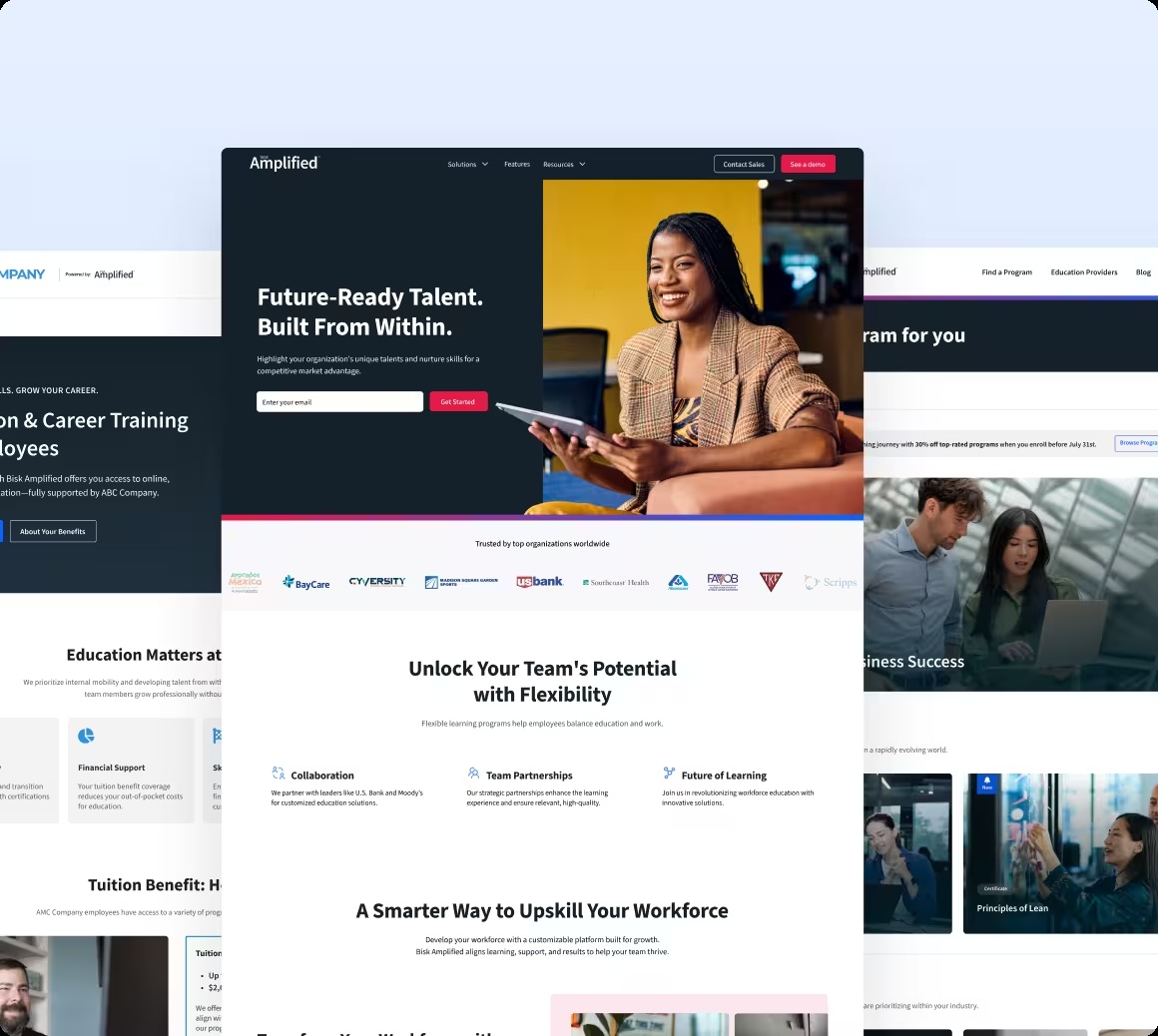
Bisk advertises zero upfront cost to launch Amplified. Tuition remains a separate expense, subject to program prices and employer coverage. In June 2026, a Tuition.io partnership connected education benefits to more than 60 university programs, adding another route between an employee’s eligibility and enrollment.
Shorter steps into new work
The USF Health Informatics Microcredential makes the division of labor visible. USF Health confers the credential, AMIA contributes standards alignment, and Bisk enables online delivery and access. Announced in November 2025, the program combines four self-paced courses with case-based work and an AI teaching assistant called HiTA.
The current program page lists 96 clock hours and a $499 price for all four courses, or $139 individually, as of October 2026. For a healthcare worker, that creates a defined commitment for exploring data, workflows and technology. A learner should still compare the curriculum with the qualifications a particular job requires.
USF Health Informatics Microcredential · October 2026
The 2026 announcements broaden that approach. ProsperU pairs Prosper’s hospitality assessment with a workbook and 20 short courses. Michigan State’s new AI and business analytics series offers four courses aimed at managers and professionals. These are targeted learning propositions; their announcements describe designs and ambitions, rather than proving retention or promotion gains.
Start with the handoffs
The lesson readers can borrow is to trace the journey before buying another catalog. Who checks demand? Who explains the benefit? Who contacts the person who stops attending? Assign an owner to each handoff. Then decide which capability belongs inside the organization and which deserves outside help.
That exercise also clarifies the buying decision. A university with an experienced online team may need only course production. An employer may need help explaining its existing tuition policy. A learner may need a shorter course and a dependable contact. Those are different requests, and treating them separately makes it easier to judge whether the service on offer solves the actual problem.
There is a pleasing continuity here. The cassette gave a working adult control over when learning happened. A portal, a coach or a shorter credential addresses other obstacles around the same adult. Bisk’s story is a reminder to look beyond the lesson itself, toward the conditions that let someone take it.