A course catalog can offer hundreds of possibilities and still leave a student unable to answer a modest question: what should I take next? In 2012, Sabih Bin Wasi spent a weekend putting prerequisites into a spreadsheet and arranging future semesters. He wanted to study computer science and business. Before he could enjoy the education, he had to organize it.
The spreadsheet is an unglamorous place for a company to begin. It has none of the theatrical advantages of a garage. But it explains the work Sabih has spent the years since pursuing. A university may possess every piece of information a student needs, while the student remains unable to assemble a usable picture. The distance between having information and being able to act on it became his business.
Today, he is the co-founder and CEO of Stellic, a degree planning and advising platform. Its beginnings were personal, its early collaborators were classmates, and its name remembers a teacher who helped him find his way. The story keeps returning to the same small act: making a complicated decision easier for the person who actually has to live with it.
Before the planner, a partnership
Sabih grew up in Karachi, Pakistan, with a teacher and a civil engineer as parents. At Carnegie Mellon University in Qatar, he studied computer science and pursued a business minor. He graduated in 2015. His academic interests already crossed boundaries; the paperwork involved in crossing them was less accommodating.
Rukhsar Neyaz, another computer science student, had her own reason to care about degree planning. She wanted to add a business administration minor. The requirements were unclear, her adviser lacked complete information, and she abandoned the plan. A choice can disappear that quietly. Nobody needs to reject an application. Sometimes the difficulty of working out what is possible does the rejecting.
Rukhsar became Sabih’s co-founder and is also his wife. Their collaboration predates the company: in 2014, they co-authored research with Houda Bouamor and Behrang Mohit on identifying sentiment in Twitter posts. The work appeared at the Semantic Evaluation workshop in Dublin. On campus, their Twitter sentiment analysis project won both first place and best poster at the annual Meeting of the Minds research symposium.
That earlier work gives the partnership some texture. Before university software and institutional sales, there were research questions, experiments and a poster to explain them. They had already practiced making something together and presenting it to other people. A startup would demand more of that habit, across rather larger rooms.
The adviser inside the name
Mark Stehlik helped Sabih navigate Carnegie Mellon. The relationship reached beyond requirements and schedules into conversations about what he wanted from his life. Some influential faculty members, Sabih has explained, never taught him a course. Their offices were places where he could bring a problem and ask for help.
Stellic’s name is a play on Stehlik’s. It is a revealing choice for a software company: the tribute goes to someone who listened. Naming a product after an adviser also leaves a useful reminder hanging over every discussion about efficiency. The human encounter mattered enough to become part of the company’s identity.
“The help I got from people like Mark is baked into Stellic’s features today.”
Sabih Bin Wasi
Carnegie Mellon became Stellic’s first client. In April 2017, the platform was being rolled out to the Pittsburgh campus for fall registration. Students could drag courses into semester plans; advisers could review those plans, exchange notes and spot problems. The shared view promised to make appointments less about checking boxes and more about academic goals and careers.
That distinction matters in an ordinary meeting. A student who spends the appointment reconstructing a schedule has less time to discuss why the schedule exists. A clear plan gives both people something concrete to examine. It can make room for a better question, including whether the student still wants the destination written at the top.
A company needs its own directions
The early product was called Metis. Its team combined computer science, business and design: Jiyda Moussa, an information systems graduate with a graphic design concentration, helped build it alongside Sabih and Rukhsar. Musab Popatia joined the project and became a co-founder and engineering leader. An academic planner was acquiring a company around it.
The transition took practical support. In 2015, the team participated in XLR8 at Qatar Science & Technology Park, then moved into incubation. Mentoring, workspace, funding and help establishing a legal entity gave the graduates a way to continue. The business itself needed guidance, just as its intended users did.
The team later joined Alchemist Accelerator in Silicon Valley. In the early American chapter, Sabih was meeting universities and investors and spending substantial time in transit. By June 2017, the company had Carnegie Mellon and Tufts as clients, and he was talking about a summer road trip to visit more colleges. The work involved selling a tool for planning while living a fairly itinerant professional life.
His early pitch had a concrete institutional benefit. Planned courses could tell administrators what students expected to take before registration arrived. A collection of individual intentions could become useful evidence for scheduling. The student’s next decision and the university’s next timetable were connected; the product made that connection visible.
A conceptual view of Stellic’s planning approach, rather than a product screenshot.
The students between appointments
By 2022, investors were describing another reason the tool mattered: advisers with heavy caseloads could struggle to reach students who neither asked for help nor attracted an urgent warning. Impact Engine called this group the “silent middle.” The phrase captures a familiar institutional problem. Being quiet is a poor way to announce that you need assistance.
Stellic integrated with existing student information and learning management systems. It could connect requirements, plans and alerts without asking a college to replace its entire infrastructure. For an adviser, less administrative reconstruction could mean more capacity to support a student. For a student, a warning about a course change could arrive while there was still time to reconsider.
The company received a Gates Foundation grant to investigate technology challenges around advising and degree progress. In March 2022, it announced an $11 million funding round led by Reach Capital, with participation from education technology founders including John Katzman, David Blake, Matt Pittinsky and Dan Carroll. Sabih wanted to build a community involving students, advisers, registrars and academic leadership.
Those groups do not experience a university in the same way. A registrar needs a dependable account of requirements. A student wants to know whether a choice will work. An adviser needs enough context to have a useful conversation. Bringing them together asks Sabih to keep translating the original student problem into several professional languages.
Returning with a longer answer
Recognition followed: Sabih and Rukhsar were included in the Forbes 2020 30 Under 30 education list, announced in late 2019. In 2024, Carnegie Mellon named Sabih, Rukhsar and Musab to its Tartans on the Rise cohort. The honors acknowledge a venture whose relationship with its university continued well beyond graduation.
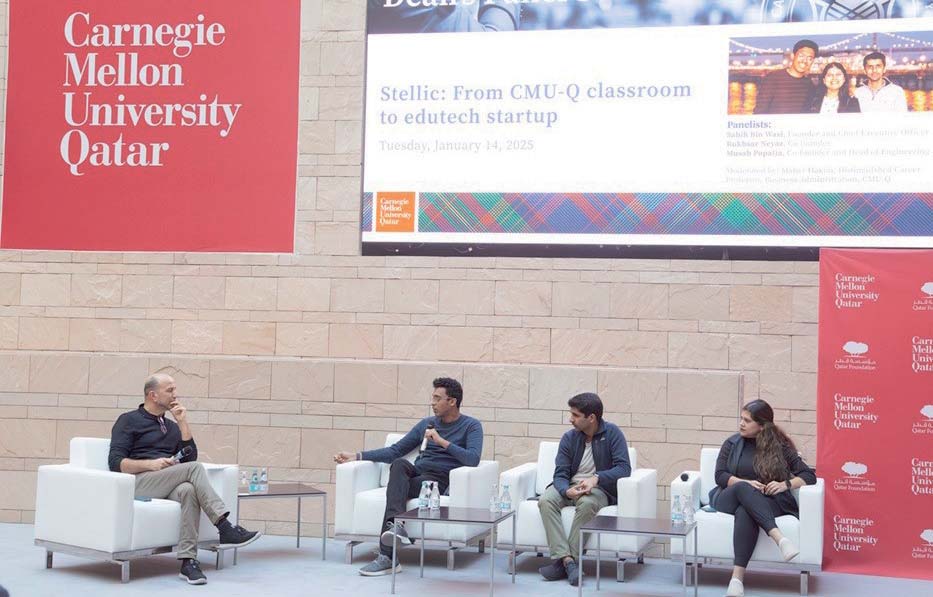
In January 2025, the founders returned to the Qatar campus for a panel moderated by Maher Hakim, who had advised them since their student days. By that February, the university reported that more than a million students had used Stellic and that it served more than 100 colleges and universities. The class project had become a topic for a class to study.
“Do the work because your heart is in it.”
Sabih’s advice to students on returning to CMU-Q
There is a satisfying reversal in that visit. The people who once needed assistance were now being asked how they had built something. Sabih’s advice emphasized commitment to the work. A decade of university requirements, integrations and conversations is a demanding way to test whether a person likes the problem he has chosen.
Keep a seat for the intern
His relationship with students also extends inside the company. In an April 2025 conversation with Jesse Chor, Sabih described an intern who stayed in touch, returned as an early full-time employee and eventually became Stellic’s CTO. The company was also preparing an official co-op program with the University of Waterloo.
The anecdote offers a useful scale for leadership. A hiring decision that looks small at the time can help determine who leads the organization years later. Keeping contact with someone after an internship creates the possibility of a second chapter. The student is allowed to become more than the temporary role printed on the offer letter.
For Sabih, that is also a practical connection to the audience he serves. He began as a student with a problem worth building around. Students joining the company bring their own recent experiences of college. Listening to them is consistent with the way the business began, and gives that founding habit somewhere to continue.
A plan that can change its mind
In his November 2025 conversation with Will Geiger, Sabih encouraged students to make a plan while remaining ready to change it, and to think about outcomes rather than prestige. It is sensible advice from someone selling planning software. A plan ought to help a person make choices; treating it as an instruction to stop exploring would defeat much of its purpose.
His newer work carries that idea forward. In a published statement about Stellic’s direction on AI, he describes building toward natural language reporting and personalized pathways shaped by a student’s credits, constraints and interests. He assigns decisions to people: students confirm changes to their plans, advisers choose outreach, and registrars validate audit rules. These are stated development ambitions, with human judgment built into the process.
The target is 10 million student success stories by 2030. It is a company goal, still ahead of him. Behind the number sits the question from that first spreadsheet: how can a student see what a choice will mean? Sabih’s business has grown around answering it. The catalog can keep its hundreds of possibilities. The student should have a way to choose.
Continue the conversation
Read, watch and listen:
- Stellic’s website and Sabih on LinkedIn
- Watch the CMU-Q founders’ panel
- Watch Office Hours with Will Geiger
- Listen to The Higher Ed Geek conversation
- Jesse Chor’s conversation on internships
- Sabih’s statement on AI and Stellic’s direction
- The early spreadsheet and seed funding story
- Carnegie Mellon’s alumni profile
- The 2014 sentiment analysis paper