Bin Wang once built a robot that looked, by his own description, rather like an airport gantry. An airport gantry has several virtues. It is orderly, purposeful and unlikely to invite a cuddle. A preschool asks rather different things of an object stationed near its entrance. In time, Taidii’s design acquired a kangaroo shape. Children began greeting it. The engineering problem had found itself a social life.
That small change offers a way into Wang’s career. He is the Singapore-based CEO and co-founder of Taidii, a company working on the operations around education. His background is in engineering; his working territory includes enrolment, attendance, payments and communication. The distance between those worlds is shorter than it first appears. Both involve getting information to the right place, at the right moment, without requiring everyone else to stop what they are doing.
A question at the lab door
In 2012, Wang was finishing postgraduate studies at the National University of Singapore. Visitors to the Social Robotics Lab asked about automating a preschool routine. The team built a response, then saw a commercial possibility. Wang went on to co-found Taidii with NUS professor Ge Shuzhi and entrepreneur Michael Yap.
There is something appealingly direct about this beginning. A practical request connected a research setting to a place with a timetable, staff and small children arriving every morning. It gave the technical work an audience whose attention already belonged elsewhere. A school cannot arrange its entire day around admiring a piece of engineering. Whatever arrives at the door has to earn its place in the routine.
“Our first version was like a gantry in the airport.”
Bin Wang, 2019
The comparison is funny because it is precise. An entrance device can perform its assigned task and still look out of place. The later kangaroo design suggests how much a product’s surroundings matter. In a preschool, the way children encounter an object belongs in the design brief alongside the information it collects. The room gets a vote.
An engineer among school operators
Wang’s NUS education ran from 2009 to 2012. His Master of Engineering specialisation is listed as sensor fusion and interactive digital media. Sensor fusion concerns combining information from different inputs; interactive media concerns the exchange between a system and its users. School management gives both ideas a thoroughly everyday setting.
A pupil’s arrival is one piece of information. A parent’s message is another. A payment belongs to the accounts, while a teacher needs the information relevant to the classroom. Bringing these together requires decisions about who sees what and when. The technical vocabulary may change, but the practical question remains recognisable: how does an organisation turn scattered inputs into something people can use?
The university connection continued beyond his degree. Taidii entered incubation at the NUS Suzhou Research Institute in August 2013. Wang received the SIP Talent Grant in 2014. The institute describes a business combining sensing technology with mobile and social platforms for preschool administration, with customers in Singapore and China. The record places his venture within a university-linked route into regional business.
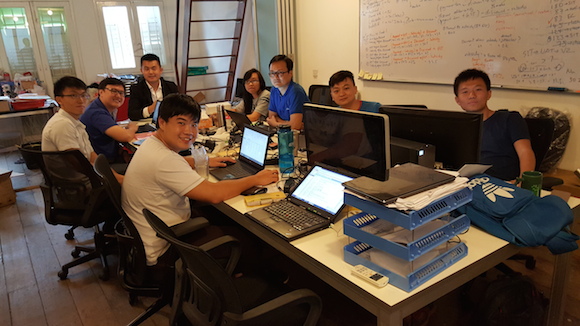
The team photograph is a useful interruption to the solitary-founder story. There are screens, papers and people sharing a working room. Wang occupies one seat among several. A company selling organisational software must first become an organisation itself. There are products to build, customers to understand and colleagues whose work has to fit together. The founder has company in every sense.
The software behind the school day
Taidii’s product pages group its work around attendance, billing, enrolment, parent communication, learning, professional development, administration and scheduling. It also describes student portfolios and reports, staff information management and a school-owned messaging platform. The breadth reflects how many kinds of work sit around a classroom.
Each category has a different audience. An administrator needs a reliable record. A teacher needs relevant information without an elaborate search. A parent wants a message to reach the intended person. A manager needs a view across the institution. One platform must accommodate these purposes while giving each user a manageable part of the whole.
Selected Taidii functions. Conceptual map; no performance claim.
Consider what happens when the same detail passes through several hands. Even a simple update can become a chain of copying, checking and forwarding. Software that connects those steps has a different job from a screen that merely reproduces a form. It must deal with the handoff. The most useful interface may be the one that spares somebody an extra visit to another interface.
This is the operational setting of Wang’s business. The attraction is easy to understand without imagining that every school works alike. Time spent maintaining records is time with a purpose, but it also takes effort. The product question is how to preserve the record while making the effort reasonable. A school’s office deserves as much design attention as its front door.
When the fee collection goes digital
The payment side provides a concrete example. Ace@Work managing director Chua Ming Kok describes working with Taidii and OCBC to introduce electronic fee collection. Parents could use the Taidii app to scan a bank-provided QR code, while eGIRO supported recurring collections. He reported less manual work and fewer errors in accounts receivable, with staff relieved of cash and cheque collection and bank visits.
That account is a customer’s description of a particular implementation. Its interest lies in the sequence of work. Payment begins with a family, passes through a banking service and reaches a school’s accounts. A useful system has to make sense across that sequence. The app is one visible point in a longer relationship.
There is a modest comedy to the subject matter. Technology businesses can describe themselves in language fit for an interplanetary expedition, then spend Tuesday helping somebody reconcile fees. For a school operator, Tuesday may be the more persuasive part. A payment recorded properly has an immediate use. A grand declaration about the future still needs someone to explain where the receipt went.
Wang’s own public comments on Taidii’s development emphasise a shift towards online learning and communication with parents, supported by the company’s banking relationship. That puts finance beside product development in the story. Building a system involves finding ways to support the business that builds it, and working with organisations capable of completing the parts outside its own walls.
A market cannot be downloaded
Taidii’s regional work brings another kind of handoff. Its participation in the Global Innovation Alliance programme connected it with the Philippines through a programme involving Enterprise Singapore, IMDA and Plug and Play APAC. The programme’s account describes mentors, partnerships and a first group of pilot users, whose experience helped Taidii adapt its offering to the local audience.
A pilot has a particular value for an operational product. It creates a place where expectations can become specific. People can discuss the forms they use, the information they need and the points where an unfamiliar system interrupts a familiar routine. A demonstration shows what a product can do. Use reveals what people need to do next.
GIA Manila connected Taidii with mentors, partners and pilot users. Programme coverage published in July 2023.
The programme story also returns Wang to an early feature of his career: the usefulness of a question from outside the technical team. Local users provide another setting in which engineering has to listen. A software company can distribute a product electronically, but understanding an institution still requires contact with the people responsible for it.
There is no need to turn that into a heroic tale of border crossing. Mentors, corporate partners and pilot customers have recognisable jobs in this process. They supply introductions, context and opportunities to try things. Their presence gives expansion a human scale. The map matters, but so does the meeting at which somebody finally explains how the school actually handles a task.
The next interface
Wang now describes his professional work in terms of education SaaS and agentic AI. It is a contemporary vocabulary for a career already concerned with information, interaction and automation. The description signals his direction of interest. The useful questions remain close to the daily work: what action does a system take, who needs to review it, and where does the result belong?
Those questions suit a school, where different responsibilities meet in the same day. A more capable system still needs to be understandable to the person using it. The engineering can grow more elaborate while the user’s request stays quite plain. Please put the information where I need it. Please let the message arrive. Please make the next step clear.
Wang’s career began with technical training and found its business setting among school routines. The early robot’s changing appearance supplies an apt final detail: the function had to find a form that belonged in the room. That remains an interesting standard for the software around it. A product earns its place when the people with a school to run can get on with their day.