A staff roster is an unlikely place to look for a connection to Mars. Yet there it is in Alan Sevugan’s company history: FriarTuck, the Singapore software business he co-founded, supplied scheduling software used by NASA for scientists working on the Mars Exploration Rover Project. Space exploration has its rockets and its photographs. It also has people who need to know when they are working.
The product was called FTStaffRosterer. Its in-house solver, FTSolver, handled large collections of variables and constraints. In the language of the office, those abstractions become names, times and requirements. Someone must be available. Someone must have the right skills. An assignment must fit the rules. Put all of these together and the apparently modest task of filling a calendar becomes rather less modest.
That early customer gives Sevugan’s story an unusual scale. The same broad question can matter inside a mission team and inside an ordinary business: how do you arrange work when many conditions must hold at once? The destination may be extraordinary; the scheduling problem is familiar enough to anyone who has ever negotiated a weekend shift.
Today, Sevugan is the founder and CEO of Workforce Optimizer, based in Singapore. The company’s name now states its subject with the plainness of a label on a filing cabinet. His career has developed around making that subject computationally tractable and commercially useful. A roster may occupy one sheet of paper. The decisions behind it can fill considerably more.
A student, a professor and a problem worth keeping
The university connection runs through the story from the beginning. Sevugan is a National University of Singapore computer engineering graduate, listed as an alumnus of 2002. His co-founder, Martin Henz, is an associate professor of computer science at NUS. Their company joined a technical education to a business problem that had no shortage of practical consequences.
In 2001, Sevugan and Henz were champions of both Startup @ Singapore and Startup @ Asia for their work on FriarTuck. Those dates put the venture’s beginnings before Sevugan’s graduation. A business-plan competition can reward an argument about the future. A customer then asks the less forgiving question of whether the thing works on Tuesday.
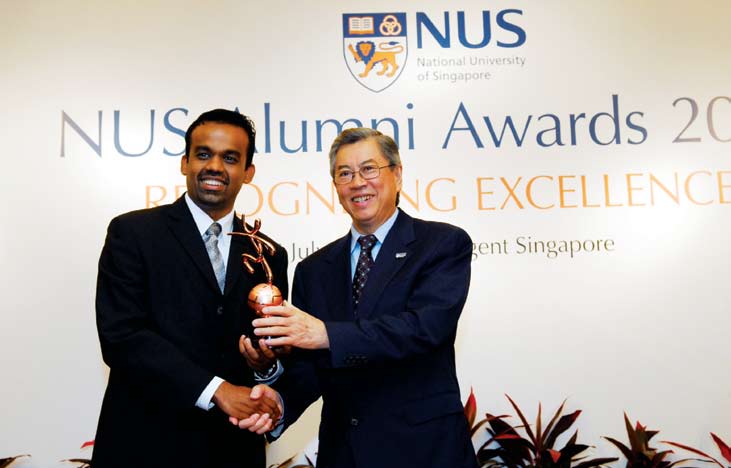
The early recognition was followed by more. FriarTuck’s FTStaffRosterer was a merit winner in the 2004 National Infocomm Awards, in the innovative product or service category. Sevugan received the NUS Outstanding Young Alumni Award in 2007. In the award photograph, he stands beside NUS Board of Trustees chairman Wong Ngit Liong, the two holding a trophy between them. For once, the object requiring careful coordination is quite visible.
There is a useful continuity here. Henz’s academic work includes decision making, planning, and transportation and logistics algorithms; NUS lists him as a non-executive director of Workforce Optimizer. Sevugan leads the business. Their continuing connection gives the company a link between the formal study of complicated choices and the practical task of selling software that helps organizations make them.
- 2001Two startup competition wins
- 2007NUS alumni recognition
- 2018S$5m Series A financing
- 2021SAP Store availability
The size of the cheque, the size of the ambition
In September 2018, FriarTuck raised a S$5 million Series A round, approximately US$3.63 million, from Philips and SEEDS Capital, Enterprise Singapore’s investment arm. The university venture had reached a financing milestone with an international corporate backer and a Singapore investment partner. The announced uses were product development, technical investment, hiring and expansion in Southeast Asia.
A funding announcement is a point on a timeline, rather than a complete explanation of a company. Here it makes the distance from the 2001 competition wins visible. Seventeen calendar years separate those two milestones. That span gives this founder’s story a different rhythm from the familiar account in which a pitch, a cheque and a new market appear to happen before lunch.
Sevugan also raised a question about who could afford sophisticated scheduling software. He described existing offerings as serving organizations with “deep pockets and sizable IT departments”. FriarTuck offered a hosted, pay-as-you-go model. His stated aim included large and mid-sized organizations, extending access to the capabilities his team was building.
The commercial detail matters because a useful algorithm has to reach someone’s desk. Price, deployment and the work of introducing a system all sit between an elegant technical answer and daily use. Sevugan’s ambition, as expressed at that stage, included widening that route. The company’s development involved both solving a difficult problem and finding a workable way for customers to buy the solution.
The quarter-hour inside the working day
To understand the business Sevugan leads, start with the demand forecast. Workforce Optimizer offers forecasts in 15-minute intervals, using historical information and factors such as promotions. It can forecast by role, day of the week and particular circumstances. That is a finer view of work than a single total for the day.
Consider an illustrative shop. A quiet morning and a busy afternoon could produce the same daily sales as a day with steady traffic. The total would look reassuringly familiar. The staffing requirements would differ. The useful question is when work arrives, and which people are needed when it does. No forecast can make tomorrow behave, but it can give planning a more specific starting point.
Workforce Optimizer’s published discussion of retail demand considers weather, price, location, promotions and footfall. Each can influence the work a business must handle. A promotion is therefore also a scheduling consideration: someone has to serve the customers it attracts. A discount sign can be small. Its consequences for the people behind the counter need not be.
Within the company’s platform, machine learning supports prediction and mathematical optimization supports scheduling. These serve different purposes. Estimating the work ahead gives the schedule a target; arranging people against that target requires another set of decisions. Sevugan’s business brings those stages into the same product, then adds the ability to change deployments when events upset the original plan.
A preference is a piece of the problem
Schedules carry personal consequences alongside business requirements. Workforce Optimizer gives employees ways to request shifts, see their rosters and swap assignments. These are concrete interactions with a system that otherwise risks sounding like a conversation conducted entirely between managers and mathematics.
The company’s writing on fair work distribution discusses preferred rest days, opportunities for preferences to be met, advance publication of rosters and workable shift swaps. It also recognizes the difficulty of keeping a service running while attending to requests. Fairness, in this setting, has to appear in the planning rules and the ways people can participate.
Imagine two employees both requesting the same evening off. That hypothetical request does not disappear because a computer receives it. A system still needs rules for coverage and for how preferences are considered. The value of an optimizer depends partly on which requirements it is given. Mathematics can work on the arrangement; the organization must decide what an acceptable arrangement means.
This is why the person behind the product remains relevant. A founder chooses which problem deserves years of attention and which parts belong in the product. The business Sevugan has built includes employee participation alongside forecasting, attendance and analytics. Those features make room for the person whose name appears in the calendar, as well as the person responsible for producing it.
“Today’s enterprises need to think about building a lean, agile and flexible workforce.”Alan Sevugan · February 2021
The unglamorous art of fitting in
On 5 February 2021, Workforce Optimizer announced that its solution was available on SAP Store and integrated with SAP SuccessFactors Employee Central. The offering connected time tracking, labor-demand forecasting and automatic scheduling with an established employee-management system. For Sevugan, it was another route into the organizations his company wanted to serve.
Sevugan described an ambition for a workforce that could operate flexibly. That ambition sets the direction. The surrounding product details describe some of the work required to support it. Forecasts and schedules have to connect with employee information and the systems already in use.
Workforce Optimizer offers interfaces to HR, payroll, point-of-sale, leave-management and authentication systems. Its integration options include REST interfaces and manual imports and exports. This is the part of enterprise software that rarely gets a flattering photograph. It is also the part that helps a new tool coexist with the old tools on which an organization depends.
There is a pleasing practicality in that range. A business might connect systems through an interface; another workflow might need a file. Either way, the information must arrive in usable form. The founder’s early technical venture has developed into a company whose responsibilities include that everyday connective work. A schedule becomes more useful when it can travel beyond the application that created it.
Monday arrives whether the plan is ready or not
Sevugan’s professional connections also extend to entrepreneurship beyond his company. His public profile lists speaking for the Asia Productivity Organization, judging the Lee Kuan Yew Business Plan Competition and serving as lead organizer of the Stanford Global Entrepreneurs Challenge. Together with the university competition wins, these roles place him on several sides of the encounter between a business idea and an audience.
That is an apt circle for someone whose own venture emerged from a university setting. Competitions provide a moment to explain an idea compactly. Operating a software business requires returning to its details. The two activities ask different things of a founder, and Sevugan’s record includes both.
His company’s current offering still circles the question that made the early venture recognizable: how to deploy people against work that changes. The interfaces are now cloud and mobile as well as managerial. The roster is accompanied by forecasts, employee requests and operational information. The underlying responsibility remains familiar to every organization that depends on people arriving at the right time.
The NASA connection is the delightful surprise in this history. The longer story lies in the work that followed: education, competitions, customers, investment and integration, all organized around scheduling. Monday morning supplies a wonderfully reliable test for such a business. It turns up every week, asks everyone to get on with it, and shows little interest in how persuasive last week’s presentation was.