An athlete’s medal can tell you who won. It is less helpful about the work that came before it. At the Fresno County Athletic Hall of Fame, Bill Poss and his team built an environment where visitors can go beyond the objects: choose a sport, explore an athlete’s life, watch an interview, and hear a story in the voice of the person who lived it. The trophies have acquired conversation partners.
For Poss, founder, CEO and president of Solutions By Design, the point was always larger than installing screens. The Hall of Fame needed a permanent home, and a 5,000-square-foot wing inside Fresno State’s Save Mart Center gave it one. His company designed the exhibit, bringing memorabilia, banners and digital storytelling into the same space. Visitors could look at an achievement and then investigate the person behind it.
Poss described the purpose in terms of character and hard work. That choice matters. A display about winning can end with a score; a display about perseverance has somewhere else to go. His work here offers a useful way into his own career, which began in the decidedly less electronic business of advertising and packaging. The recurring question is how to make someone care enough to keep looking.
Before the screens, there were cherries
Poss founded Solutions By Design in 1985 to offer advertising, marketing and graphic design to local clients. Agriculture became part of its foundation. In California’s San Joaquin Valley, a business selling design did not have to look far for people selling fruit. The company’s early work included branding, collateral and packaging for apples, cherries and oranges.
That work required making practical distinctions visible. In a crowded produce market, a package has to identify its contents and give the buyer something to remember. The company’s design portfolio includes a brand and packaging program for Chief Wenatchee, the Washington grower cooperative, with promotional work extending to Taiwan, Hong Kong and Tokyo. Its packaging work also includes Trinity Fruit’s Prima Blanco white-flesh peaches and nectarines, and Setton Farms pistachios.
The geographical reach grew while the home base stayed in Fresno. The shift toward computers and the web expanded the kinds of work the business could take on. Poss’s account of those years describes adopting desktop design systems and beginning website development as the internet spread. A label, a website and an exhibit ask different things of a designer. All three still need an audience to understand what it is looking at.
and graphic design
and the web
and public spaces
The founder still has a day job
Poss is a Fresno State alumnus. In his company’s sports-display brochure, his responsibilities are unusually concrete for someone with three titles: directing new products and project development, serving as chief strategist and creative director on multimedia work, and managing key accounts. The founder’s name appears beside a list of things that need doing.
The same document places him among colleagues with distinct responsibilities. Operations director Sheri Netto coordinates projects and content. Nicholas Luena leads development work. Art director Mae Espejo contributes interface design. These roles help explain how an enterprise that began with graphics could undertake environments involving software, construction, content and maintenance. Someone has to make the picture; someone has to make the picture respond.
A 2015 expansion of the company’s Montage display range shows Poss involved in the physical side of that work, too. After a trip to China, the company announced an agreement with a manufacturer to design and fabricate kiosk products. Earlier, Poss and account manager Nikki Schoettler had visited Paso Robles wineries to research another market for interactive displays. The work took him from the drawing board to the places a product might actually stand.
An arena with room for another kind of story
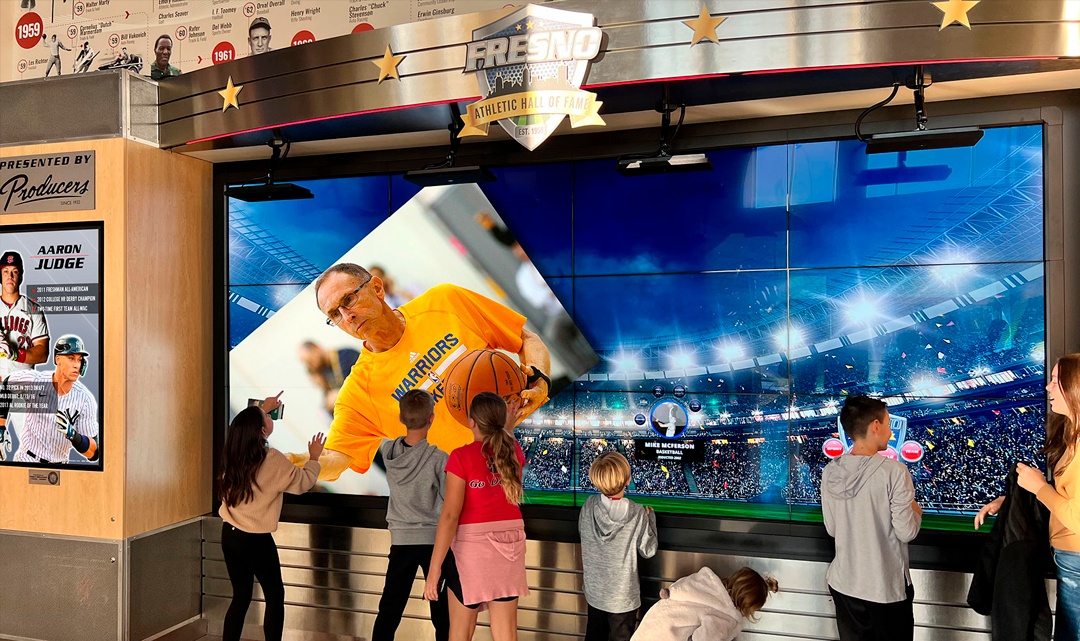
Inside the Hall of Fame, the setting helps carry the argument. Athletes’ stories occupy the same building where Fresno State basketball is played. The distance between a young visitor and a sporting ambition becomes, at least physically, rather short. Poss’s team made room for several ways of exploring that ambition, from large interactive surfaces to individual story stations.
The exhibit includes athlete biographies, photographs and video. It also includes a historic timeline mural around the space. Each format has a different pace: the mural can be read in passing, while an interview invites a longer stay. Putting them together allows visitors to choose how deeply to enter a story. A room full of people does not arrive with a single attention span.
Poss’s stated objective gives the hardware a useful test. Does it help communicate accomplishment and effort? Does it let a young visitor encounter an experience beyond the final award? The project’s significance in his career rests partly in that connection between an elaborate installation and a plain human purpose. The technology offers access; the athletes supply the reason to use it.
A school bus is a design brief
At Fresno City Hall, another public audience presented a different problem. School groups arrive in numbers, and a corridor outside the council chamber has to accommodate them. Solutions By Design’s work there included two adjacent interactive video walls, freestanding kiosks, a council-chamber LED wall and registration displays. The visitor experience had to fit the building as well as the content.
The two main walls were designed to serve four people apiece. The company lowered the sill beneath the displays to help younger guests reach them. Those decisions reveal the physical arithmetic behind an apparently effortless touchscreen: how many hands, how high, and how much room remains for everyone else? A small child’s reach is a specification with consequences.
The visual language belongs to the Valley. Floating illustrations include crops, outdoor activities and local landmarks. Grapes, peaches and almonds appear alongside references to Yosemite and the area’s giant sequoias. Menus open onto civic and historical material, including interviews with local officials. For a company whose beginnings included agricultural graphics, fruit returning as an animated invitation inside City Hall makes a pleasing career rhyme.
History, with the volume turned up
The Italian Heritage Exhibit at the Big Fresno Fair asks visitors to enter a different atmosphere. Its first phase debuted in 2021. The setting evokes a Tuscan villa, with stone and clay-tile elements framing four vertical interactive displays. A streetscape photograph was divided across the screens, letting the installation read as a panorama before anyone touched it.
Once activated, the displays open onto subjects including agriculture, business, food, sport and community institutions. Oral histories give local people space to describe their ancestry. A map of Fresno’s old Italian district lets visitors move through blocks and discover families and businesses. A place can become easier to understand when its streets acquire names, faces and remembered voices.
The Armenian history installation at the fair uses two touch displays and a mural to explore migration to the Valley and community contributions. Its content also supported a website, allowing material developed for a physical exhibit to travel beyond the room. In both projects, the company’s role is to give accumulated community knowledge a form people can navigate. The interest is already there in the histories; the interface helps visitors find an entrance.
The mountain has opinions about the internet
At the Museum of the Sierra in Shaver Lake, a Buffalo Soldiers exhibit brought another constraint. Mountain internet access was limited. Solutions By Design installed a local server, with a separate cloud backup, so the exhibit could serve its content without depending on a generous connection. The decision belongs to the less photogenic side of exhibition design, where reliability earns its keep quietly.
The content required another kind of infrastructure: historical checking. The team consulted retired Army officer and historian Brian Shellum while researching and writing. The display includes historic photographs, material about uniforms and weapons, and an interview with a Yosemite ranger. A freestanding vertical kiosk conserved floor space in the museum.
These details widen the portrait of the business Poss directs. Graphic design alone would not resolve the connection problem. Software alone would not establish whether the history was sound. The project called for editorial work, technical choices and sensitivity to a particular room. Its success depended on the pieces cooperating, including the pieces a visitor would have little reason to notice.
“No project is too big, no project is too small.”Bill Poss, as recalled by Ogunquit chamber chair Brian Crawford
A small office in Maine
In spring 2024, the Ogunquit Chamber of Commerce decided to relocate to a small, central office. It wanted visitors to plan their time in town while discovering member businesses. The chamber found Solutions By Design through a Google search. A Fresno company with an agricultural-design past was now working on the practicalities of a Maine holiday.
The resulting system used a vertical interactive display, business videos and QR codes. Visitors could browse accommodations, restaurants and activities; participating businesses could support the installation through sponsorship. A local server handled video delivery. As in Shaver Lake, the machinery was selected around the circumstances, including cost.
Brian Crawford, the chamber’s board chair, recalled Poss saying on their first call, “No project is too big, no project is too small.” The phrase is a service promise, and the little office gives it a useful setting. Across his career, Poss has kept adding ways to deliver a message: packaging, websites, kiosks, video walls, whole rooms. What holds the work together is the invitation to pay attention. Sometimes that invitation begins with a cherry on a box. Sometimes it waits for a visitor to put a finger on the screen.