Bill Adams learned early that a gate was something you ran toward. On the ranch where he grew up, his father expected him to jump from the truck before it had quite stopped, open the gate and hurry back. Walking would have conveyed an unfortunate lack of enthusiasm. The gate, apparently, was conducting a performance review.
Decades later, Adams could see how much that small routine had taught him. Speed signaled effort; effort became bound up with worth. He carried the lesson into adulthood, where business tends to reward anyone who can make urgency look like a character virtue. Eventually, he began examining the bargain.
Today he is co-founder and CEO of Leadership Circle, advising the sort of executives whose decisions affect whole organizations. His subject is leadership. His own habits supply some of its more revealing case studies.
The gate came before the boardroom
Adams’s professional life includes starting, owning and selling businesses, consulting with senior executives, and helping organizations change how they operate. He has occupied corporate staff and line roles as well as the advisor’s chair. His master’s degree, from the University of Montana, is in interpersonal and organizational communication. The wording is academic; the preoccupation is recognizably human: what happens between people when work has to get done?
His consulting history stretches across industries. An official biography lists clients including Honda Worldwide, Google, Pixar, Disney Animation, American Express and Yale University. That range matters because a hotel, an animation studio and a university do not share a convenient instruction manual. The people directing them still have to persuade, listen, decide and accept responsibility.
Adams also co-authored The Whole Systems Approach and The Quest for Quality, contributed to editions of The Change Handbook, and led participation conferences with Margaret Wheatley. Long before his recent essays about personal habits, his work was already concerned with getting more of an organization involved in its own future.
A rose, with instructions
One of Adams’s memorable lessons arrived through a car window. He had dropped off a mentor after a long working day when she offered a compact review of the experience: “Bill, working with you is like a slap and a rose.” She wanted considerably more rose.
It was an awkwardly useful observation. Adams had regarded his quick eye for flaws as a contribution. He could identify what needed fixing and say so promptly. From his side of the exchange, that looked helpful. The mentor invited him to consider the receiving end.
His later account acknowledges that criticism, delivered without care, can make people retreat. A leader may leave a conversation pleased with the precision of the diagnosis while everyone else leaves determined to say less next time. Such efficiency has rather expensive consequences.
Adams connects that experience to learning how to remain open in relationships and deliver difficult feedback with concern for the person hearing it. He retained the desire for candor. He began paying closer attention to its delivery.
“Bill, working with you is like a slap and a rose.”
A mentor’s feedback, recalled by Adams
Other people supplied corrections too. Hugh Knop, an early mentor, challenged the firmness of Adams’s opinions when he was only 21. Later, client and mentor Steve Ewing challenged his tendency to enlarge a story beyond its facts. Adams says Ewing’s intervention still influenced his precision 35 years afterward.
These recollections give his teaching a useful tension. He has made a profession of helping people change, while freely describing occasions when he needed help recognizing his own behavior. The advisor is occasionally the person who requires advising. It keeps the occupation honest.
The consultant takes the assessment
In 2005, Adams was working on a multiyear transformation project at Yale University. His firm needed a leadership model that could support the work over time. He asked senior consultant Gayle Young to investigate what was available. She returned enthusiastic about Bob Anderson’s Leadership Circle model.
Adams’s firm tried Anderson’s Leadership Culture Survey. A debriefing conversation followed. Adams was struck by what Anderson could understand about the firm and its chief executive without having met them. The experience helped alter how Adams led and how his company approached its clients.
That beginning is worth lingering over. An established consultant went looking for a method to use with other people and found something that required him to reconsider himself. Professional experience had given him grounds for skepticism. It also gave him enough context to recognize work he wanted to adopt.
Adams and Anderson became business partners and co-authors. Adams brought experience with organizational transformation; Anderson brought the leadership model and assessment he had developed. Their collaboration joined the demands of running organizations with an interest in how leaders themselves develop.
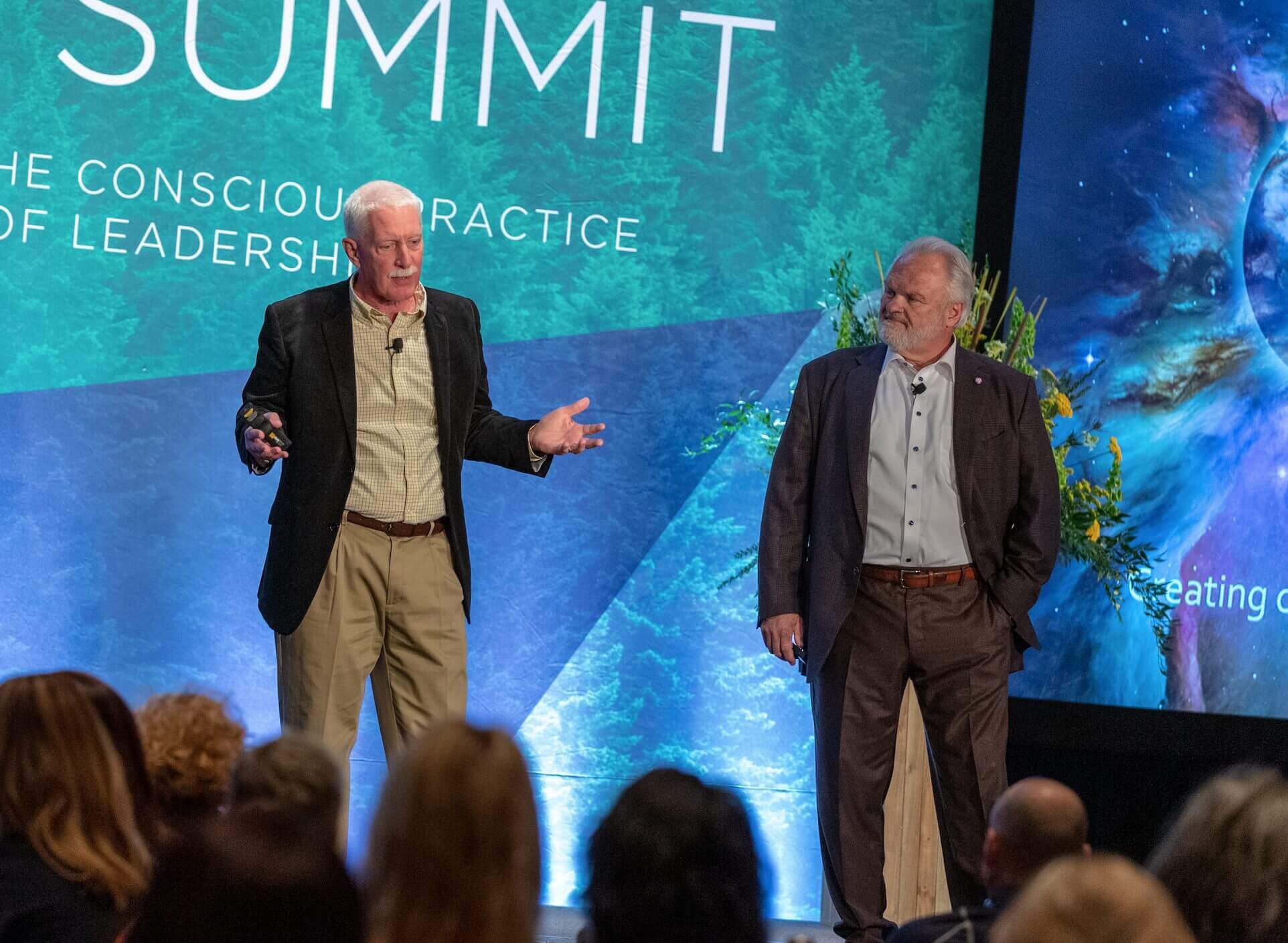
In March 2014, Full Circle Group and The Leadership Circle announced Adams’s appointment as CEO, alongside Betsy Leatherman as president. Anderson moved into the chairman and chief development officer roles. The announcement placed responsibility for daily operations with Adams and Leatherman. For Adams, the principles being discussed with clients also had a business of their own to answer to.
Two books, one recurring problem
Mastering Leadership, written with Anderson and published by Wiley in 2015, connects the visible work of leadership with the assumptions beneath it. Their language distinguishes an outer game of skills and action from an inner game of beliefs, identity and interpretation.
The distinction helps explain Adams’s interest in apparently minor personal episodes. A person can learn to conduct a meeting, allocate resources or give a presentation while continuing to interpret disagreement as a threat. Technique improves; an old reflex keeps its office.
In their account, development requires attention to both. Competence remains essential. So does understanding the reasoning and self-image directing its use. Adams’s stories about haste and criticism give those abstractions something to stand on. You can see the behavior before being asked to consider the model.
Scaling Leadership followed in 2019, with a foreword by Pixar co-founder Ed Catmull. It asks what happens when leaders must develop capacity beyond themselves. The book examines how senior leaders describe one another’s strengths and liabilities, connecting those descriptions to the ability of an organization to grow and adapt.
Leadership
The leader’s skills and the assumptions beneath them.
Leadership
Developing the capability of a whole organization.
The two titles trace a practical progression: examine how you lead, then consider the leadership taking shape around you. An executive’s effectiveness cannot be judged solely by how much depends on that executive. The people who work alongside them need room to become capable decision-makers too.
The partnership keeps asking questions
Adams and Anderson have continued their public conversations. In a February 2026 episode of On the Balcony, they discussed the evolution of their model with Michael Koehler and Judit Teichert. The conversation returned to reactive and creative leadership, their own patterns, and the demands of increasingly complex organizational work.
In another conversation, available on YouTube, they explored caring connection. It is a revealing choice for two people whose business vocabulary includes assessments, performance and organizational capability. Their discussion puts the quality of relationships inside that vocabulary, where Adams has long argued it belongs.
Writing about Unity Academy in March 2026, Adams described watching Anderson bring together practitioners with different bodies of knowledge. He also acknowledged his partner’s inclination to create things alone. The collaboration required Anderson to work against that preference. Friendship had apparently preserved its capacity for useful observation.
Adams makes shared ownership central to his account of collaboration. Polite agreement has limited value if nobody contributes an independent perspective. A group becomes more capable when its members can bring distinct knowledge to a shared undertaking. For a chief executive, that involves surrendering some of the pleasure of being the person with the answer.
Teaching remains part of the work. In October 2025, Adams described leading Leadership System certification with Cindy Adams in Park City, Utah. The program develops practitioners who work with leaders over time. He wrote about how discussions of organizational systems kept returning to the assumptions of the people running them.
- SelfExamine the habits directing your behavior.
- TeamMake room for other people’s judgment.
- OrganizationDevelop leadership beyond one person.
An editorial reading of the progression in Adams’s work.
A little less self-importance
In 2023, Utah Business named Adams a CEO of the Year honoree. Asked about his younger self, he spoke about taking the work seriously while easing up on personal self-importance. He remembered fear of embarrassment limiting his willingness to take risks. His advice included humor and forgiveness.
Family figures prominently in his account of what sustains him. He and Cindy have four children; in that 2023 interview, he spoke of 14 grandchildren and the pleasure of watching his children become parents. His biography places him outdoors with the family, a setting some distance from an executive workshop.
Asked what he would do without the CEO role, he still imagined working with leaders. He also wanted more involvement in youth leadership and more time with family. His aspirations had room for work, giving back and relatives who might eventually have heard enough advice for one afternoon.
His March 2026 writing defended introspection as part of leadership practice: noticing your impact, receiving feedback and choosing a response deliberately. It fits a career in which other people’s observations have repeatedly interrupted a comfortable explanation of himself.
The boy at the ranch gate learned how to hurry. The executive has spent years examining when to pause. There is a certain satisfaction in that development. Even a person paid to advise CEOs can still be learning how to listen.
Follow the conversation
Work, writing and conversations with Bill Adams.
- Leadership Circle: company and leadership team ↗
- Bill Adams on LinkedIn ↗
- His essay on drive and the ranch gate ↗
- His reflection on feedback ↗
- Developing Others to Expand Impact ↗
- Watch: Adams and Anderson on caring connection ↗
- Listen: The Next Stage of Leadership ↗
- The 2023 CEO award and five questions with Adams ↗