A business can be beautifully named, properly registered and still leave its owner unable to pay the bills. BGE Berry Touraine’s Cher branch works in that awkward space between wanting to work for yourself and knowing whether the numbers, the customers and your own circumstances will allow it. Its offer includes the familiar business plan. It also includes something less celebratory: helping a person let go of a project when that is the sensible outcome.
This is a local branch of a French nonprofit association, serving people in Bourges and across the Cher. Business creation sits alongside training, employment support, digital access and work with local authorities. The mix matters. Someone who arrives wanting to open a business may need a qualification, help finding work or a better understanding of what running that business would actually involve.
BGE’s published offer explicitly includes reassessing project viability with the Cher departmental council for people receiving RSA income support. That is a useful clue to its priorities. The person has a future even if the first business idea does not.
A salon with its own wheels
Consider Élodie Sohier. After more than a decade in beauty and wellness, including hotel spas and luxury establishments, she chose entrepreneurship in 2024. Her business, Cocoon de Soy, takes beauty treatments and relaxation services into the Sancerre countryside in a truck. Customers can also book it for private and professional events.

The shift was about how and where she wanted to practise her trade: more freedom, more proximity, and access to services in rural places. BGE helped her during creation and continued supporting the business afterward. In its July 2026 portrait, she emphasises regular follow-up and professional opportunities through the network.
For readers considering a similar move, the distinction is useful: being good at a service and finding a workable way to sell it are separate jobs. Sohier brought the first. BGE’s support addressed the second.
One door, several possible next steps
The Carrefour de l’Entrepreneuriat in Bourges makes the organisation’s coordinating role tangible. Based at the Pôle Tertiaire Libération, at 70 avenue de la Libération, it advertises free, personalised orientation and access to more than ten partners. The state, Bpifrance and Bourges Plus support the initiative. Individual appointments, workshops and networking events give people different ways to begin.
The proposition is straightforward: explain your situation to one person who can help you find the next appropriate contact. That can save a prospective owner from having to understand the entire local support system before using it. It is especially relevant when a question crosses boundaries, such as whether a business idea needs training, finance or a rethink.
BGE’s local entrepreneurship meetings name the CCI, CMA, Initiative Cher, ADIE, France Active, France Travail and Odyssée Création among their partners. Several are alternatives for particular needs. The CCI du Cher supports business creators; the CMA serves artisans. BGE’s position is broad, with employment and skills services sitting close to business advice. These organisations also work together.
Free advice still has a payer
Pass’Création supplies a concrete answer to the cost question. BGE says eligible participants receive its services free because the Région Centre-Val de Loire, European FSE+ funds and AGEFIPH finance the programme. Its stated ambition is for businesses to be “viables, vivables, pérennes”: financially workable, liveable for their owners and capable of lasting.
“viables, vivables, pérennes”
Three tests in the Pass’Création criteria: can it work, can you live with it, can it last?
The conditions are consequential. The project must already be defined, the participant must be ready to commit, and the intended business must represent their main employment. Supplementary income activities are outside the programme’s stated purpose. Someone casually exploring a weekend sideline should therefore begin with orientation rather than assume this particular pathway fits.
Training has a separate price list. The second-half 2026 catalogue lists a seven-hour course on artificial intelligence for organisations at €350, 21 hours of introductory accounting and financial analysis at €840, and a 28-hour micro-enterprise management course at €1,390 in its classroom/remote format. Funding possibilities depend on the course and the learner’s situation. A listed price and the amount a participant ultimately pays are different questions.
Catalogue prices, not a quote for a complete business launch. Individual funding arrangements vary.
This gives BGE a mixed delivery model: publicly supported programmes alongside priced training and services. The adviser helps prepare a financing case and connect people with relevant organisations. That role should not be mistaken for a promise to finance the venture.
Try selling before you commit
Within the regional offer, Incubatest addresses a stubborn problem: a business plan describes customers; a market test lets them respond. The service offers legal hosting under a CAPE business-support contract, allowing accepted participants to invoice through Incubatest’s SIRET identifier before registering independently. It combines that framework with advice, management tools and accounting support.
The service is presented across Berry Touraine and also under the Incubatest 37 identity. A Cher applicant should establish availability and admission with the team. The practical value lies in gathering evidence: whether anyone buys, what they buy and whether the experience supports the original plan.
BGE describes several possible outcomes from the test: proceed to registration, adjust the project or use the experience to pursue another professional direction. Our reading is that this makes reconsideration part of the method. A weak response from customers is information worth having before taking on more commitments.
The distance between help and the person who needs it
Local access is one of BGE’s practical distinctions. Its economic-development work includes employees assigned to intercommunal territories. The Portes du Berry authority, for example, describes a BGE officer supporting creation and takeover projects across its territory and Berry Loire Vauvise. The adviser works within the local geography, rather than expecting every question to arrive at a central office.
There is a mobile version of that idea too. BGE’s entrepreneurship bus serves priority territories across Cher, Indre and Indre-et-Loire. Bpifrance also dates the organisation’s work with the CitésLab neighbourhood entrepreneurship programme in Bourges to 2010. Outreach is a longstanding part of this operation.
Some barriers arrive before a business question can be asked. BGE’s digital services include access to connected computers and help with online procedures. Its Cher Parcours Emploi listing describes individual employment support, available in person or remotely, with 12 hours over 12 weeks and no participant charge. These services help explain why the organisation’s remit extends beyond founders.
The work continues after opening day
For established small companies, Ma TPE 4.0 offers a seven-hour digital pathway built around a diagnosis, expert workshops, personal advice and an action plan. Its published conditions include two years in business, turnover above €15,000 and up-to-date tax and social obligations. A brand-new venture therefore needs a different entry point.
The training offer is similarly practical: sales, management, accounting, communication and digital skills, in short modules or longer learning pathways. BGE also advertises customised courses. Its Bourges adviser recruitment material calls for skills in assessing projects, guiding entrepreneurs and communicating with different audiences. The expertise being sold is the ability to make business decisions more informed and more manageable.
Networks supply another form of follow-up. The Club des Entrepreneurs organises opportunities to meet other owners and exchange experience. BGE and Bourges Plus are also bringing businesses together around Lac d’Auron for the inter-company challenge scheduled for September 25, 2026. It is an unusually energetic diary entry for an organisation that also teaches accounting.
Count the businesses. Remember the other outcomes.
In its 2025 activity report announcement, published in July 2026, BGE Berry Touraine says 465 entrepreneurs created businesses with its support. That is a regional result across its operation, not a Cher branch total. The same account stresses that support can lead to employment, training, skills assessment or another route instead of a registration.
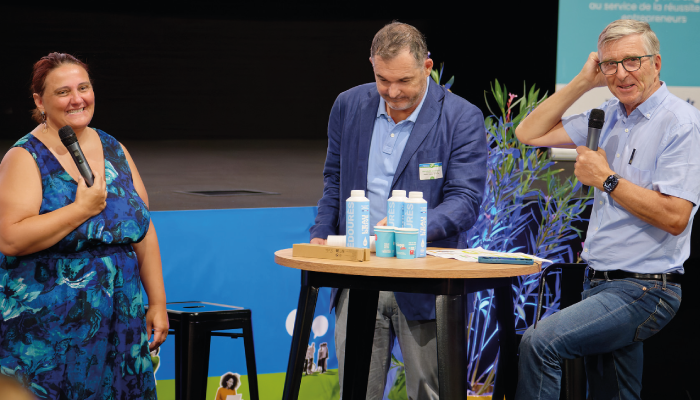
The regional organisation hosted the national BGE assembly in Tours in June 2026, where discussions included AI, changing work patterns and environmental questions. Those subjects sit alongside the immediate concerns of a local business owner: getting customers, choosing tools and earning enough to continue.
The useful lesson to borrow from BGE is a sequence of decisions. Define the customer and offer. Test the assumptions. Work out which skills are missing. Find the appropriate adviser and funding route. Then return to the evidence as the business changes. That approach requires time, honest numbers and a willingness to revise the plan. A course cannot manufacture demand, and an introduction cannot make an unsuitable project fit its owner’s life.
For someone in Cher wondering whether a skill could become a livelihood, BGE offers places to investigate that question with help. Sometimes the answer has wheels. Sometimes it needs another round of work.