Benji Vaughan once made a music video with magnets, ferrofluid and a paint set belonging to his children. The production facilities were his living room. A stage manager and photographer helped turn it into a miniature film studio; Vaughan then spent hours editing the results. It is a useful scene to keep in mind when considering the founder of Disciple. Before there were community platforms and funding rounds, there was a musician wondering what would happen if he put one interesting thing next to another.
Disciple grew from a similarly practical curiosity. Vaughan had fans, and those fans had things to say to each other. The available tools made that relationship awkward. Building somewhere for them to gather eventually became a business that served people far beyond music. The route included a disappointing first app, an agency that nearly went bust and a change in who the company thought its customers were.
Meanwhile, the musician has kept releasing records. In May 2026, Younger Brother, his collaboration with Simon Posford, returned with Mutually Assured Distraction. The title is rather well suited to a person who has spent years thinking about where our attention goes.
A guitar on extended leave
Vaughan grew up in a small town in Surrey and studied economics at the University of Bristol. His musical education followed its own syllabus. As a teenager he worked with an electric guitar and a drum machine, gradually becoming more interested in what he could make the machine do. The guitar, he recalled, became “unemployed for 10 years.” One imagines it had time to consider its options.
He recorded as Prometheus, developing a career in psychedelic electronic music. His catalogue also carries his own name and the names of collaborations. These identities offered different places to experiment. A musician can acquire several working lives without ever leaving the studio; the accounting grows complicated before the commute does.
Younger Brother paired him with Posford, the producer behind Hallucinogen and a member of Shpongle. Their debut, A Flock of Bleeps, appeared in 2003. The Last Days of Gravity followed in 2007, and Vaccine in 2011. The sequence traces a partnership willing to move beyond the boundaries of its first record.
The professional credits widen the picture further. Vaughan worked on The Egg’s Forwards, and his discography includes production, composition and engineering. Making a track and helping somebody else finish theirs require related but different forms of attention. Both involve knowing when the machinery is serving the music and when it is getting in the way.
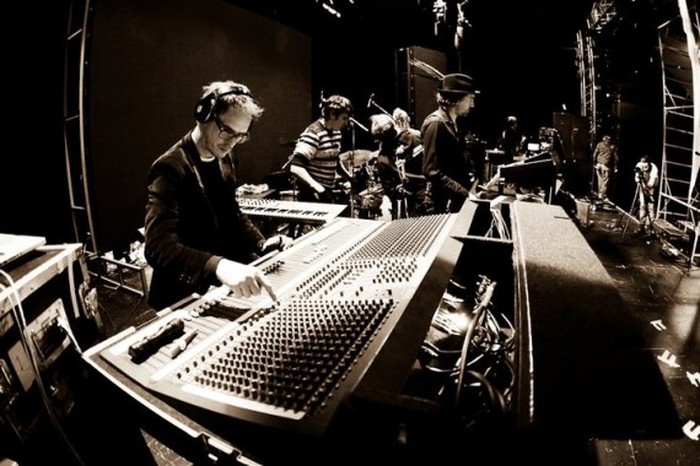
The living-room effects department
In September 2013, Vaughan released Even Tundra under his own name. Its eleven tracks run for roughly 58 minutes. The titles include “Ursa Major,” “Bird Song” and “Footsteps in Silicon”: a small collision of the natural and the manufactured before anyone has pressed play.
The accompanying visual experiments brought that collision into the house. For the title track’s video, Vaughan investigated ferrofluid, a liquid that responds to magnetic fields. He found demonstrations online, worked out how to film it, and added watercolour paint when the children’s set happened to be nearby. The extraordinary-looking material had an ordinary domestic neighbour.
There is a temptation to give such an afternoon a grand label once the results are finished. Vaughan’s account is more appealing than that. He and a collaborator tried things. He edited what they captured. The technology supplied possibilities, and somebody had to decide which ones were worth keeping.
That habit would travel well into software. Knowing that a tool can do something is only the beginning. The more interesting question is whether anyone has a reason to use it, and whether the result makes them want to come back.
A famous address book, an awkward business
The first version of Disciple drew directly on Vaughan’s musical world. He wanted to communicate with a passionate following in a more interactive way. Email offered a limited conversation. As attention moved towards smartphone apps and large social platforms, an independent community space became harder to arrange.
He hired an agency to build an app. The result fell short of what he hoped for. He then assembled a small technology team and began making apps for other musicians. His contacts helped the company win work, including the Rolling Stones. A musician’s address book had become a sales channel.
The logo collection, however, did not settle the economics. Vaughan later described the music market as fragmented, the sales process as complicated and the record-label budgets as insufficient. After about a year, the business had come close to going bust. That admission gives the origin story some welcome friction. A prestigious customer can look excellent on a slide while the next invoice remains stubbornly necessary.
The company moved towards a consistent software product that could serve community organisers across many fields. By 2018, Vaughan was describing that transition publicly. Bespoke development would give way to a software-as-a-service model: more customers using a shared product, rather than each project requiring its own elaborate build.
A room of their own
The early fan-club prototype had offered a revealing glimpse of what members wanted. Vaughan later recalled a subscription costing around four dollars a month. Fans could get music early, discuss rides to festivals and contribute ideas for merchandise. The artist gave people a reason to join; the members supplied much of what happened next.
A shared ride is a modest thing to build a theory around. It is also a useful test. Someone who merely receives announcements has little reason to talk to another recipient. Someone trying to reach the same festival has an immediate reason. The practical detail makes the larger idea easier to understand.
Disciple’s offer was a space that a host could run under its own identity, with control over its community. The company charged for hosting rather than filling the feed with advertisements. That approach put the commercial relationship in plain sight: the organiser paid for the tools and decided how to use the space.
Vaughan explained the product to audiences outside music as a way to build businesses around shared interests. The examples became increasingly varied, extending even to cattle farmers exchanging information about their cows. A platform developed through musicians had found users with quite different reasons to gather. The common requirement was somewhere useful to meet.
In 2021, Disciple announced a six-million-dollar Series A round. Investors included Pink Floyd drummer Nick Mason, alongside Sir Peter Michael, Rob Pierre and Keith Morris. For Vaughan, another musical connection had entered the business story. Mason’s involvement is an appealing detail; the more consequential question was whether the product could work for hosts without a famous name.
The company reported two million members across 500 communities at the time. Those figures describe that moment in its development, rather than a present-day headcount. They do show how far the customer base had travelled from one musician’s original problem.
There is a discipline hidden inside the word “community.” The organiser needs to know what brings people together and what they want to do once they arrive. Software can provide the room, the doors and the noticeboard. Someone still has to make the place worth visiting.
“Music is my first love, so outdoor gigs are where it’s at for me.”
Benji Vaughan, 2021
The studio keeps calling
Vaughan’s later career resists the neat ending in which a musician becomes an entrepreneur and quietly packs away the instruments. Twisted Records released Eidolon in October 2023, describing a return to performing and more time spent composing. The eleven-track record appeared a decade after Even Tundra. The gap makes the continuation feel earned.
In June 2024 came Oneiric, three tracks written and produced by Vaughan and mastered by Geoff Pesche at Abbey Road. Its titles include “Headful of Sun,” “Hexagon Flush” and “Pollen Count.” A catalogue can reveal a sense of humour without requiring the artist to deliver a speech about it.
His business interests widened too. In 2024, Mark Downey publicly introduced Conduit AI with Vaughan and Hamish Dickson. Vaughan’s public professional profile now lists that company. Its work focuses on bringing business knowledge into AI systems so they can operate usefully in particular organisations.
In July 2025, Vaughan published an essay called Context is All You Need. He argued for giving AI a detailed understanding of a business: its purpose, customers, workflows and data. These are his views about implementation, and the emphasis is revealing. Once again, the circumstances surrounding the user occupy the centre of the argument.

That connection between the projects is a way of reading his career, rather than evidence of a plan drawn up at the beginning. His own stories describe adjustment, experiment and changing direction. The continuity comes from paying attention to what people are trying to do with the tools in front of them.
Then there is the music itself. Younger Brother’s Mutually Assured Distraction arrived on May 1, 2026, with nine tracks and contributions from MiraBelle Rose, Jay Marsh and cellist Rena Jones. It reached number 12 on the UK Official Album Downloads Chart. The record’s stated concern with digital overstimulation adds another turn to Vaughan’s long interest in attention.
He has built software for people who gather around something they love. He has also continued making something they can gather around. The living-room magnets belong in that story as much as the funding round does. Both began with a person looking at the available equipment and asking what else it might allow.