The first market is where a business discovers whether its nouns can become verbs. Partnership, platform, transformation - handsome words, all three. In Columbus in 2017, Benjamin Shaker was given the less handsome assignment of making them work on Monday morning. Agilon health had just been formed. Its first partnership, with Central Ohio Primary Care, needed an operator. Shaker, newly arrived as Ohio Market President, became that operator.
The proposition was specific. Agilon wanted to bring a scaled, risk-based model into a place Shaker called a “nontraditional geography.” Columbus was not a showroom. It was the workshop. The early team had to connect a national ambition to the habits of an independent physician group, build the local structure, gather usable information, create a governing rhythm and show that performance could travel without the local relationship being flattened.
Shaker was unusually prepared for such an unglamorous frontier. He had studied economics at Youngstown State University, then earned a Master in Health Administration at Ohio State. His first professional chapter included consulting at EY, followed by strategy and clinical-integration roles at Navvis and Orlando Health. From 2013 until early 2017 he served as vice president and chief operating officer of Mount Carmel Health Partners, a clinically integrated network within Trinity Health. The sequence moved steadily closer to the ground: from analysis, to network design, to operations, to a market that did not yet have a manual.
The Columbus draft
At agilon’s 2023 investor day, Shaker described the original ambition plainly: prove that the model could work in Columbus while building the foundation for scale. He also supplied the before-and-after numbers. The first partnership involved 180 primary care physicians and four payers in one geography. Five years later, he said, the network worked with more than 2,700 primary care physicians and 28 payers across 32 geographies.
Those figures are a snapshot, not a victory lap. Agilon’s current materials describe a network in approximately 30 communities, and Shaker’s remit as chief markets officer covers partnerships across more than 30. Networks change shape. Contracts change. The sharper clue to his operating style is what sat underneath the count.
Shaker outlined a common structure used from Columbus to Pittsburgh, Austin and Southeast Ohio. Each market paired administrative leadership with a physician medical director. Teams assembled a broad view of performance, identified where attention was needed, added resources around local practices and managed the work through a shared operating cadence. The language is procedural because the work is procedural. A platform becomes useful when somebody knows what to do with it before lunch.
“We actually from the very start built that together with our physician partners.”Benjamin Shaker, agilon health investor day, 2023
That sentence contains the more interesting half of the model. Agilon did not design the system in isolation and then deliver it like flat-pack furniture. Shaker said the business launched with physician partners, including decisions about ease of use and deployment. As more markets joined, more input entered the loop. The platform, in his phrase, kept “getting smarter.” Co-creation was not a ceremonial workshop. It was maintenance.
Standardize the machinery, not the relationship
Scale presents an old temptation: treat consistency as sameness. Shaker’s public descriptions point to a narrower bargain. The operating structure is common. The performance expectations are explicit. The partnership remains local. Agilon says he participates on many Partnership Boards, the governing rooms where a national platform meets a local group’s judgment.
This is why “markets” in his title can be misleading. The job is not merely adding dots to a map. It is translation among executives, local teams, physicians and payers, all of whom use different clocks and different vocabularies. A national company talks about a portfolio. A local partner talks about next week. The useful operator can hold both conversations without making either side feel like a footnote.
The portable lesson: make the structure repeatable, keep the feedback local, and measure close enough to the work that a team can respond. Scale the grammar. Let each market keep its voice.
Shaker’s own career became a demonstration of that translation. He moved from Ohio Market President to president of the Central Region, then became chief markets officer in September 2020. In the new role, his unit of responsibility widened, but his unit of attention did not. At investor day he spoke about examining variation at the individual physician level and about market teams reviewing performance on a regular cadence. The map grew. The operating lens stayed close.
An agilon employee spotlight in late 2022 caught Shaker at a revealing moment. He called seeing the company’s “big idea” work and take off quickly a rewarding experience. Then, almost immediately, he shifted the frame from satisfaction to preparedness: the team was handling near-term priorities while positioning for the future in a dynamic environment.
There are two clocks in that answer. One counts today’s obligations. The other watches the category move. Operators often get trapped by one or the other. Live only in the first and a company becomes efficient at yesterday. Live only in the second and the future is a beautifully furnished room nobody can enter. Shaker’s formulation keeps the door between them open.
The economics of attention
His education offers a useful frame for that balancing act. Economics asks what happens when scarce resources meet competing wants. Health administration asks what happens when the spreadsheet acquires buildings, teams, contracts and schedules. Shaker studied both, first at Youngstown State and then at Ohio State. His public presentations join the two disciplines without advertising the seam. He talks about large networks, but returns to individual performance. He describes a common platform, then insists on proximity to partners. Allocation is always hiding inside the language.
Even his stage manner, preserved in investor-day transcripts, is built around handoffs. In 2023 he introduced three ideas, then brought a practicing Southeast Ohio physician into the conversation to explain what the operating system meant locally. He later passed to the technology chief to explain the data layer. The sequence mattered: model, lived use, machinery. Shaker did not cast himself as the sole narrator of a system whose credibility depends on many participants.
The approach also explains why partnership boards belong in his official biography. A board creates a regular place for disagreement to become a decision. It forces national expectations and local knowledge to occupy the same table. For someone charged with performance across dozens of communities, those rooms are not ceremonial. They are where a repeatable model gets edited without losing its spine.
When the operator enters the executive room
That balance became particularly relevant in July 2025. During an agilon leadership transition, the board created an Office of the Executive Chairman and named Shaker and chief financial officer Jeff Schwaneke as co-interim principal executive officers. Shaker remained chief markets officer while joining a group of senior leaders responsible for steering the company through the search for a permanent chief executive.
The appointment placed a market operator near the center of enterprise decisions. It also made institutional sense. Shaker had been present since the first partnership, had run a region, served on partnership boards and could see the business from the place where strategy meets its consequences. Tim O’Rourke became chief executive in May 2026, ending the interim chapter. Agilon continues to list Shaker as chief markets officer.
A tenure that long can easily harden into company mythology: the early employee, the first market, the founding story polished until no fingerprints remain. Shaker’s public record resists that treatment because he returns to mechanisms. Common structures. Daily measures. Local proximity. Systems built with their users. His preferred evidence is less “I was there” than “here is how it runs.”
A first market is not valuable because it is first. It is valuable because the second market can learn from it.
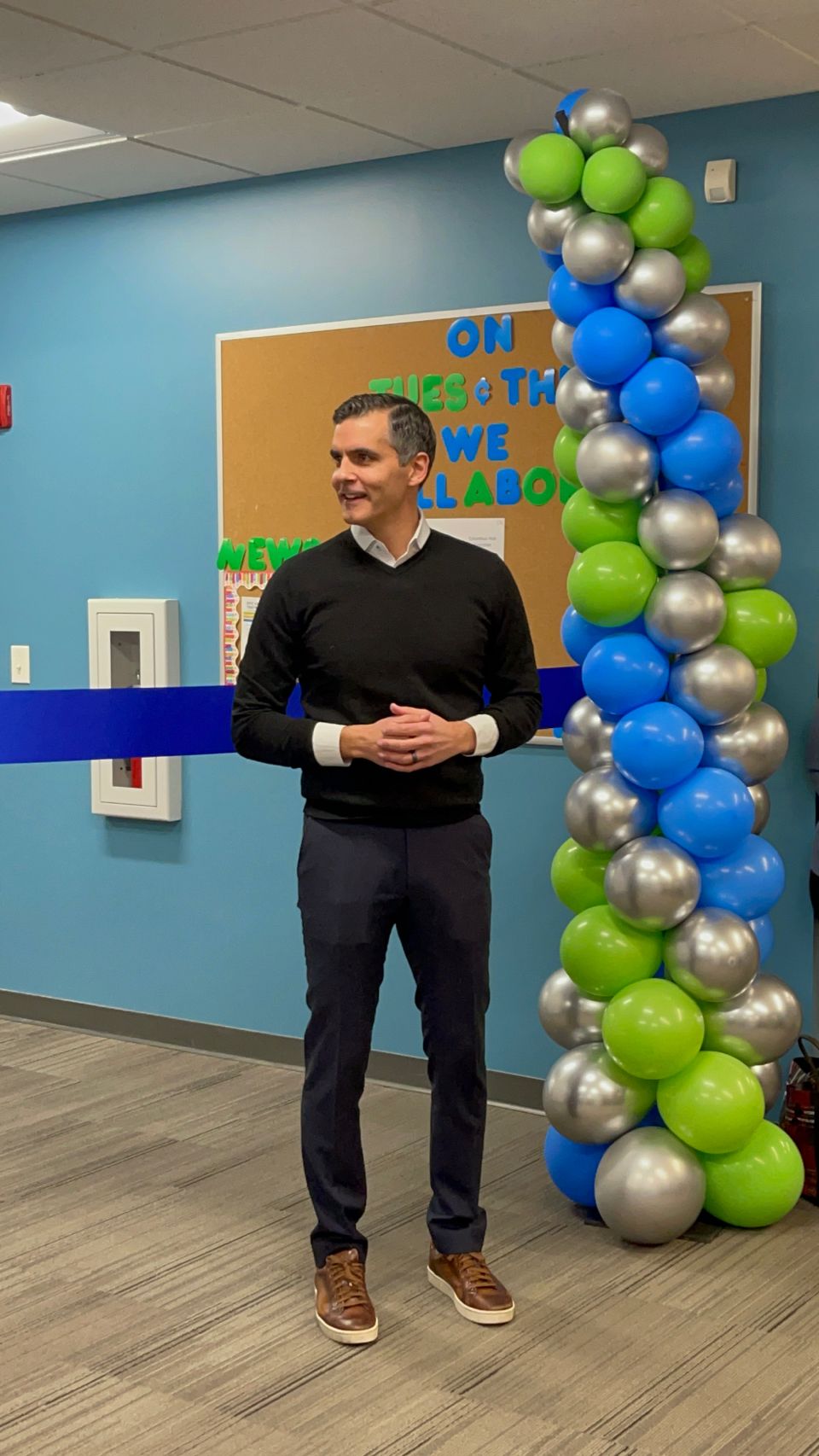
The Columbus origin remains visible. Shaker lives in the metropolitan area. The local partnership with Central Ohio Primary Care still anchors his professional biography. In January 2023, he and regional president Jason Swartz hosted the reopening of agilon’s renovated Columbus hub. The photographs show balloons, a ribbon and the cheerful informality of an office event. They also show a man standing inside the geography that became a template.
What can another operator borrow from his story? Begin close to the work. Build the first system with the people who must use it. Distinguish the elements that need to be common from those that need to remain local. Measure in units small enough to invite action. And when the first version succeeds, do not frame it. Revise it.
Shaker’s career is not a tale of one startling invention. It is about disciplined transmission: carrying an idea from a Columbus partnership into dozens of communities while preserving enough local ownership for the idea to stay alive. The glamour, such as it is, belongs to the map. The craft lives in the operating manual - written once, tested everywhere, and never quite finished.