On one table sits a vintage watch with its case opened and its assumptions exposed. On another, somewhere less photogenic, sits a healthcare contract. Cooper Zelnick has made a career out of asking both objects the same impertinent question: must it work this way?
The answer has carried him into two fields that rarely share a sentence. He is the chief executive of Groups Recover Together, a national organization with more than 120 locations across more than a dozen states. He is also the founder of Cloister Watch Company, a small New York studio that restores and redesigns vintage timepieces. One occupation deals in networks, contracts, and teams. The other can turn on the placement of a single word above six o'clock.
There is an easy joke here about a busy executive and time management, so let us make it and move on. What matters is the deeper resemblance. Zelnick is attracted to systems with history, intricate parts, and users who suffer when the design is wrong. He does not begin by smashing the mechanism. He studies it. Then he decides what deserves preservation and what has merely survived from habit.
01 · The apprenticeshipA career built from the inside out
Zelnick arrived at Groups in 2017 as chief of staff. It was an unshowy title and, in retrospect, the ideal entrance. A chief of staff sees the company between departments, where strategy loses its polished shoes and encounters the carpet. The role put him close to executive decisions while making him useful wherever a problem failed to respect an org chart.
He had come from RRE Ventures, where he worked as an investor with interests in financial technology and healthcare. Venture capital teaches pattern recognition from a distance. Operations tests whether the pattern can survive Tuesday afternoon. At Groups, Zelnick chose the second education. He became an executive director in 2018, moved into corporate development and strategy, served as chief strategy officer, took responsibility for revenue, and then became president. In 2025, he was appointed CEO.
That succession is a compact map of the business. Staff work taught proximity. Corporate development taught expansion. Strategy required a theory of where to go. Revenue required somebody to pay for the journey. The presidency joined the parts. By the time the chief executive title arrived, Zelnick had already spent about eight years walking the factory floor, figuratively and often geographically.
His college subjects are worth noticing. History and English are not the standard prelude to a healthcare operating job, which is exactly why they are interesting. Both disciplines reward close reading. Both ask what a structure reveals about the people who built it. Both train suspicion toward a neat story that leaves inconvenient facts outside the frame. Zelnick graduated magna cum laude and was elected to Phi Beta Kappa. He then carried an editor's instincts into industries overstocked with spreadsheets.
Pay for the destination
The recurring word in Zelnick's public arguments is outcomes. Traditional fee schedules pay for discrete activities. Groups built much of its business around value-based arrangements that tie economics more closely to results. The distinction sounds bloodless until one sees what it permits an operator to do: invest in useful work that a conventional billing code may overlook, coordinate services instead of merely accumulating them, and measure whether the whole system helped rather than whether every part generated an invoice.
Zelnick tends to explain the model as a problem of agreement before it is a problem of finance. First define success. Then measure it. Then make the reward point in the same direction. It is a view that treats incentives as architecture. People still matter enormously, but they work inside rooms somebody designed.
That argument also reveals the investor who became an operator. The investor asks whether a model can scale. The operator learns that scale is not a spell. It is a sequence of local compromises, payer relationships, hiring decisions, technical connections, and patient handoffs. Groups now says it has served more than 100,000 people and operates more than 120 locations. Those numbers are large; the machinery underneath them is granular.
This preference for alignment over ornament may also explain his long rise through one organization. Executive biographies often celebrate the decisive leap. Zelnick's makes a case for the accumulation of context. He stayed close enough to see strategies become workflows and promises become metrics. His promotion to CEO was an arrival, but not an introduction.
03 · The second clockThe orange dial and the accident
Cloister Watch Company began, in Zelnick's telling, by accident. In 2009, an acquaintance asked him to find and restore a watch from the man's birth year: a 1963 Rolex Datejust. The project was completed; the buyer changed his mind. This was discourteous but, for design history, convenient.
Zelnick kept the watch and altered it for himself. He mixed a shade of orange for the dial. A specialist in Bavaria used period techniques to execute the color, while a fabricator made a sapphire caseback that exposed the movement. The watch became his daily companion. Less than a week later, another collector persuaded him to sell it. A private experiment had found its market, and the color acquired a name: Just Orange.
Cloister grew into a design house for watches that might have existed but did not. It works with old cases and movements, commissioning specialist craftspeople to restore, refinish, and customize them. Zelnick's taste leans toward mid-century restraint rather than gemstones and spectacle. He has removed a Rolex date magnifier, added carefully judged typography to the empty half of a Jaeger-LeCoultre dial, and embraced cases shaped like eggs, television sets, and slightly tipsy squares.
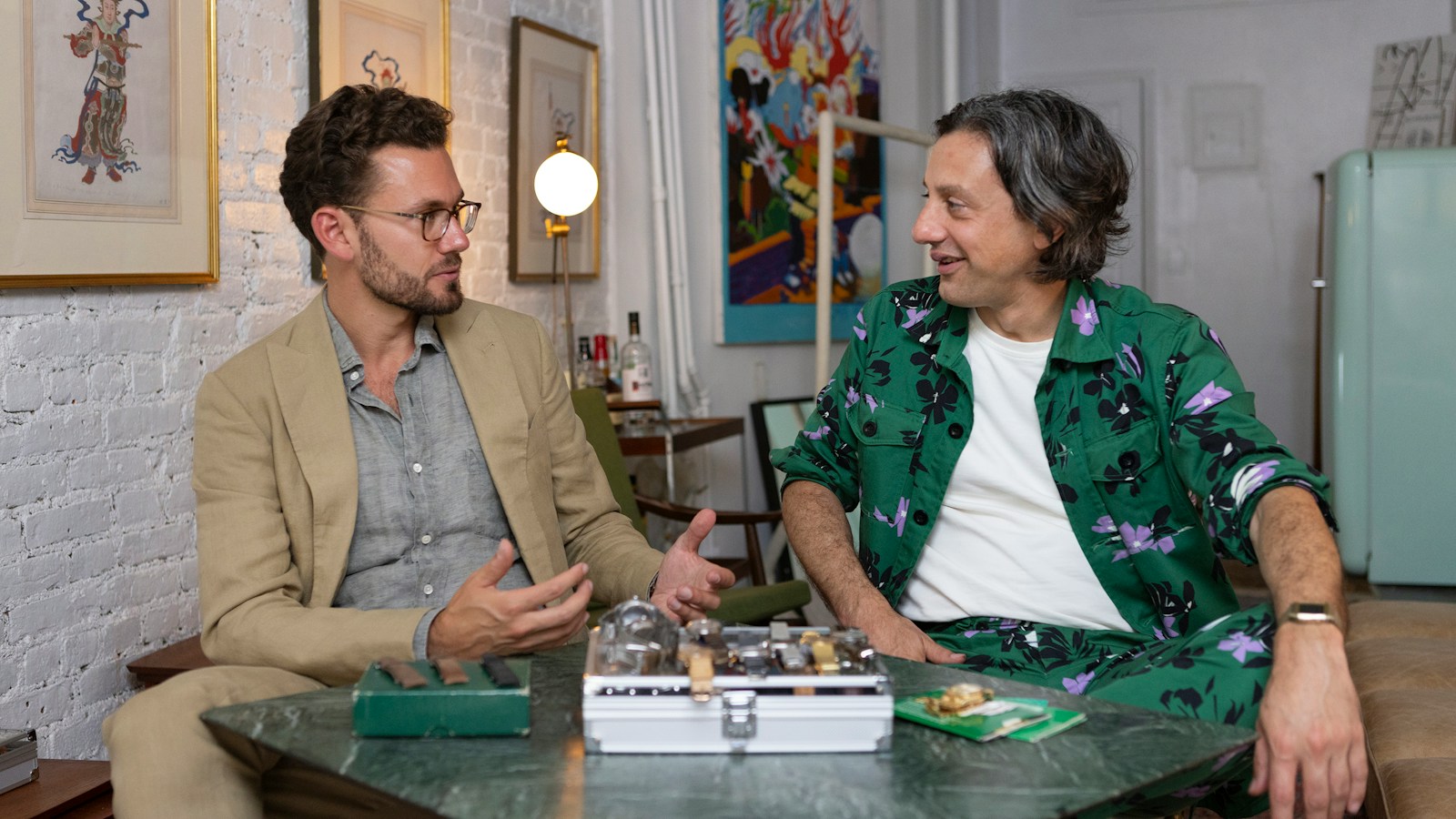
Collectors can be doctrinaire about originality. Cloister's work introduces a mischievous qualification: originality is crucial when resale value is the purpose, but a watch intended to be loved and worn may answer to its owner. This is not permission for indiscriminate vandalism. The strongest Cloister pieces look as though their changes were waiting quietly inside the original design. Rebellion, in this studio, arrives wearing good tailoring.
The healthcare executive and the watch designer meet at that point. Neither begins with novelty for its own sake. Zelnick's interest is in fit: between payment and result, between object and owner, between an inherited structure and its present use. The question is not how much can be changed. It is which change makes the whole mechanism make more sense.
04 · The first dealA bigger mechanism to integrate
In March 2026, Groups closed its acquisition of Better Life Partners, the first acquisition in the company's history. The transaction deepened its presence in New England and added capabilities that could travel across the broader network. It also doubled the number of people served weekly in the region, from roughly 3,000 to more than 6,000.
Zelnick did not describe the work with the false breeziness common to deal announcements. He called acquisitions hard. He spoke about bringing two organizations and two teams together. The verbs are revealing: not capture, not conquer, but bring together. A transaction can be signed in a room. Integration must happen across calendars, systems, habits, and trust.
He has also been plain that Groups wants to do more. The company is building a corporate-development pipeline and looking for targets aligned with its mission and economics. This is the former venture investor returning to deals with an operator's scar tissue. He now has to live inside the combined company after the presentation closes.
Respect without worship
The easiest way to misunderstand Zelnick is to make the watches a charming after-hours eccentricity. They are charming, certainly. But they also illuminate his working style. A watch is a system whose components cannot bluff. If the tolerances are wrong, the hands will tell you. If the design is clumsy, the wrist will tell you. It offers immediate instruction in the difference between complexity and coherence.
Running an organization is less obliging. Feedback arrives late, mixed with noise, and narrated by interested parties. The attraction of measurable outcomes becomes clearer in that light. Metrics are imperfect, but they make the mechanism speak. They create a basis for revision.
Zelnick's two careers finally converge on a kind of respectful impatience. He respects old machines enough to study them closely. He is impatient with the notion that age alone makes every choice sacred. A vintage dial may need one line of text. A healthcare contract may reward the wrong activity. A growing company may need capabilities it cannot build quickly enough on its own.
The answer is rarely a grand gesture. It is the considered alteration: a different incentive, a careful acquisition, a small orange circle. Time, after all, does not improve every system. Sometimes it merely reveals where the work is waiting.