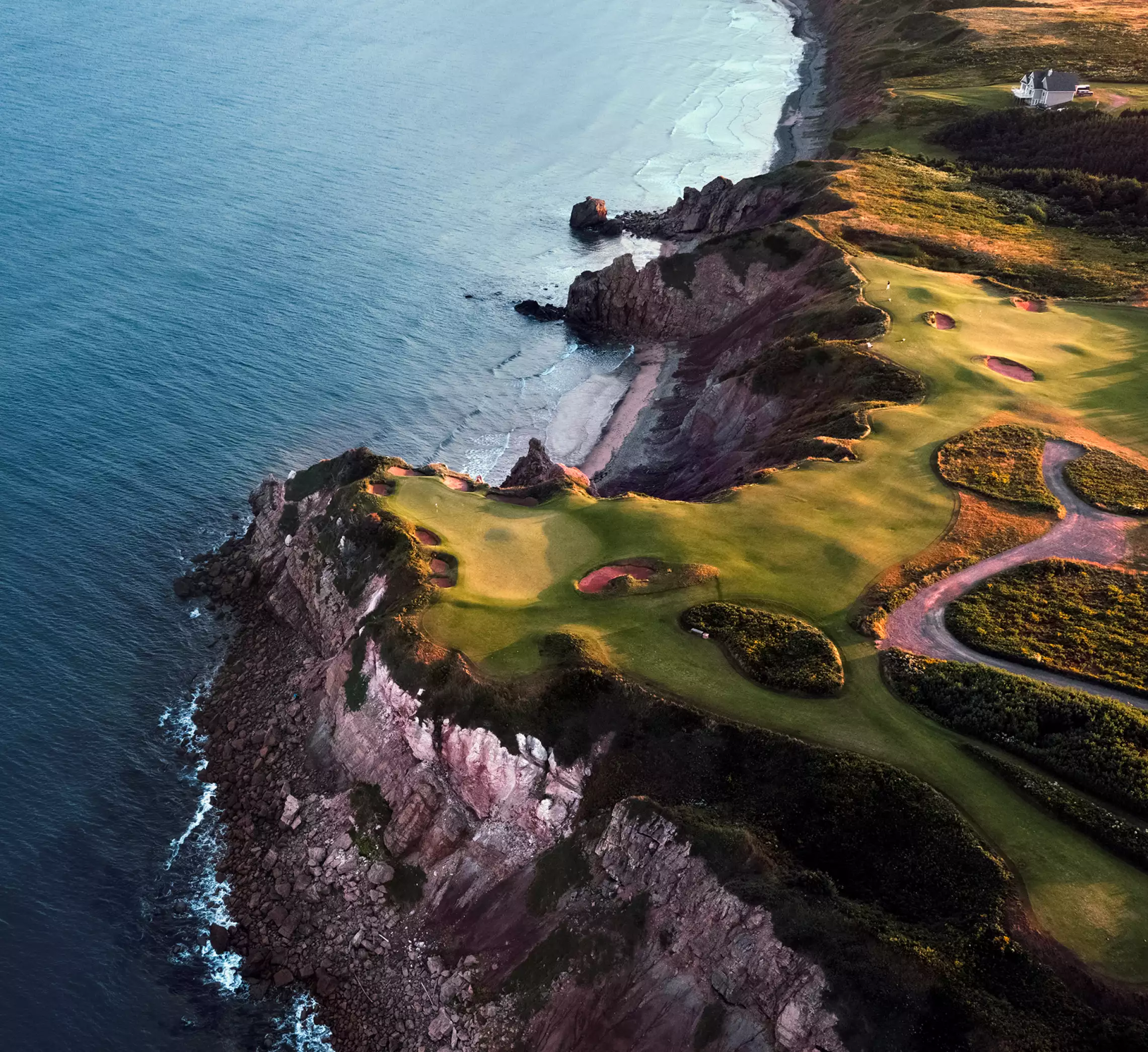
In December 2004, Ben Cowan-Dewar went to Inverness, Nova Scotia, to look at a place where a golf course might go. He was 25. The town had lost its coal mines, and local people had spent years trying to give the land another purpose. He arrived with a golfer’s imagination and no completed development to put on his résumé. There were easier ways to spend a winter.
His introduction had come over dinner that spring. Rodney MacDonald, then Nova Scotia’s tourism minister, described a site in his home riding. Later, during a round at Highlands Links, its longtime professional Joe Robinson supplied more encouragement. By December, Cowan-Dewar was standing on the ground himself. The photographs had failed to show the contours. The coastline was better experienced in person.
That difference between looking at a picture and standing on the land would become a recurring feature of his working life. For the moment, it was enough to persuade him to keep going. Cabot Links would admit golfers to a ten-hole preview in 2011. The full 18 followed in 2012. A visitor can walk a course in an afternoon. Making one exist required a substantial portion of his twenties.
An atlas before a balance sheet
Long before Cabot, there was an Ontario farm and a boy interested in what could be done with it. At 12, Cowan-Dewar built a golf hole with seven tees. This is an economical solution to having only one hole: change the place from which the trouble begins. His interest extended to drawing holes and studying the game’s geography. The World Atlas of Golf offered a reading list that required luggage.
His family supplied the first travelling companions. He played in Florida with his grandfather and took golf trips with his father. As a teenager, his appetite for distance also took him on a 1,100-kilometre canoe journey from Yellowknife toward the Arctic Ocean. The future resort developer had an early willingness to go somewhere inconvenient.
At the University of Toronto, he turned the golf interest into Golf Travel Impresarios. Initially organizing trips to Scotland and Ireland, he also recognized what the young internet could do for courses trying to reach customers abroad. A resort no longer had to depend entirely on print and postage to find a golfer on another continent. He could help make the introduction.
The business put him in contact with courses and the people responsible for them. It let him examine architecture while learning how golfers chose their holidays. Organizing other people’s trips was a practical education for someone who wanted to give them a new place to visit. University College would later invite its 2005 alumnus back to tell the Cabot story.
The people who could build it
Cowan-Dewar’s attraction to Inverness did not make the project inevitable. The community’s ambition predated his visit. Local volunteers had already given years to the possibility of a course, and there had been earlier proposals. The newcomer inherited both an opportunity and the reasonable question of whether this attempt would end differently.
He later acknowledged that he had no background as a developer, architect or golf professional. His description of his qualifications was admirably free of varnish. He had seen enough golf to know what interested him. Turning that knowledge into a working destination required people with skills he did not have.
Mike Keiser supplied an important part of the answer. The developer of Bandon Dunes in Oregon had shown that golfers would travel considerable distances for courses worth the effort. He became Cowan-Dewar’s partner and mentor. The example mattered as much as the encouragement: remote golf already had paying customers.
Rod Whitman supplied the architecture. Cowan-Dewar knew his work at Canadian courses including Blackhawk and Wolf Creek, and had played with him. Whitman’s job was to turn the Inverness ground into holes people would want to play again. The choice gave Cabot Links an author with his own eye, rather than simply borrowing the look of an admired resort elsewhere.
The financial crisis complicated the building years. Progress continued, sometimes slowly, while the project still had no full course to sell. Cowan-Dewar and his wife, Allie, moved to Inverness, putting the work on their doorstep. Persistence becomes a less abstract quality when it determines where the family lives.
A town gets a second act
When Cabot Links opened, Inverness acquired a new reason for people to come. A second course followed: Cabot Cliffs, designed by Bill Coore and Ben Crenshaw, began welcoming golfers in 2015. The two courses gave visitors different experiences within the same destination. Both went on to appear in world top-100 rankings.
There is a temptation to tell this as an entrepreneur’s private triumph. Cowan-Dewar’s own recollections make the frame wider. He has described contractors getting work, people moving back and local businesses improving their shopfronts. He could imagine golf holes during that first visit. He could not have predicted all the activity that would gather around them.
The distinction matters. A destination brings a continuing need for staff, accommodation, meals and maintenance. The effect on the town continues after the golfer has taken a photograph and driven away. Cowan-Dewar received the Meritorious Service Medal in 2017, and was named to Canada’s Top 40 Under 40 the following year. His public work also included chairing Destination Canada and, earlier, Tourism Nova Scotia.
His enthusiasm for the surrounding golf has occasionally produced an unusual sales pitch. When writer Josh Sens visited newly opened Cabot Links in 2012, Cowan-Dewar urged him to drive on to Highlands Links, a course in which he had no financial interest. A host sending a customer elsewhere is memorable. An architecture enthusiast making sure a visitor sees Stanley Thompson’s work is entirely understandable.
The map fills in
Cabot’s later growth involved several kinds of work. In Florida, the former World Woods became Cabot Citrus Farms, a redevelopment that celebrated its official grand opening in January 2025. It combined two 18-hole courses, short courses, practice facilities and cottages. A golfer could spend a visit doing rather more than repeating the same round.
In Saint Lucia, Coore and Crenshaw designed Point Hardy Golf Club on a peninsula at the island’s northern end. Its December 2023 grand opening added a Caribbean destination to a story that had begun on a Canadian coast. Cowan-Dewar’s relationships with architects were carrying into new landscapes.
Bordeaux supplied a different opportunity. Cabot acquired the existing Golf du Médoc resort in 2024. One of its courses was designed by Coore; the other by Whitman. The pairing was familiar from Cape Breton, although the French courses had their own much earlier histories. Cabot Bordeaux brought those established designs into the business alongside the region’s food, wine and culture.
That September, Cabot announced a strategic investment in Norway’s Lofoten Links. In Scotland, the acquisition of Castle Stuart had created the opportunity to expand an existing destination. Cabot Highlands now includes Tom Doak’s Old Petty, officially opened on May 15, 2026. Its opening and closing holes cross, and its routing works around a tidal estuary, an old church and the castle.
The sequence can look tidy when reduced to dots on a map. Cowan-Dewar has described opportunities arriving in bunches after long periods of work. A purchase, a course under construction and a grand opening belong to different stages of the process. They can produce headlines close together while representing years of separate effort.
Somewhere to sit after the last putt
Among all the land and construction, a modest piece of furniture offers a useful clue to Cowan-Dewar’s interests. At Cabot Cliffs, couches beside the 18th green gave golfers somewhere to pause after finishing. They could discuss the round, have a drink and watch others complete theirs. The arrangement subsequently travelled to other Cabot destinations.
It is easy to appreciate the appeal. Golf generates an inexhaustible supply of things that must be explained to one’s companions. Providing a comfortable seat acknowledges that the conversation is part of the day. The scorecard may be finished; the account of the difficult seventh is still developing.
“I am a big believer in serendipity.”
Ben Cowan-Dewar
For a new project, he has also described asking whether he would enjoy going there for the next 45 years. That is a demanding test for a place, and a revealing one for its developer. It suggests repeated visits after opening day, with enough affection for the setting to keep returning when it has become work.
There is a written record of his interest beyond the company’s properties, too. His contributions to Golf Club Atlas include pieces on Hirono in Japan, Nirwana Bali in Indonesia and Banff in Canada. Those bylines place him in the conversation as a student and observer of courses. They also help explain why the travel business suited him: seeing a place produced something to think about after the trip. For a person now responsible for developing destinations, that earlier habit is useful context. He had spent time considering other people’s work before asking anyone to judge his own.
His attachment to the first course remains personal. Asked in 2024 where he would choose to play one final round, he picked Cabot Links. His three children were born in Inverness. The course is tied to the family’s life as well as the company’s beginnings. After the travel business, the building years and the expanding map, he still has a reason to head for that particular first tee.