Before Belva Devara could help other people learn, he had to find somebody to teach him. He and his friend Iman Usman were preparing for graduate study in the United States. They needed suitable tutors. In Indonesia, finding one depended heavily on recommendations and word of mouth. For two people preparing to enter highly organized universities, the search was an unexpectedly untidy preliminary examination.
The difficulty helped inspire Ruangguru, which they founded in 2014. Its first proposition was straightforward: bring students and private teachers together online. The name means “teacher’s room” in Indonesian. It is a pleasantly ungrand name for a company that would attract international investors and put its co-founder in rooms considerably more ceremonial than a teachers’ office.
Devara’s biography is often told through its universities. Nanyang Technological University. Stanford. Harvard. Later, Yale. The list is real, but it leaves out the interesting complication. Someone who had navigated an unusually successful educational route was building a business around the obstacles in everybody else’s.
The student with a business problem
Adamas Belva Syah Devara was born in Jakarta on May 30, 1990. At Nanyang Technological University in Singapore, he studied business and computer science on scholarship. The combination would prove useful: an education platform needs software, but it also needs a reason for teachers, students and paying parents to use it.
His early career included consulting at McKinsey & Company and work with Indonesia’s presidential delivery unit. Then came graduate school: an MBA at Stanford, completed in 2015, and an MPA at Harvard Kennedy School, completed in 2016. Business administration and public administration share a noun. Their practitioners do not always share a definition of success.
Ruangguru was already underway during those studies. Devara’s return to Indonesia in 2016 marked his move into working on it full time and taking over as CEO, with Usman moving into product and partnerships. The partnership matters. This was a company built by two friends with different educational and professional experiences, rather than a solo invention that happened to acquire employees.
He has described the preparation behind his Stanford admission as a three-year process involving tests, essays and an interview in Thailand. That detail gives the university list some texture. An acceptance letter is a tidy ending to a story; the preparation usually involves rather more drafts.
A lesson that could travel
The tutor marketplace addressed a problem of discovery. A student needed a teacher, and the teacher needed to be found. Yet matching two people leaves the timetable intact. A tutor still has a finite number of hours. Another student still needs another appointment.
Ruangguru widened its approach. It introduced a mobile app with live tutoring and homework assistance, then developed ruangbelajar, a subscription service built around learning videos, exercises and summaries. The business was moving from locating instruction to producing and distributing it.
That shift is central to understanding Devara’s work. A recorded explanation can be watched outside the tutor’s working day. A quiz can help a student discover which part of the explanation did not stick. Live teaching can gather learners who would otherwise have to be in the same place. Each format changes the practical arrangements around getting help.
The products also show how much labor sits behind the word “technology.” Someone has to teach the lesson, organize the curriculum and write the questions. The screen may be small; the educational work behind it remains substantial. Devara’s business depends on making that work available in a form families will choose.
The arithmetic behind access
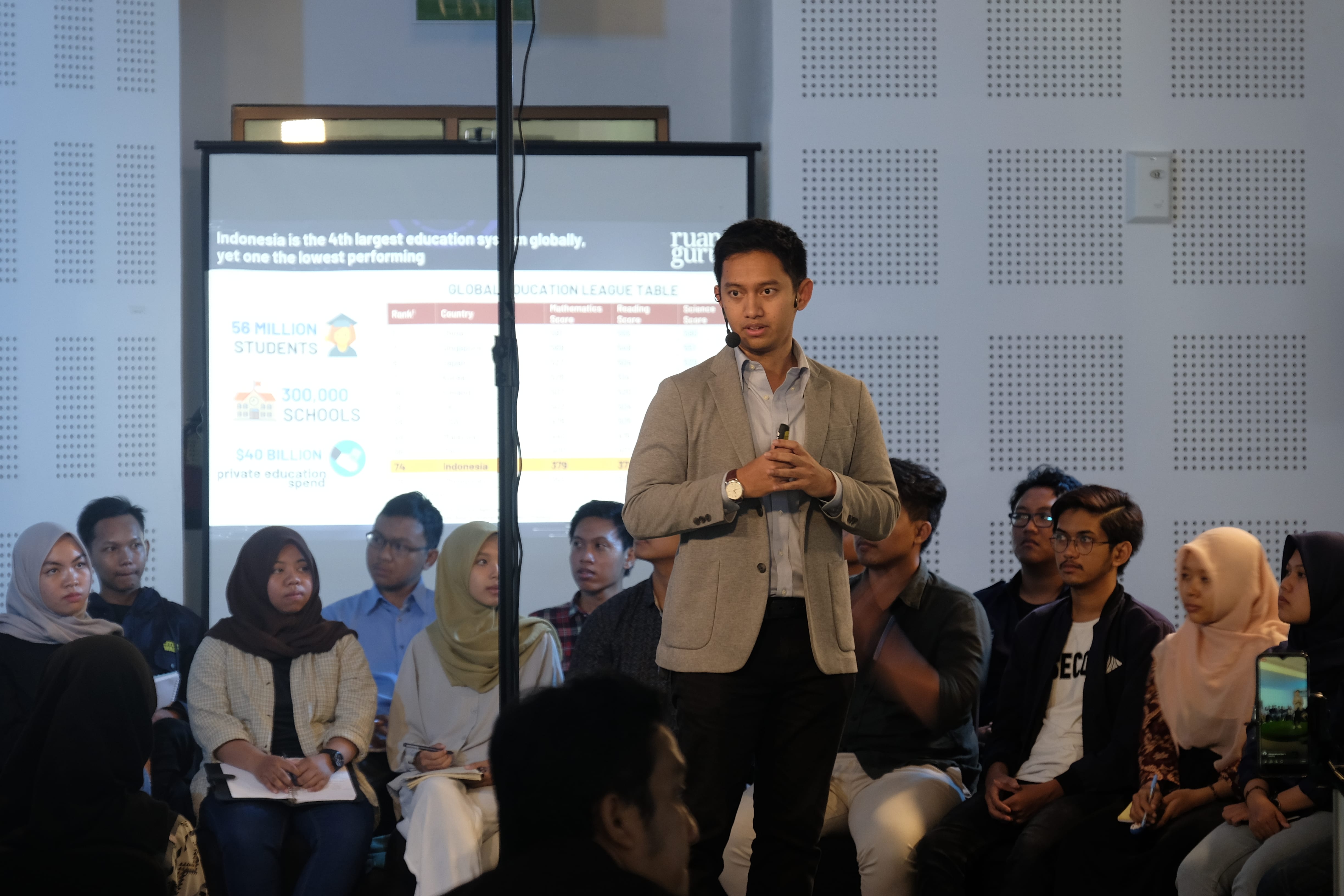
At a February 2020 social entrepreneurship event in Yogyakarta, Devara argued that spreading benefits widely while keeping costs low could help a business endure. He linked Ruangguru’s founding purpose to more equal access to education. The language was social, but the mechanics were commercial: a service has to keep operating if people are going to keep using it.
Education, in his account, offered a route toward a better life. It was a familiar proposition, made more demanding by the task of putting a price and a distribution system around it.
“Padahal, pendidikan adalah kunci untuk hidup yang lebih baik.”
Belva Devara · Yogyakarta, 2020
The money arriving at Ruangguru changed the scale of that task. In December 2019, the company announced a $150 million Series C led by General Atlantic and GGV Capital. In April 2021, it announced another $55 million, led by Tiger Global Management. Those were investments in a company, with the expectations that come attached.
The distinction matters when reading an entrepreneur’s biography. Funding measures what investors are willing to back. It does not tell you what a particular child has learned. For Devara, the challenge has been to run a business in which the commercial promise rests on providing something useful to students and families.
Capital for the next lesson
Geography gave the ambition a concrete test. At the time of the 2019 funding announcement, Usman said 80 percent of Ruangguru’s students were outside Jakarta. The figure described where users were, rather than how much they had learned. Even so, it addressed an essential part of the company’s proposition: educational help should be able to travel beyond the capital.
A short walk into the palace
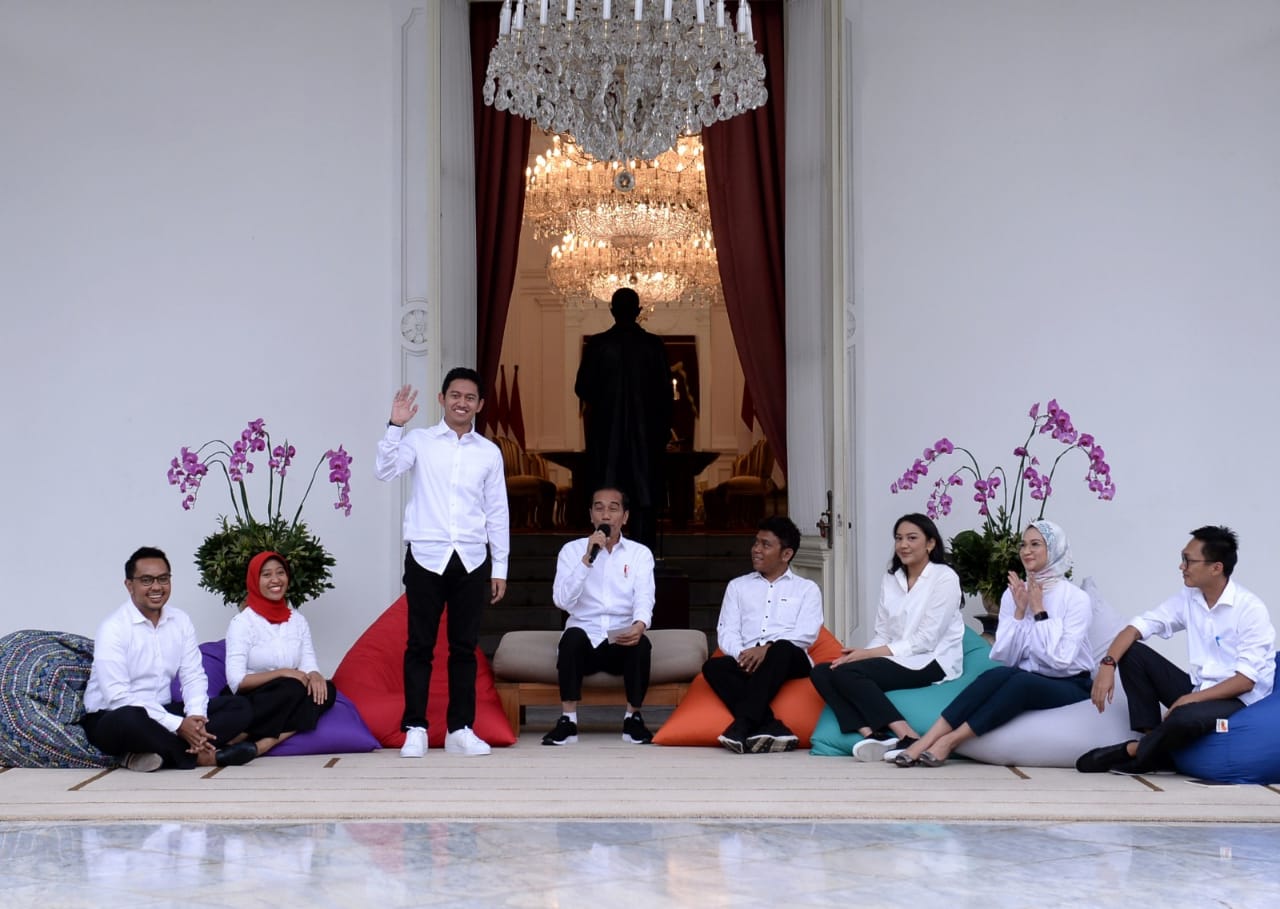
On November 21, 2019, President Joko Widodo introduced Devara as a member of his special staff. He would continue his daily work as Ruangguru’s CEO while contributing advice on innovation. The appointment brought the two halves of his graduate education into unusually close proximity.
In December 2019, he announced CiptaNyata, a plan to use his after-tax presidential staff salary for small-business grants and mentorship. The initial proposal would run for six months before evaluation. He connected it to the difficulty of finding capital and mentors when starting a business. The idea echoed the tutor search: useful expertise existed, but reaching it could be a problem of its own.
It also brought scrutiny. In April 2020, Ruangguru’s involvement in the government’s pre-employment card program prompted questions about a conflict of interest between Devara’s public position and his company’s commercial activity. Skill Academy, a Ruangguru offering, was involved in the program.
Devara denied taking part in the selection decisions. He said those decisions had been made independently by the coordinating economic ministry and the program’s management. On April 21, he publicly announced his resignation from the presidential staff, saying he had submitted his letter on April 17.
The episode belongs in the same life as the scholarships and entrepreneurial awards. A founder’s wish to contribute to public life does not settle the questions that arise when a business participates in a government program. The overlapping roles attracted criticism; the public role ended. His work at Ruangguru continued.
Recognition, followed by more studying
The professional recognition accumulated alongside the business. Devara and Usman were named to Forbes Asia’s 30 Under 30 in consumer technology in 2017. EY Emerging Entrepreneur recognition followed in 2019. In 2020, Harvard Kennedy School awarded Devara its Digital Innovation Award.
Harvard’s recognition focused on defining a problem and providing a technological response with ways to measure its impact. That is a useful description of the work beneath the founder’s public persona. Identify where learning breaks down, build a service around it, then examine what students actually do.
In 2022, he joined Yale’s World Fellows program, a four-month period of academic enrichment and leadership development. The same year, NTU named him a recipient of its Nanyang Outstanding Young Alumni Award. His university connections had become a recurring part of his working life, extending beyond the degrees with which he began it.
There was a personal milestone that year, too. He married Sabrina Anggraini on March 5, 2022. Their wedding was streamed on her YouTube channel; a joint channel now carries both their names. The public life surrounding the education business had expanded to include a family audience, alongside the students, teachers and investors who had followed its earlier chapters.
The quizmaster enters
Then the education business acquired a different kind of stage. Ruangguru’s Clash of Champions put academically accomplished students into competitive entertainment. The company was working on the appetite for learning as well as the supply of lessons.
Its marketing leadership has described discussions involving Devara, Usman and the team about students’ enthusiasm for competitive reality shows. Usman later recalled that television stations had declined the proposed program. A show organized around academic ability was apparently a harder sell than its founders hoped.
Devara became a game master. By August 2026, he was guiding contestants through “The Last Dinner,” a Clash of Champions Season 3 round involving recall and rapid mathematics. The job title CEO generally suggests meetings. This version came with contestants trying to remember things under pressure, which at least gave the meetings some competition.
There is a limit to what the spectacle can establish. Enjoying a contest and understanding the material are different achievements. Still, the format puts academic effort in front of an audience. In Devara’s career, the search for a teacher had led, by a circuitous route, to helping present the questions.
How does a useful lesson reach the student who needs it?
That question connects the tutor marketplace, the subscription videos and the public stage more convincingly than a list of credentials does. Devara has changed institutions and acquired new titles. The recurring problem is practical: making help easier to find, easier to afford and worth coming back to. A very accomplished former student is still working on the arrangements for the next lesson.