Consider the connection between a needle and a syringe. It is easy to overlook until it loosens. In 1925, BD acquired the Yale Luer-Lok, a way to secure that connection. A century later, the company is pursuing another connection: the one between a medicine cabinet, an infusion pump and the information a clinician needs. The objects have become more complicated. The underlying question is familiar. What happens at the handoff?
- The everyday business: medical supplies, drug delivery, medication management and interventional devices.
- The new shape: biosciences and diagnostic solutions moved to Waters in February 2026.
- The test: connected equipment has to earn trust in the untidy conditions of actual care.
A business hiding in the ordinary
Maxwell Becton and Fairleigh Dickinson founded the company in 1897. Its history includes glass syringes, a U.S. needle factory and the Plastipak plastic syringe, introduced in 1961. These were objects healthcare workers needed repeatedly. Manufacturing them consistently was itself a substantial technical task.
Today, BD sells to hospitals, pharmacies and pharmaceutical manufacturers. Nurses encounter its vascular-access products; pharmacy teams use its dispensing systems; drugmakers buy delivery components. Its expertise runs through materials, sterility, precision manufacturing, software and clinical workflow. The customer may be an institution, but the final encounter is often between one worker, one device and one patient.
The economics follow the repetition. A hospital installs equipment, then replenishes compatible supplies and maintains the system. In February 2026, chairman and CEO Tom Polen called it a “highly recurring consumables model.” For a buyer, the meaningful price therefore includes supplies, service, integration and training across the relationship. A purchase order captures only part of it.
One detail from BD’s own account of its culture is revealing. The founders worked beside their colleagues, with lockable roll-top desks providing their privacy. It is an appealing origin story for a manufacturer: the boss close enough to see the work. The modern equivalent would be leadership close enough to hear about a defect before it becomes a disclosure problem.
The company that got smaller on purpose
BD’s name still appears on laboratory equipment and diagnostic products. That can obscure a consequential change. On February 9, 2026, its Biosciences & Diagnostic Solutions business was spun off and combined with Waters. BD received $4 billion in cash; the transaction valued the separated business at $18.8 billion at closing. The familiar label and the corporate boundary do not always move together.
The remaining company has four reporting segments. This is a practical guide to its market position: essential supplies and drug-delivery components alongside connected equipment and procedural devices. The separation makes it easier to see what management wants to connect.
Fiscal Q3 2026 · continuing operations · quarter ended June 30
First, find the medicine
Take Pyxis Pro, BD’s automated medication dispenser. Its illuminated bins, badge access and stackable storage address a wonderfully unglamorous problem: finding and retrieving the right medicine without making a crowded medication room more crowded. The Incada cloud platform, introduced alongside it in October 2025, adds inventory visibility and natural-language analytics using Amazon Web Services infrastructure.
The ambition extends beyond the drawer. BD wants information from pumps, monitors and pharmacy robots to become more useful together. That is a roadmap, rather than evidence that every device already communicates perfectly. European Pyxis Pro and Incada platform launches were announced in April 2026; the analytics extension there was planned for the following year.
A map of BD’s portfolio, not a claim of universal interoperability.
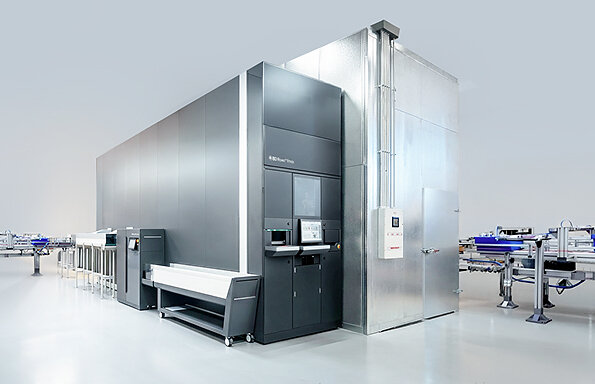
In September, the idea acquired a specific address: Fairview Health Services in Minnesota. The health system became the first U.S. deployment site for the Vmax 160 pharmacy robot. Fairview fills roughly 20,000 prescriptions weekly. The machine handles boxed medicines and supports refrigerated storage, expiration tracking and automated labeling. Here, automation means coping with packaging and temperature as much as moving faster.
A $4.2 billion view of the patient
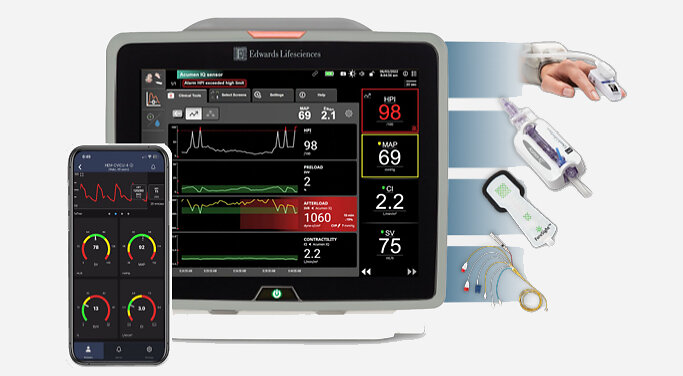
BD paid $4.2 billion for Edwards Lifesciences’ Critical Care business, completing the purchase in September 2024. It brought monitoring systems, sensors and clinical decision-support tools. The strategic logic is straightforward: medication delivery and measurement of a patient’s condition often happen beside the same bed.
That breadth distinguishes BD from a narrower equipment supplier. It also gives the company more integration work. Omnicell’s dispensing systems provide a clear alternative in medication management, including its own cloud-connected approach. BD’s wider portfolio is an opportunity; the customer still has to judge whether the connections improve a particular workflow.
For a hospital considering such a system, the useful questions are concrete. Can staff retrieve a medicine during a network interruption? Who maintains the drug records? How are updates tested? What happens during a recall? These questions turn a feature comparison into an operating decision. Better dashboards help only when the underlying inventory and clinical processes remain dependable.
The alarm that matters
There is an uncomfortable counterweight. The SEC found that BD knew in 2016 that Alaris software changes required new regulatory clearance. Software flaws were followed by failures in accounting and investor disclosure. In December 2024, BD agreed to a $175 million civil penalty, without admitting or denying the findings.
An updated Alaris system received FDA clearance in 2023. That did not end every safety issue. In an October 2026 update, the FDA described a separate Class I recall involving certain infusion sets, with performance concerns particularly at low flow rates. The lesson is specific: a pump, tubing and use conditions form a system. Testing one part cannot establish how every combination behaves.
A pump, tubing and use conditions form a system.
The engineering lesson
The next connection is a supply chain
On October 6, BD announced plans for $19 billion in U.S. investment over several years, including $3 billion for manufacturing expansion. Its government agreement includes conditional relief from future Section 232 tariffs. These are commitments and conditions, not completed factories or realized savings.
For someone building a business, the transferable idea is to inspect a repeated handoff closely. What gets lost? What must fit? What must work every time? BD’s stated culture prizes innovation and quality. Its record makes clear how much depends on keeping those obligations together. A hospital benefits when the cabinet, the clinician and the supply chain are ready for the same patient.