An introduction sounds like a small thing. Two names, one email, perhaps a sentence explaining why they should talk. BayStartUP has built a considerable operation around making that sentence credible. Each year, the Bavarian startup network says it meets 800-900 young companies. About 150 qualify for investor events and direct introductions. The interesting part is the distance between those numbers: the preparation, the questions, and the decision to wait.
- Core founder services are largely free; BayStartUP takes no startup equity.
- Business plan competitions turn an early idea into written expert feedback.
- Investor access depends on preparation and fit, rather than simply showing up.
For a founder, the temptation is to treat fundraising as an address-book problem. Find somebody with money, deliver a pitch, repeat. BayStartUP’s process suggests a different diagnosis. Before the email goes out, somebody needs to establish what the company is selling, who will buy it, how it can grow, and why this particular investor belongs in the conversation. Charm remains welcome. Arithmetic gets a seat too.
A network with two birthdays
The roots reach back to 1996 and the Munich Business Plan Competition. Northern Bavaria’s competition followed in 1999. BayStartUP itself emerged in 2014, when evobis and netzwerk nordbayern merged. That distinction explains the apparently contradictory founding dates attached to the company: one describes the lineage, the other the organisation carrying it forward.
The merger had a practical ambition: give founders across Bavaria comparable support, including those outside its metropolitan centres. Today, the company works from Nuremberg and Munich, with regional connections extending through universities, municipalities and startup institutions. Its territory matters. A regional network can know the people around a company long before that company has a sufficiently fashionable story to travel.
The pitch gets its examination first
The entry point for financing coaching is a two-page application and an initial business plan or pitch deck. Coaches work through the financing strategy, financial plan, valuation and fundraising agenda. They challenge the team’s assumptions. BayStartUP explicitly leaves operational tasks with the founders: feedback is available, but nobody is volunteering to become your outsourced management.
This makes the service closer to rehearsal with a demanding audience. The intended users are innovative, technology-oriented companies with scalable models and growth potential. A clever invention still needs a customer and a plausible way to become a business. A founder who wants somebody else to write the plan has mistaken the offer.
“We do not take shares of startups”BayStartUP’s published founder offer
Business planning is treated flexibly. BayStartUP discusses Lean Startup, the Business Model Canvas and iterative validation alongside conventional planning. The final document can take several forms. The useful discipline is explaining the customer’s problem, the competitive landscape and the economics clearly enough that another person can interrogate them.
The prize is useful. So is the criticism.
The Bavarian Business Plan Competitions make that interrogation available early. The competitions cover Munich, Northern Bavaria, Swabia and Southeast Bavaria’s Ideenreich. Across the programme, €85,000 in prize money is available. Participants receive written feedback from up to eight jurors in each applicable phase, giving them something more actionable than applause.
Teams can enter later phases, and incorporation is not required. There must be a Bavarian connection through the company or a team member’s residence or studies. Those conditions give the programme a specific constituency. Within it, a founder can bring an unfinished argument and improve it before asking somebody to finance its consequences.
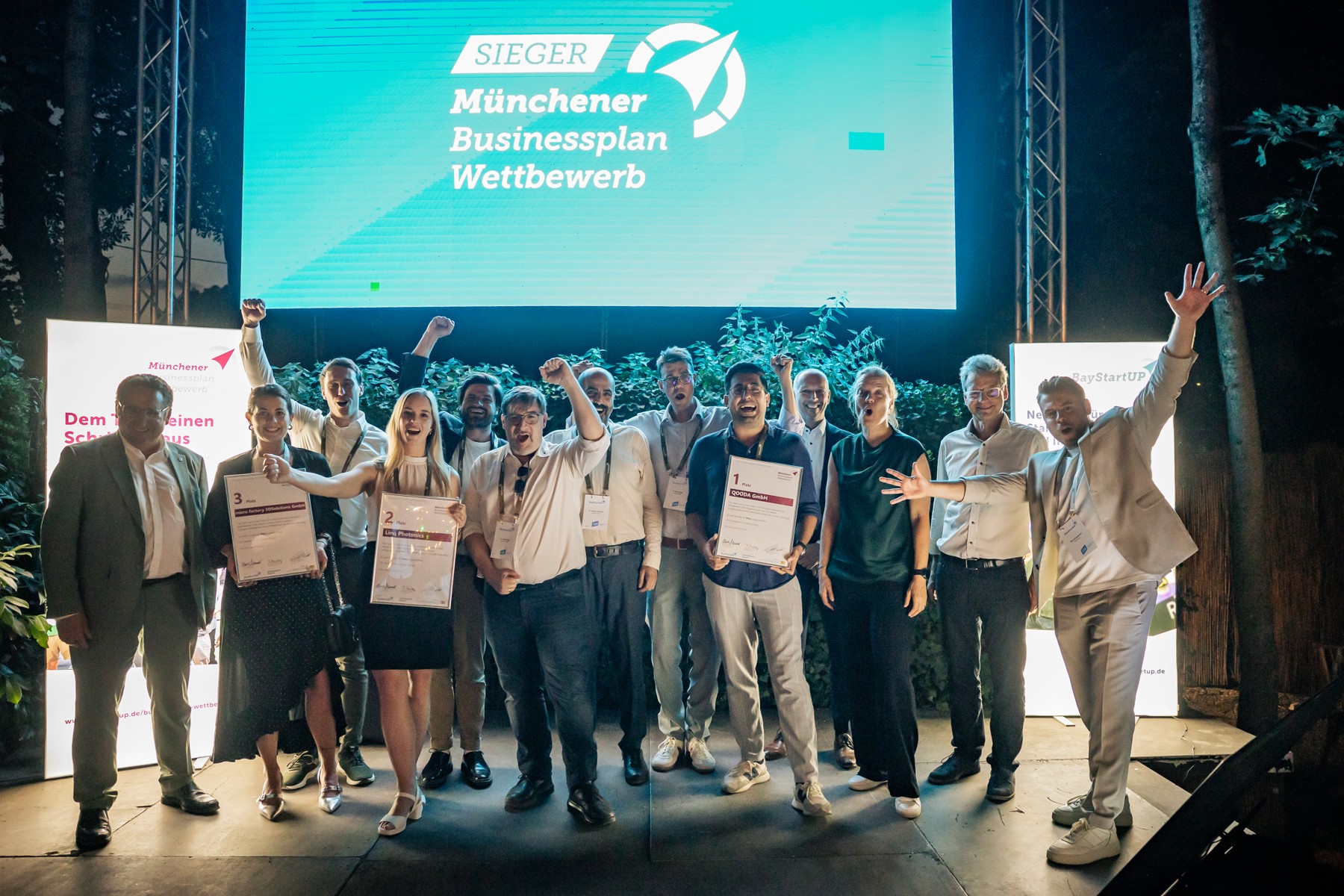
The 2026 Munich competition offers a revealing cross-section. QOODA won with quantum-based navigation technology designed to work without satellite signals. Linq Photonics, developing photonic control systems for quantum computers, placed second. Medical 3D-printing automation company micro factory 3DSolutions came third. These are different technical worlds, sharing the awkward task of explaining a commercially viable next step.
Who pays for a free conversation?
BayStartUP calls itself a neutral, non-commercial intermediary. Its startup services are largely free, investor introductions carry no introduction or presentation fee, and investor network membership has no fee. The Bavarian Ministry of Economic Affairs and corporate sponsors support its activities. Two shareholder support associations also contribute through membership income.
The structure makes the absence of an equity claim understandable. The associations draw members from business, institutions and the startup community, including former competition participants. The arrangement gives successful founders a route back into the network. It also distinguishes BayStartUP from an investment fund choosing companies for its own portfolio.
mediated across 578 early-stage financing rounds since 2014
Capital for supported startups; not BayStartUP’s own fundraising.The next useful person may be a customer
Investors receive selected opportunities matched to their interests, plus meetings and conferences. The network reports more than 400 business angels and family offices and more than 200 early-stage venture capital providers. For a founder, that breadth is useful only when the matching is specific.
The corporate side widens the possible conversation. BayStartUP offers technology scouting, venture clienting and startup challenges: define an industrial problem, find suitable teams, organise discussions and support pilots. Its 2026/27 Nexperia challenge, with Avnet Silica, targets EU hardware startups working on power electronics for micromobility applications. Expert access and components can matter alongside investor visibility.
Copy the order of operations
The practical lesson travels beyond Bavaria. Write down the business logic, expose it to criticism, prepare the financing case, and approach investors whose interests match. BayStartUP reports a 30-40% financing rate among companies presented in its network. Even after selection, an introduction remains a possibility rather than a cheque.
That makes timing part of the work. A rushed company cannot substitute a warm contact for preparation; a business without a scalable model may need a different financing route. BayStartUP’s contribution is to make the conversation more informed before it becomes consequential. For founders, the useful question is whether they are ready to give that carefully chosen recipient a reason to reply.