The offer came with an escape hatch. Set up your own shop, Pacific Australia Container Express Line told Barbara Spector Yeninas, and we will become your first client. Try a five-month contract. By January, everyone could decide whether to carry on. It was a practical arrangement for a woman preparing to exchange a reporter’s byline for her name on the business. Nobody had to pretend to know the next fifty years. They only had to agree on the next five months.
Yeninas opened BSY Associates on August 1, 1974. The proposition rested on something she already possessed: a working knowledge of shipping, acquired while asking questions on the New Jersey waterfront. Ships had operators, ports had managers, newspapers had deadlines. She understood how those worlds met, and how often they missed one another. There was a living to be made in the gap.
“Shipping I knew,” she said. Three words, with the economy of someone who had worked in a newsroom. The qualification was also a boundary. She was building around a subject she could understand well enough to explain, challenge and keep learning.
Before the business card, there was “Barb Wire”
Born in the Bronx on March 21, 1940, Barbara Spector moved with her family to Lakewood, New Jersey. She skipped two grades and finished high school at sixteen. At New York University, her college column had a name that suggests its author did not intend to spend her life being soothing: “Barb Wire.” She earned a BS and an MA in journalism and mass communications.
The joke in that column title is worth keeping. Much later, people would describe her generosity and her quick wit in the same breath. A sharp edge and a welcoming manner could coexist. The aspiring journalist had already found an economical way to announce both her name and a willingness to have something to say.
Her professional reporting began at the Asbury Park Press. She then joined the Newark Evening News, initially on general assignment, and developed its maritime beat. Containerization gave her a changing industry to follow. The port was a place where new equipment, new routes and new commercial relationships became visible before they reached the shopping basket.
A container can look stubbornly uninteresting from the roadside. Its contents, destination and ownership are concealed. To report on it requires a second look: who needs it, who moves it, who pays when it waits? Yeninas made that world her subject. Her later business would depend on the same habit of looking past an ordinary exterior.
A picket line, a marriage, a closed newspaper
The Newark News also brought her together with Joseph Yeninas, an editorial cartoonist and art director. They met as co-captains on the newspaper’s strike picket line and married in December 1971. A newsroom had furnished them with professions; its labor dispute furnished the introduction. Romance sometimes arrives with flowers. In this case, there were placards.
When the paper folded in 1972, the institution that had supported her reporting disappeared. Her knowledge of the industry survived it. That distinction matters in her story. An employer could close; the questions she had learned to ask and the people she had learned to reach were still there.
Her move into business gave that accumulated experience a different use. A reporter learns to recognize the detail that makes an account intelligible. A communications adviser has to help someone else recognize it, too. The transfer sounds straightforward until the client has spent years assuming that everyone understands the machinery as well as they do.
The patience of a forty-year client
Evergreen Marine became one of the relationships by which her career could be measured. The agency and the Taiwan-based carrier marked forty years together in 2015, tracing the agreement to July 1975. Captain S. Y. Kuo was present when that contract was signed. Decades later, he also presented her with an industry lifetime achievement honor.
Yeninas explained the relationship in terms that were unusually plain for a publicity business. Budgets deserved care. Clients needed an honest account of what the agency could deliver. Recommending work simply to improve the agency’s own earnings was a poor basis for partnership. Her formulation was “partnership before profit.”
That principle asks more of an agency than agreeable conversation. It requires telling a client when a project does not justify its cost, then trusting the relationship to survive. The forty-year milestone makes sense in that light: useful advice has to remain useful after the celebration, when the next decision lands on the desk.
Someone had to change the entertainment
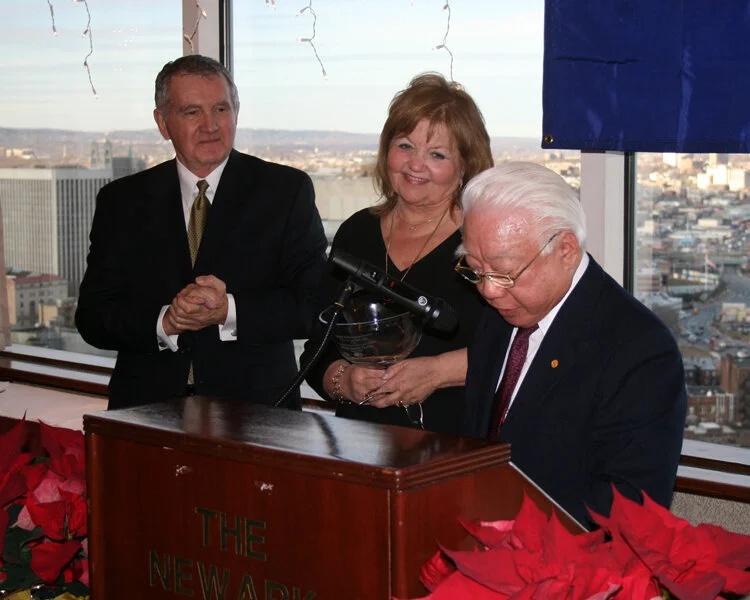
Her business reached beyond press releases. Association management and industry gatherings became part of its work. She served the Containerization & Intermodal Institute for thirty-five years and the New York/New Jersey Foreign Freight Forwarders and Brokers Association for eighteen. The United Seamen’s Service Admiral of the Ocean Sea Awards became another long-running commitment.
Those jobs put her close to the customs of a business world where women were often scarce. One recollection captures the atmosphere with uncomfortable efficiency. When she began working on the freight forwarders’ dinner, its entertainment was a stripper. The following year, Chubby Checker performed instead. There were complaints about the change, she recalled, but the audience enjoyed him.
It is a funny anecdote with a serious setting. Who belongs at a business dinner is partly decided by what the dinner assumes about its guests. Changing the entertainment changes the invitation, even when nobody rewrites it. Yeninas could organize an evening and, in doing so, make the room a little easier for someone else to enter.
as executive director
NY/NJ forwarders’ association
Reading was part of the job
Yeninas’s account of leadership was less theatrical than that dinner story. She emphasized teamwork, giving people credit for their particular strengths, and making their contributions count. She also expected people to read. Keeping up with an industry was a daily obligation, especially as maritime communications moved from announcing new ships toward explaining technology.
The distinction is practical. A firm can retain a familiar client name while the client’s business changes around it. Yesterday’s expertise then becomes an attractive nuisance: reassuring to its owner, increasingly unhelpful to everyone else. Her insistence on reading made curiosity a working requirement. Longevity needed fresh information.
Recognition followed: the Girl Scouts named her New Jersey Businesswoman of the Year in 2000, NJBIZ included her among its Best 50 Women in Business in 2007, and CII honored her with a Lifetime Achievement Award in December 2008. The awards registered different aspects of the same career: entrepreneurship, women’s leadership and sustained service to an industry.
“I read a great deal and encourage others to do so as well.”
Barbara Spector Yeninas · 2019
She recognized a successor when she came back
Lisa LoManto Aurichio began her career at BSYA in the early 1990s, left to build experience elsewhere, and later returned. Her outside work included Hertz, Shandwick and Calvin Klein Cosmetics. In January 2018, Yeninas named her president, retaining the CEO role herself. Experience gained away from the founder’s desk had become an asset to the firm.
It was a consequential choice for a business carrying its founder’s initials. Naming a president gave responsibility a visible home beyond the person who had started everything. Aurichio could bring knowledge of other organizations to a company with a long memory of its own. Returning did not require beginning again.
Yeninas died on May 31, 2024, aged eighty-four. That August, BSYA marked its fiftieth anniversary and announced Aurichio as president and CEO. June Chin became vice president of client services and events, and Anna Maria Hubner became creative services director. The succession arrangements Yeninas had directed were in place when the company needed them.
The part of the story that keeps going
Beyond work, she collected antique posters and art, cooked for friends and family, and traveled widely. She and Joe had two daughters and seven grandchildren. These details give the business biography some welcome company. The person who understood the importance of an industry gathering also liked to bring people around a table in her own life.
Her travels took her from Panama to Prague and from Hawaii to Hong Kong. Those places sit comfortably in a life spent working with international trade, but her interest in the world also had a personal dimension. Antique posters offer another small clue: words and pictures, made to catch the eye, preserved long after their immediate purpose has passed. For a writer married to a cartoonist, collecting them seems an apt pleasure.
Her public professional profile expressed a wish to keep learning and giving back. The two ambitions belonged together. Learning kept her useful to the industry she had chosen; giving back widened the circle of people able to participate in it. Neither required a new company name or a ceremonial announcement. Both could be practiced in the next conversation, with the next person who needed an introduction or a little guidance.
A memorial fund at the International Women’s Media Foundation supports the Gwen Ifill Mentorship Program in her name. Its purpose joins two durable threads of her life: journalism and helping other women develop their careers. The connection returns the story to a writer learning her trade, with someone taking her questions seriously.
There is a pleasing scale to that ending. Her work dealt with international carriers, ports and the movement of cargo, yet its continuity depends on individual people: a client willing to try five months, a colleague invited back, a younger journalist receiving guidance. Barbara Spector Yeninas understood an industry by getting to know the people inside it. She left them more ways to find one another.