In April 2017, the company famous for TASER made an offer that sounded like an expensive misunderstanding. Eligible American police agencies could try its body cameras for a year, free. Software, storage, training, and support came with them. The company also changed its name to Axon. A weapons manufacturer was asking customers to think about something less dramatic: what happens after somebody presses record.
A camera produces footage. Footage produces work. Someone must upload it, label it, find the relevant moment, obscure a bystander’s face, and get the right file to a prosecutor. Axon’s opportunity was hiding in that succession of chores. The device opened the door; the work behind it gave the company reasons to stay.
- The offer: connected cameras, TASER devices, evidence software, real-time operations, and training.
- The engine: equipment bundled with subscriptions and multiyear customer relationships.
- The tension: fewer handoffs for agencies, more dependence on one supplier.
01Before the cloud, a family bet
Rick Smith and his brother Tom founded AIR TASER in 1993, after two of Rick’s friends were killed in a shooting. They worked with Jack Cover, inventor of the original TASER, on a redesign using compressed nitrogen instead of gunpowder. That change mattered: it let the new device avoid the firearm classification that had constrained the earlier design.
The first thing under strain was the family’s finances. Axon’s account says Rick’s parents came close to financial insolvency before the 2001 stock-market listing. The ambition was to give people another way to stop a threat. The present mission, “Protect Life,” carries that origin into a much broader business.

TASER remains central. The TASER 10, introduced in 2023, can deploy ten individually targeted probes and has a maximum range of 45 feet. Those are concrete changes to the equipment an officer carries. They do not make force harmless, or remove the need for judgment and training.
02The camera has an afterlife
Axon Body 4 adds live communication to recording. Axon Evidence handles storage, review, redaction, and sharing. Records addresses documentation; Fusus brings available video feeds and other information into real-time operations. Skydio supplies drones integrated with Axon’s systems, while Dedrone addresses airspace security. Virtual-reality training gives officers a place to rehearse encounters.
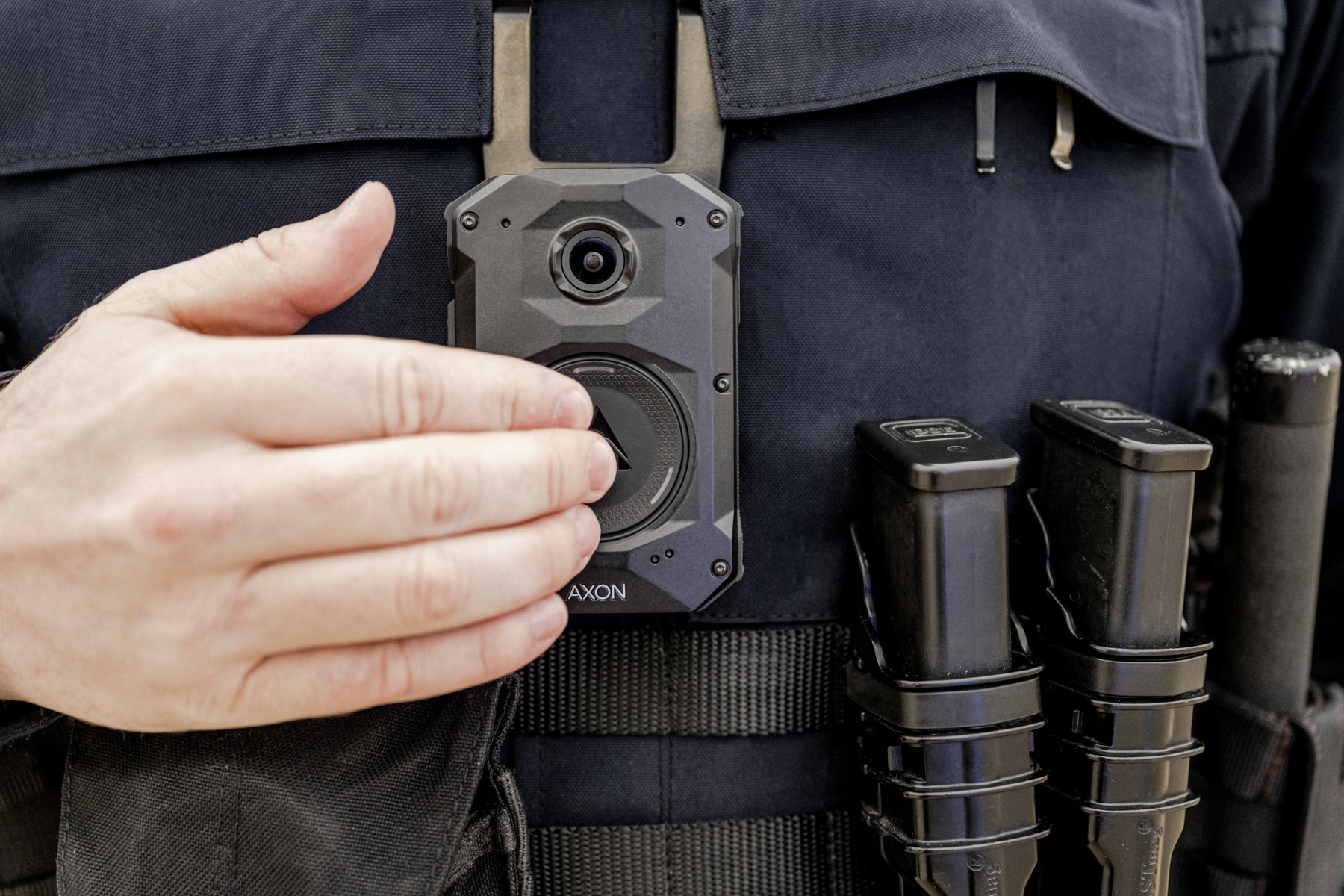
The customers extend from municipal police to federal agencies, corrections, and commercial security teams. Canada’s RCMP planned a national camera rollout estimated at 10,000 to 15,000 units. In its field test, roughly 212 frontline users uploaded more than 15,000 videos. Even a small deployment quickly becomes an information-management job.
Motorola Solutions offers competing body cameras and evidence tools. Axon’s distinction is the combination of TASER equipment, cameras, evidence, training, and operations in one commercial relationship. Its expertise spans electronics, cloud software, and the awkward practicalities of moving a recording through an investigation. The competitive contest increasingly concerns the whole workflow. For a department comparing bids, that shifts the question from camera specifications to daily use: how many times must a person re-enter information, switch screens, or request a file? Those small frictions can make the integration valuable to its users. Those are purchasing questions as much as technical design questions.
- 01CaptureBody & vehicle cameras
- 02ManageStore, find & redact
- 03PrepareDraft & human review
- 04ShareInvestigators & justice
03Free was the introduction
The 2017 trial reduced the immediate cost of trying a connected system. It also let an agency experience the work around the camera before deciding whether to pay. Today Axon sells equipment and software through bundles and subscriptions. Buyers need to evaluate the full contract: storage, features, replacements, training, and the eventual effort of moving elsewhere.
The scale is visible in the accounts. Revenue rose from $2.08 billion in 2024 to $2.78 billion in 2025. By June 2026, annual recurring revenue had reached $1.6 billion. These measures describe different things: annual sales record a completed year; recurring revenue expresses the annualized subscription base at a point in time.
Building the wider system costs money, too. In 2024, Axon paid incremental acquisition consideration of $241.3 million for Fusus and $391.1 million for Dedrone, beyond its existing interests. Research and development expense reached $209 million in the second quarter of 2026. Integration is a product promise with an engineering bill attached.

04Now the camera helps with the paperwork
Draft One, launched in 2024, turns recorded audio into a draft police-report narrative. Officers review it, supply missing details, and sign off. The attraction is easy to understand. A recording that once generated another task can now help perform it. For an agency short of staff, saved writing time is something it can put to use.
Customer feedback changed the product. Fort Collins officers wanted shorter reports for routine incidents; Axon added short, medium, and long options. That is a useful correction to the assumption that more generated text means more value. Sometimes the helpful output is the one that stops at 200 words.
“Sometimes I need a short report that’s going to be 200 words or less.”
Bob Younger, Fort Collins Police Services, speaking to Security Management
The conditions matter. A draft depends on what the recording captures, and polished prose can still require correction. Agencies need time for review, clear rules for use, and agreement about how AI assistance is documented. Removing typing does not remove responsibility for the resulting account.
05A connected system still needs permission
In 2022, Axon proposed TASER-equipped drones as a response to mass shootings. Nine members of its twelve-person AI ethics board resigned. The company paused the project after the backlash. The breakdown was already visible before deployment: advisers objected to the risks and to how the proposal had been announced. By July 2026, Smith was again discussing research into drones capable of stopping someone.
Axon’s stated culture includes “Win Right” and “Expect Candor.” The drone episode gives those phrases a practical test: who can challenge a product, and when does that challenge change the decision? Separately, the National Institute of Justice’s research review found that cameras do not consistently deliver the behavioral improvements people expect. Recording an encounter and improving it are different achievements.
The business lesson travels beyond policing. Start with a necessary device. Study every task it creates. Make the next task easier, then connect the pieces. The approach is less attractive when customers need independent systems, cannot fund recurring contracts, or lack the capacity to review automated output. Axon has built a substantial business around reducing those handoffs. Its public promise must be judged encounter by encounter.
↗Follow the work
Explore Axon and watch the product demonstration.