SERIES A Axoft closes oversubscribed $55M round
FLEURON Implant material 10,000x softer than polyimide
CLINIC First-in-human studies in 11+ patients worldwide
FDA Breakthrough Device Designation granted
STANFORD Exclusive license signed for Fleuron
2027 FDA trial targeted for traumatic brain injury
SERIES A Axoft closes oversubscribed $55M round
FLEURON Implant material 10,000x softer than polyimide
CLINIC First-in-human studies in 11+ patients worldwide
FDA Breakthrough Device Designation granted
STANFORD Exclusive license signed for Fleuron
2027 FDA trial targeted for traumatic brain injury
YesPress Profile · Neurotechnology
Axoft.
A Cambridge company building brain implants soft enough for the brain to ignore - and patient enough to listen for years.
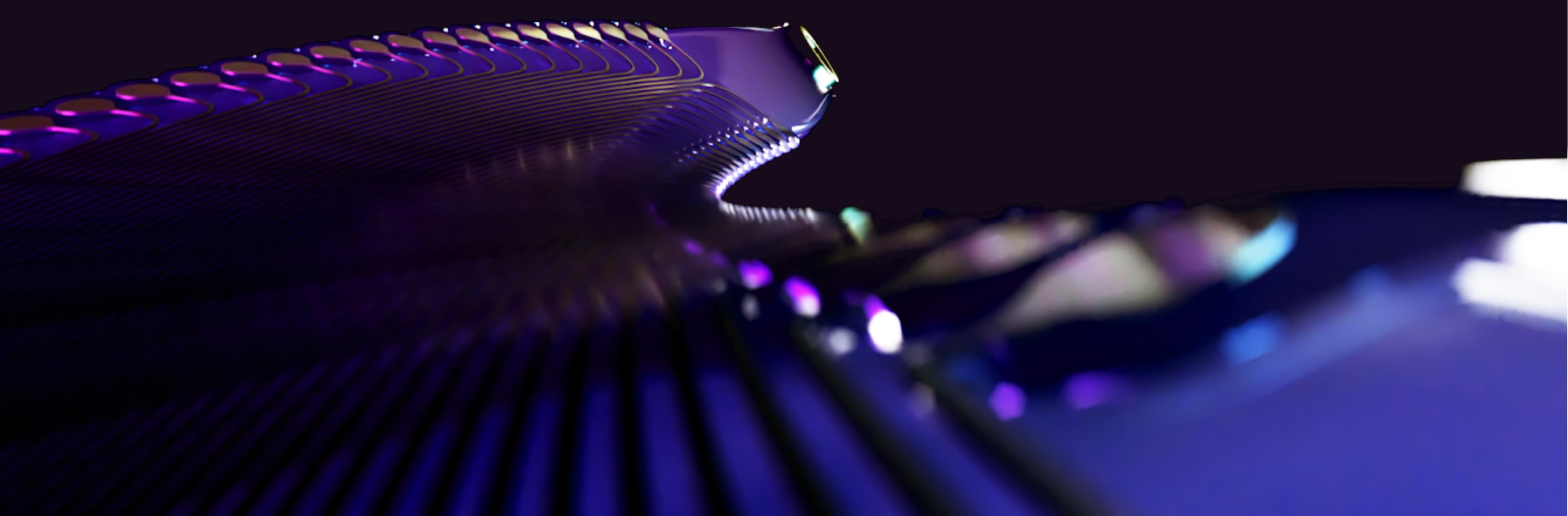
Axoft's neural probe, lit like a nightclub it will never attend. Each of those fanned-out threads can carry sensors that sit against single neurons - the whole point being that the brain barely registers it arrived.
FOUNDED 2021
HQ Cambridge, MA
TEAM ~39
RAISED $60M+
STAGE Series A
Who they are now
A startup that made electronics behave like jelly - on purpose
In a lab off Massachusetts Avenue, a thread thinner than a thought is being lowered into brain tissue. It does not scrape. It does not scar. It settles in like it belongs there, because Axoft spent years making sure it would. This is the company's whole bet, reduced to a single quiet moment: an implant the brain refuses to fight.
Axoft is a neurotechnology company building implantable brain-computer interfaces - iBCIs, in the trade. In April 2026 it closed an oversubscribed $55 million Series A, pushing total funding past $60 million. It has run first-in-human studies in more than eleven patients across Boston, Panama, and China. It holds an FDA Breakthrough Device Designation. By the standards of a field that loves to promise and rarely ships, that is an unusual amount of actual evidence.
But the headline number isn't the dollars. It's a different figure entirely: 10,000. That's how many times softer Axoft says its core material is than the plastic used in conventional brain implants. Everything else - the funding, the trials, the factory they're now building - follows from that one stubborn idea.
“
Our goal is to unlock the natural language of the brain by capturing the activity of single neurons. To do that, we had to build a new class of brain-computer interface from the ground up.
- Paul Le Floch, CEO & Co-Founder
The problem they saw
The brain treats a rigid implant like a splinter
Here is the inconvenient physics. Brain tissue has roughly the consistency of soft tofu. The materials we make electronics from - silicon, polyimide - have the consistency of, well, electronics. Put something stiff into something soft and let the head move around for a few months, and the body does what bodies do: it walls off the intruder with scar tissue.
That scar is the quiet villain of the entire industry. It pushes neurons away from the sensors. Signals fade. A device that worked beautifully in week one is half-deaf by month six. For decades, the standard answer was to add more electrodes and hope statistics rescued you. It's a bit like turning up a radio to drown out the static - technically louder, not actually clearer.
Axoft's founders looked at this and asked a heretical question. What if the implant isn't the thing that should be tough? What if the right move is to make the electronics so soft that the brain never notices a foreigner has moved in?
“
The problem is: soft materials are not very high-performance.
- Paul Le Floch, on the trade-off everyone said was unbeatable
That sentence is the trap the whole field had fallen into. Soft meant safe but blurry. Stiff meant sharp but short-lived. You picked your compromise and lived with it. Axoft decided not to pick.
The founders' bet
Three Harvard scientists and one improbable material
Axoft grew out of Jia Liu's bioengineering lab at Harvard. Paul Le Floch, a materials-science PhD and Liu's first graduate student, engineered the soft material. Tianyang Ye, a Harvard PhD in nanoelectronics, designed the electronics that had to survive being printed on something squishy. Liu, who spent her doctorate building ultra-flexible mesh electronics that mimic neural networks, came along as co-founder and scientific advisor. They incorporated in 2021.
The bet was specific and risky: build a material that is mechanically almost indistinguishable from brain tissue, yet still works as a photoresist - the light-sensitive stuff used to pattern computer chips. If it worked, you could fabricate dense, high-resolution electronics that were also soft enough to vanish into the cortex. If it didn't, you had a very expensive jelly.
The founding cast
- Paul Le Floch - CEO. Forbes 30 Under 30 (Science, 2021). Built the material.
- Tianyang Ye - CTO. Nanoelectronics PhD. Built the brains of the device.
- Jia Liu - Co-founder & Scientific Advisor. The Harvard lab it all came from.
It worked. They named the material Fleuron. And it turned out to be soft in a way that's genuinely hard to picture - up to 10,000 times softer than polyimide, and by some measures about a million times softer than silicon. The kind of number that sounds like a typo until you watch it stop leaving scars.
“
This will significantly increase the number of neurons Axoft's probes can measure and stimulate.
- Jia Liu, Co-Founder & Scientific Advisor
The product
What softness actually buys you
The marketing word is "bio-inspired." The engineering reality is more interesting. Because Fleuron doubles as a photoresist, Axoft can pack a probe with more than a thousand sensors and still keep it pliable. The company's own numbers describe the payoff against conventional rigid implants - and they are the kind of claims that deserve a chart rather than an adjective.
Axoft's Fleuron probe, by its own measure
Company-stated improvements vs. conventional rigid neural implants
Material softness
(vs polyimide)
Put together, the pitch is single-cell electrophysiology that holds up over time. Not a louder radio - a clearer one. And critically, Fleuron is ISO-10993 compliant and biocompatible, which is the unglamorous paperwork that decides whether a clever material ever becomes a real medical device.
“
With a brain-computer interface, we can determine very precisely what's happening in the brains of the patients.
- Paul Le Floch, CEO
The proof
Eleven patients, two continents, one factory going up
Talk is cheap in neurotech. Implants are not. So the more persuasive part of Axoft's story is what it has already done with its device in living people. First-in-human studies have run across Mass General Brigham in Boston, The Panama Clinic, and a hospital in China - more than eleven patients in total, with the implant decoding brain signals safely.
11+PATIENTS IMPLANTED
$55MSERIES A (2026)
3CLINICAL SITES
2027FDA TRIAL TARGET
The Series A reads like a vote of confidence from people who do diligence for a living. C.P. Group Innovation led; Alumni Ventures, the Stanford President's Venture Fund, Hillhouse Investment, and Gaorong Ventures joined. The capital has three jobs: expand the global trials, push toward US FDA approval, and - the least glamorous, most telling item - build a good-manufacturing-practice facility in Cambridge to mass-produce both the implants and the Fleuron material itself, helped along by Massachusetts manufacturing grants.
That Stanford license matters too. It means Fleuron isn't just an internal trick; it's a product other labs can buy, which is a quietly clever way to seed an ecosystem around your own material while everyone else is still arguing about electrode counts.
“
We see a big need from a patient perspective.
- Paul Le Floch, on why the soft path is worth the difficulty
The mission
Reading the brain's native language
Axoft frames its purpose in a phrase it keeps coming back to: unlocking the natural language of the brain. The near-term clinical target is sobering and specific - disorders of consciousness, where a soft, stable implant could measure recovery and tell doctors whether someone is still in there after a traumatic brain injury. Beyond that, the company points at paralysis, depression, movement disorders, and dementia.
It is a long road, and Axoft is careful enough not to pretend otherwise. The 2027 FDA trial is for traumatic brain injury; devices reaching physicians by 2028 is a target, not a promise. In a field that has buried more timelines than it has kept, that restraint is almost refreshing.
Where the implant is pointed
- Disorders of consciousness & coma - measuring recovery and awareness
- Traumatic brain injury - the 2027 FDA trial population
- Paralysis - restoring communication and control
- Depression, movement disorders, dementia - the longer horizon
Why it matters tomorrow
The competition went dense. Axoft went patient.
The marquee names in brain-computer interfaces - Neuralink, Synchron, Precision Neuroscience, Paradromics, Blackrock Neurotech - mostly chase performance through electrode density and clever surgery. Axoft is running a different experiment: that the winning variable is not how many sensors you cram in on day one, but how many are still listening in year three. If the body never builds a scar, the math of the whole field changes.
That's the wager. Soft, stable, single-neuron resolution that lasts - turned from a Harvard lab curiosity into a manufactured medical device with the regulatory paperwork to match. Nobody has proven it at scale yet, including Axoft. But they've put more patients, dollars, and ISO compliance behind the idea than a clever lab demo usually earns.
Return to that thread being lowered into tissue. It settles, and it stays. No scar walls it off. Months later it is still there, still listening, still relaying what a single neuron has to say. The brain, for once, is not fighting the machine - because the machine had the decency to feel like brain. That is the entire company, in one quiet implant that refuses to be noticed.