The Dispatch
A material that thinks it's tissue
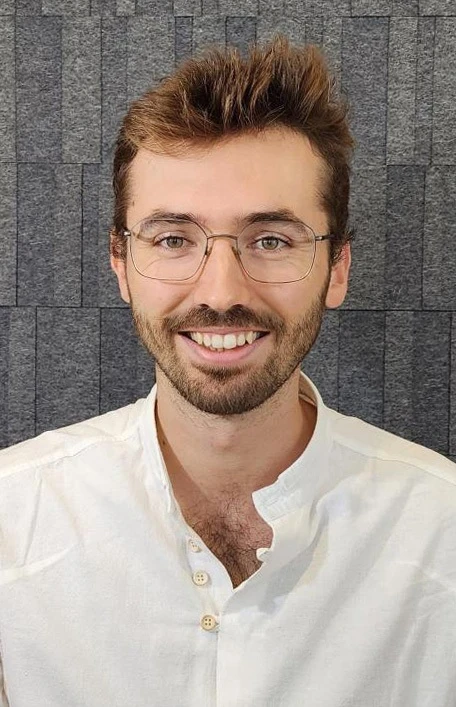
A brain rejects what it cannot recognize. Stick a stiff electrode into soft neural tissue and the tissue does what tissue does to a splinter: it scars, it walls the thing off, the signal fades. For decades that was simply the cost of listening to neurons. Paul Le Floch decided it didn't have to be. At Axoft, the Cambridge company he runs as co-founder and CEO, the implant is built from a material so soft and so close to the mechanics of brain tissue that the brain more or less stops noticing it is there.
The material has a name: Fleuron. It is up to thousands - by some measures ten thousand times - softer and more flexible than the polyimide used in conventional neural probes. That softness used to come with a catch. As Le Floch puts it, "Soft materials are not very high-performance." The trick Axoft pulled off was making a soft material that also behaves like a proper photoresist, which means it can go through standard chip-fabrication processes. The payoff is a probe that bends like neural tissue yet carries more than 1,000 sensors.
That number matters more than it looks. "In the last few decades," Le Floch has said, "we've gone from measuring one neuron, to 10 neurons, to hundreds of neurons - now we're getting into thousands." Each jump is a higher-resolution window into what the brain is actually doing. The aspiration is single-neuron resolution, sustained over years rather than weeks, without the scarring that blurs the picture.
The problem with brain implants is that the benefits to the patient are rarely strong enough to balance the risks.Paul Le Floch
Read that quote twice, because it is the whole thesis. Le Floch is not selling miracles. He is rebalancing an equation. If you cut the risk - less scarring, less inflammation, an implant that stays stable instead of degrading - then the bar for "worth it" drops, and a brain-computer interface starts to look less like science fiction and more like a pacemaker. That is exactly the comparison he reaches for. He wants neural implants to become as ordinary and accepted as pacemakers and cochlear implants.
The early evidence is on the table. In 2025 Axoft completed its first-in-human cases at The Panama Clinic, where the device was used during brain-tumor resection surgeries. Within minutes it could differentiate whether a patient was conscious or unconscious. "With a brain-computer interface," Le Floch explains, "we can determine very precisely what's happening in the brains of the patients - if they are conscious, if they are not conscious, if they are vegetative, if they are recovering, or if their state is degrading." To date the platform has been implanted in 11 patients worldwide.
The conditions Axoft is aiming at are the ones medicine has the least to offer: coma, paralysis, depression that resists every drug, movement disorders, dementia. The pitch is bidirectional - not just reading the brain but eventually speaking back to it - by stacking three disciplines that rarely share a room: materials science, electronics, and AI-driven neural decoding. "Better neural signals," Le Floch says, "are the foundation everything else is built on." Get the physical layer right, and the software has something real to work with.
There is a commercial logic underneath the science, and Le Floch is unusually clear-eyed about it. Rather than wait for some distant future where healthy people line up for elective brain surgery, Axoft is starting where the demand already exists. "We see a big need from a patient perspective," he says, "and there is already an ecosystem in hospitals for using neuromonitoring devices." Neuromonitoring during surgery is an established practice with established workflows. Slot a far better sensor into that workflow and you have a product, not a moonshot - a near-term wedge that funds the longer climb.
He is not doing it alone. The company he co-founded with Tianyang Ye, now its chief technology officer, and scientific advisor Jia Liu has since added a leadership bench built for the regulated, clinical road ahead - including a chief product officer in Matt DeNardo and a chief clinical and data officer in Oliver Armitage. Headcount has grown to roughly 39 people working across polymer chemistry, microfabrication, firmware, and clinical strategy. To validate the technology before it scales, Axoft has been running animal-model work in collaboration with Massachusetts General Hospital, the kind of methodical groundwork that rarely makes headlines but decides whether a device ever reaches a patient.
The Origin
From a Paris bench to a Harvard gamble
Le Floch did not arrive at neurons head-on. He came at them sideways, through the mechanics of stretchable materials. He earned bachelor's and master's degrees in France, where the interest in bioelectronics first took hold, then crossed the Atlantic in 2016 to start a Harvard PhD. His first home was the lab of Zhigang Suo, a mechanics-and-materials heavyweight, where he studied how soft, stretchable things behave under stress.
Then he did something that, in the careful world of graduate study, counts as a leap. He switched labs to become the first graduate student of Jia Liu, a newly arrived assistant professor of bioengineering. Joining a brand-new lab as its founding student is a bet on a person and a direction that does not yet have a track record. It is also, in retrospect, the moment the company became possible. Liu would go on to co-found Axoft and serve as its scientific advisor.
What if we could develop solutions tailored for this problem instead of borrowing from the semiconductor industry?Paul Le Floch
That question is the founding instinct. The neurotech field largely inherited its toolkit from semiconductors - rigid, silicon-shaped, optimized for a world of circuit boards, not cerebella. Le Floch's contrarian move was to refuse the inheritance and design the material from scratch. The advantage compounds: because Axoft owns the chemistry, it can change the material when the device needs improving. As he describes it, the team can "modify it because we designed the materials," tuning behavior at the level of the polymer itself.
The intellectual core of his thesis was a mismatch problem. Brain tissue is soft and wet and alive; electronics are stiff and dry and inert. Every time those two worlds meet at an implant, the mechanical gap between them produces friction - micromotion, inflammation, scarring - that degrades the signal. Le Floch's wager was that closing the mechanical gap would do more for long-term stability than any amount of clever signal processing layered on top of a rigid probe. Match the implant's softness to the tissue, and you remove the root cause rather than treating the symptom. Years later, that single conviction is still the spine of the company.
He defended his PhD in mechanical engineering and materials science in June 2021. By then he had already raised nearly $1 million in pre-seed funding - before the degree was even in hand - and co-founded Axoft alongside Liu and Tianyang Ye, a fellow Harvard PhD who became the company's CTO. The science came out of the Harvard John A. Paulson School of Engineering and Applied Sciences; the company was built to carry it into the world.
The recognition arrived quickly. In 2021 he took the Materials Research Society's Graduate Student Gold Award. In 2022, Forbes put him on its 30 Under 30 Science list. The work itself reached the field's most demanding venue, Nature, with papers in December 2023 and June 2025.
The Bet
Patience as a strategy
Neurotech is not a domain for the impatient. Implants, regulators, clinical trials, manufacturing under good-manufacturing-practice rules - the clock runs in years. Le Floch is candid about the temperament it takes. Starting a deep-tech company, he says, requires "a leap of faith that your technology actually has a good edge," paired with the confidence that you can keep raising the resources to see it through.
In April 2026 that confidence was rewarded. Axoft closed an oversubscribed $55 million Series A led by C.P. Group Innovation, with Alumni Ventures, the Stanford President's Venture Fund, Hillhouse Investment and Gaorong Ventures joining. The capital has three jobs: expand clinical trials globally, push toward US regulatory approval, and build a GMP facility for mass production. Total funding now sits north of $60 million, with an FDA trial targeted for 2027 and physician availability hoped for soon after.
The roster of backers is itself a tell. C.P. Group Innovation, Alumni Ventures, the Stanford President's Venture Fund, Hillhouse and Gaorong are not names that chase hype cycles; they are patient pools of capital that price decades, not quarters. An oversubscribed round in a field this slow is a vote on the founder's temperament as much as the technology. The money is earmarked for the unglamorous parts - trials, regulatory filings, a manufacturing line built to medical-grade standard - which is precisely where neurotech companies tend to stall.
What makes Le Floch worth watching is not the funding line - plenty of founders raise. It is the discipline of the original choice. He looked at a field building brains out of borrowed silicon and asked whether the right answer was a different material entirely. He switched labs on a hunch, raised money before he had a diploma, and then spent the better part of a decade proving the soft answer could also be the high-performance one. He still frames the destination in the most ordinary terms he can find: not a cyborg future, but a day when a brain implant is as unremarkable as a pacemaker on a chart. The brain, for once, may not notice the difference. That is the point.
In His Words
Field Notes
The material is named Fleuron - a typographic flourish, and a quiet nod to its founder's French roots.
Fleuron doubles as a photoresist, so it survives standard chip fabrication while staying soft enough to pass for brain tissue.
HQ sits at 501 Massachusetts Avenue in Cambridge - walking distance from the Harvard and MIT labs where the science was born.
He raised close to $1M for the company before he had even defended his doctorate.